Legislation Broadening Concealed Carry Rights Clears House Committee but Faces Steep Hurdles on Capitol Hill

The Constitutional Concealed Carry Reciprocity Act would require states to honor permits from elsewhere allowing residents to carry firearms in public.

AP/Brittainy Newman
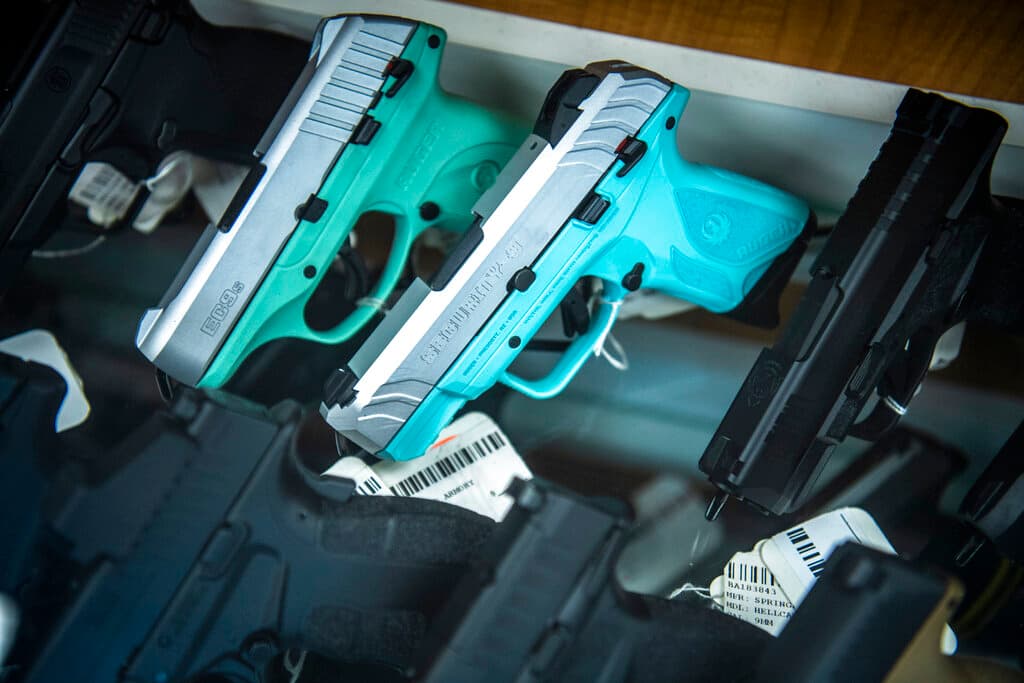
Handguns for sale at SP firearms, June 23, 2022, Hempstead, New York. AP/Brittainy Newman

Republicans on the House Judiciary Committee have advanced a bill that would let anyone legally permitted to carry a concealed weapon in one state to carry it in any other state even if the second state’s rules are more stringent than the first.

The Constitutional Concealed Carry Reciprocity Act, introduced by Representatives Tracey Mann and Richard Hudson, both Republicans, would make it easier for the more than 22 million Americans with concealed carry permits to travel across state lines with their weapons.

The committee’s chairman, Congressman Jim Jordan, said, “Our First Amendment rights do not change from one state to another and our Second Amendment rights should not either.”

Republicans have been trying to get such legislation through Congress for a decade. The closest it has come to passing was in 2017 when it cleared the House. Republicans also controlled the Senate at the time, but lacked the 60 votes to avoid a filibuster so the measure died there. The law could face a similar hurdle this session.

The National Rifle Association has called passage of the legislation a top priority and “crucially important” for the Second Amendment rights of its members.

Various constitutional carry or permitless carry laws of different degrees of permissiveness are on the books in 29 states, and Democrats on the committee say the varying laws would put the onus on local police to know the gun laws of all 50 states when stopping people.

A Maryland Democratic congressman, Jamie Raskin, calls the name of the act a misnomer because it would force some states to allow gun rules weaker than their own. “This is not a reciprocity act, quite the contrary, it has nothing to do with reciprocity. It abolishes reciprocity,” Mr. Raskin said.

A gun control advocacy group, Brady, called the legislation one of the largest threats to public safety in recent memory.

“In America, you are 26 times more likely to be shot and killed than people in other high-income countries,” the president of Brady, Kris Brown, said. “A concealed carry mandate would dramatically increase this likelihood of violence by allowing a mass of untrained, unlicensed individuals to carry hidden, loaded guns in public, without so much as a background check.”

Scholar and Second Amendment rights advocate John Lott says the threat is overblown. “Most of the country already has concealed reciprocity,” Mr. Lott said. “They can’t point to any problems. It’s just not an issue.”

He said it would simply make concealed carry permits similar to drivers licenses that carry over from state-to-state.

Current concealed carry laws vary widely from state to state, with some allowing residents to carry with no permit at all or only minimal oversight from local enforcement and other, primarily Democratic, states requiring cumbersome, costly and time-consuming applications that often involve criminal background checks and mandatory training courses.

The measure passed the committee on a party-line vote of 18-9 and will advance to the House floor. If it clears the House it would move to the Senate, where Senator Cornyn already has introduced similar legislation. “Looking forward to passing this in the Senate,” Mr. Cornyn said on social media.

President Trump has said he supports the legislation.

If the reciprocity act does become law it is expected to face a court battle.

The executive director of the Duke Center for Firearms Law, Andrew Willinger, says there is no existing case law surrounding the concept and may need the Supreme Court to weigh in.

“The biggest constitutional question will be whether it falls within one of Congress’ enumerated powers,” Mr. Willinger tells the Sun.

_________

Correction: Jamie Raskin is the Maryland Democratic Congressman opposed to the concealed carry legislation. His first name was misspelled in an earlier edition.


The New York Sun

© 2025 The New York Sun Company, LLC. All rights reserved.

Use of this site constitutes acceptance of our Terms of Use and Privacy Policy. The material on this site is protected by copyright law and may not be reproduced, distributed, transmitted, cached or otherwise used.

The New York Sun

Sign in or  create a free account

or
By continuing you agree to our Privacy Policy and Terms of Use