Like Communist China, Vietnam Revises History in Celebrating End of World War II With No Mention of America’s Role
In a powerful expression of nationalism, a “naval parade” of warships appears off Vietnam’s southern port of Cam Ranh Bay as a show of strength against China’s control of the South China Sea.
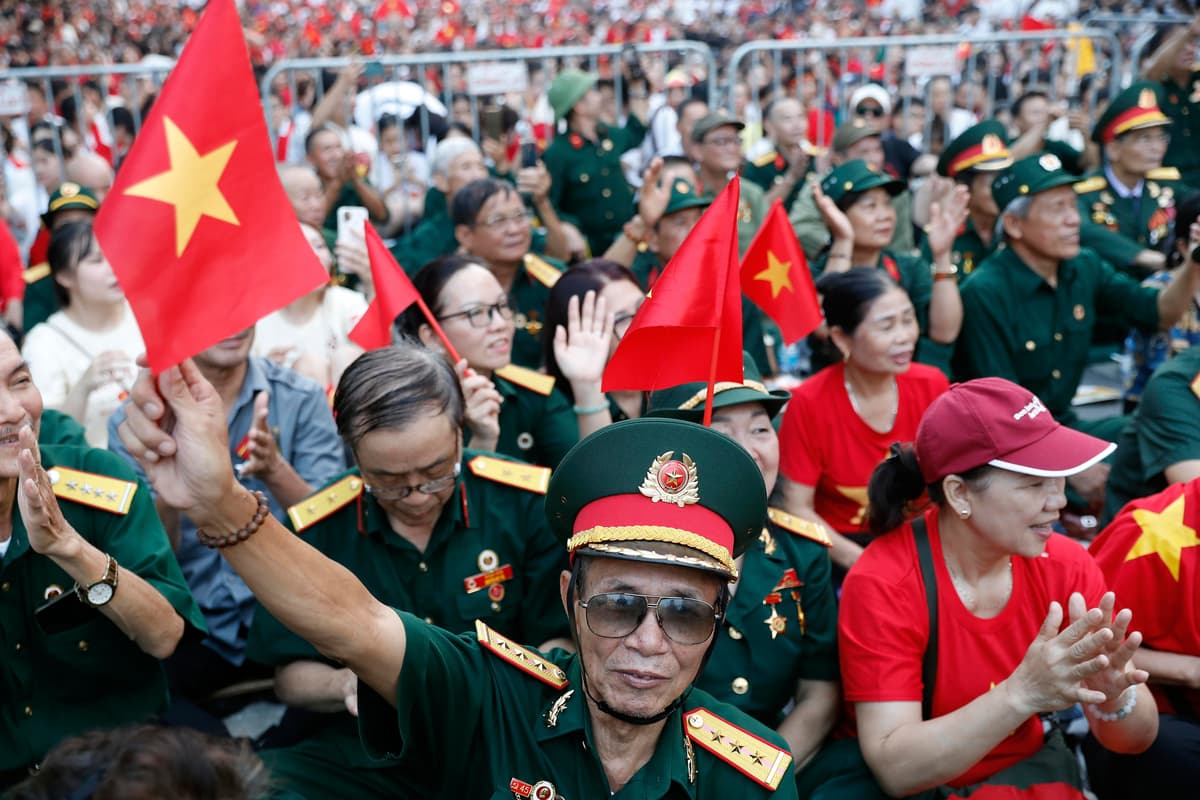
Vietnam has its own version of that turning point in history 80 years ago when the Japanese lost World War II — and their rule over much of Asia. Just as Communist China celebrates the occasion as a communist “victory,” so the Vietnamese, also revising history, call the date of Tokyo’s surrender their “national day.”
In a powerful expression of nationalism, a “naval parade” of warships appeared off Vietnam’s southern port of Cam Ranh Bay as a show of strength against China’s control of the South China Sea.
Vietnam’s state press did not mention China in any report on either the “national day” parade at Hanoi or the accompanying naval display, but there could have been only one potential foe as China asserts its supremacy over the waters between Vietnam and the Philippines that Beijing claims as its own.
The Vietnam News Agency said navy and coast guard vessels, “showcasing an arsenal of modern vessels and equipment,” formed “the backbone of Vietnam’s strategy to assert and defend its sovereignty over seas and islands.” The entire display of gleaming frigates, patrol ships, missile corvettes, and seaplanes appeared live on huge screens in Hanoi.
“The parade spotlighted Vietnam’s naval evolution from a fledgling force reliant on armed motorboats to a modern maritime power equipped with advanced aircraft and warships,” the Vietnam News Agency said.
Like Beijing, Hanoi marked the end of World War II when Emperor Hirohito of Japan, having surrendered on August 15, 1945, after the atom-bombing of Hiroshima and Nagasaki, signed the formal surrender on the battleship USS Missouri at Tokyo Bay on September 2, 1945. Neither China nor Vietnam, of course, mention America’s role in defeating Japan.
The communists had yet to take over, but the Vietnamese, like the Chinese, prefer to forget such details as the anniversary became the reason for a celebration rivaling the “victory” parade over which China’s president, Xi Jinping, is presiding Wednesday at Beijing.
The Communist Party general secretary, To Lam, said the country’s revolutionary leader, Ho Chi Minh, signed a “declaration of independence” on that date, ushering in “an era of independence and freedom.” It would be nine more years before the Communists wrested power from the French at Hanoi — and nearly 30 before they united “North” and “South” Vietnam.
“Hanoi gets to ‘celebrate’ dear old dead Ho’s declaration, but a lot of things happened before the colonial French finally said, ‘Zut, alors,’” a journalist who covered Vietnam for years, Alan Dawson, says. “Not to mention,” Mr. Dawson adds, in sardonic reference to the cultural impact of French rule, “Vietnam makes the best ‘French bread’ in the civilized world.”
Like the Vietnamese, the Americans appeared happy to forget the history while applauding Hanoi on the biggest holiday on its calendar. The crowds were far larger than those witnessed by this reporter at Ho Chi Minh City, formerly Saigon, on the 50th “Liberation Day” anniversary of the defeat of the American-backed Saigon regime on April 30, 1975.
Along with statements of triumph, the Vietnamese press featured congratulations from Secretary Marco Rubio, who heaped praise on Hanoi without mentioning the war that cost 58,220 American lives before the Americans withdrew in 1973, two years before Hanoi’s soldiers stormed south to victory.
“The United States admires the resilience, determination, and progress made by the Vietnamese people,” Mr. Rubio stated. “Vietnam continues to demonstrate remarkable growth and development, becoming a vital partner in the Indo-Pacific region and a leader in addressing shared global challenges.”
Enlarging on prospects for a bright future, Mr. Rubio also noted that Washington had established diplomatic relations with Hanoi 30 years ago — and was “proud of the progress we have made together under the Comprehensive Strategic Partnership.”
Avoiding any traces of the bloody past, Mr. Rubio’s statement hinted at cooperation against China by “addressing regional challenges, including maritime security and transnational crime.”
The parade through central Hanoi, as military units strutted to martial music live via state video link, was lavish and long. Clearly the Vietnamese were anxious to show off their anniversary on a scale as grand as the one at Beijing.
However, no foreign heads of state attended the parade or a banquet hosted by To Lam and the state president, Luong Cuong. The guest list showed only foreign officials two or three rungs below the top while the spotlight shines on Beijing, where President Xi Jinping will sit beside President Vladimir Putin and North Korea’s leader, Kim Jong-un.Ignoring China, VNA published a commentary, “From enemies to partners: 30 years of Vietnam-US ties.” The two “have deepened their relationship through key milestones,” it said, “culminating in the launch of a Comprehensive Strategic Partnership in 2023.”