Lisa Cook Denies Mortgage Fraud: Fed Governor Says Trump Can’t Fire Her Because She Disclosed Everything to Biden 

The statement marks the first direct response to allegations that surfaced last month and prompted President Trump’s removal effort.

AP/Mark Schiefelbein
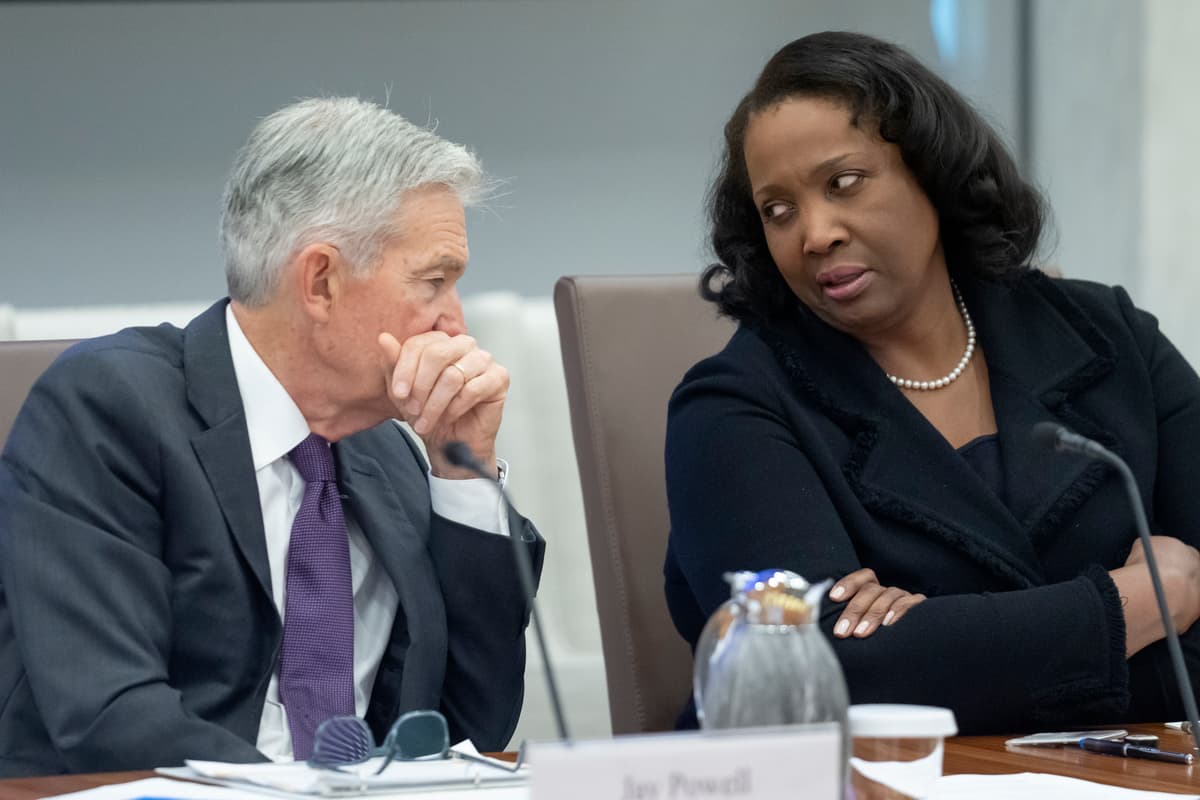
Federal Reserve Chairman Jerome Powell, left, talks with Board of Governors member Lisa Cook, right, during an open meeting of the Board of Governors at the Federal Reserve, June 25, 2025. AP/Mark Schiefelbein

A Federal Reserve Board governor, Lisa Cook, as she fights President Trump’s attempt to remove her from the central bank’s board of directors, has explicitly denied allegations of mortgage fraud for the first time. 

In a court filing submitted Tuesday, Ms. Cook’s attorney, Abbe Lowell, stated that his client “did not ever commit mortgage fraud” — marking the first direct response to allegations that surfaced last month and prompted Mr. Trump’s removal effort.

Trump administration officials say there is irrefutable documentation — signed by Ms. Cook in 2021 — in which she falsely stated that two different homes were her primary residence, in order to get favorable mortgage terms. While Mr. Lowell does not refute the Trump officials’ claims, he says it’s too late to go after Ms. Cook over the mortgages, as they were fully disclosed to the Democrat-controlled White House and Senate when Ms. Cook was nominated and confirmed.

Because she was confirmed after having disclosed all her finances, Mr. Lowell says, the mortgage issue does not provide legal grounds for presidential removal.  

“The Government has long known about the alleged facial inconsistencies in Governor Cook’s financial documents,” he wrote. As a result, Mr. Lowell argued that Ms. Cook’s mortgage applications “likely cannot constitute a legitimate basis” for the president to fire her. 

Ms. Cook, one of President Biden’s most controversial nominees, was confirmed in May 2022 only after Vice President Kamala Harris broke a 50-50 tie. At the time of her nomination, Republicans claimed she had extremist, far-left views on race — including supporting reparations to black people — and that she had embellished her academic credentials to make her seem experienced in monetary policy. 

Democrats argued that as a black woman who’d studied the impact of racism she’d bring a “critical voice” to the Fed that was wanting.  

On Tuesday, Mr. Lowell contended that the mortgage fraud allegations serve as “mere pretext” for Mr. Trump’s actual motivations, describing them as “nothing more than a set of cherry-picked, cut-and-paste allegations to try to give the President political cover to remove a Board member with whom he has policy disagreements.”

The filing was submitted to support Ms. Cook’s motion for a temporary restraining order that would allow the central banker to remain on the Fed board while the case proceeds in court. The judge overseeing the case — Obama appointee Jia Cobb, who has already ruled against Mr. Trump on an immigration case — likely will not rule on the emergency injunction before the end of the week, court filings indicate. 

This weekend, Mr. Trump demanded on Truth Social that Judge Cobb recuse herself, as she and Ms. Cook both belong to Delta Sigma Theta, a black women’s college sorority. The sorority put out a statement last month denouncing the attacks on Ms. Cook.

Mr. Lowell’s filing marks the latest development in the legal clash that erupted last month when Mr. Trump became the first president in the Fed’s 111-year history to attempt to fire a central bank governor. Mr. Trump announced he’d fired Ms. Cook because she’d lied on her mortgage applications, something his advisors say was uniquely problematic in that Ms. Cook sat on the powerful board that sets interest rates for mortgages and other loans.

Ms. Cook has refused to accept her firing. The legal battle will likely test the boundaries of a century-old federal law that broadly defines when a president can remove a Fed governor. The clash may also force the judiciary to re-examine Supreme Court precedent regarding the central bank’s independence.

The accusations against Ms. Cook were initially raised by the Federal Housing Finance Agency director, Bill Pulte, and prompted the Department of Justice’s special attorney for mortgage fraud, Ed Martin, to open a criminal investigation. 

Mr. Pulte, a scion of the Pulte Homes fortune, points to documents showing that Ms. Cook obtained mortgages for properties in Michigan and Georgia and listed both as her principal residence. He accuses her of “falsifying residence statuses” to “potentially secure lower interest rates and more favorable loan terms.” The documents in question would have been signed before Ms. Cook joined the Fed in 2022. Ms. Cook has not been charged with a crime. 

Mr. Pulte has made similar accusations against New York’s attorney general, Letitia James, regarding homes in Virginia and Brooklyn, and Senator Adam Schiff, regarding homes in Maryland and Burbank. Both politicians — devoted foes of Mr. Trump — are now under investigation by Mr. Martin.

The Federal Reserve Act of 1913 states that a president can fire a Federal Reserve Board member only “for cause,” but provides no clear definition of what constitutes adequate cause. Because no president has ever attempted to fire a Fed board member, the courts have never addressed this standard.

The president argues that Mr. Pulte’s evidence offers “sufficient cause” under the Federal Reserve Act to remove Ms. Cook from her position. In a termination letter sent to Ms. Cook last week, Mr. Trump claimed that her “deceitful and potentially criminal conduct in a financial matter” eroded his and the public’s “confidence” in her “integrity.”

Ms. Cook responded by challenging the president’s efforts in federal court, claiming that the president lacked the legal basis to remove her. 

If Judge Cobb rules in favor of Ms. Cook, as Mr. Trump appears to expect will happen, the White House will almost certainly appeal the matter to a higher court. Mr. Trump has seen appeals courts overturn multiple rulings by district-level judges. The case of Ms. Cook, legal observers say, could well end up at the Supreme Court.


The New York Sun

© 2025 The New York Sun Company, LLC. All rights reserved.

Use of this site constitutes acceptance of our Terms of Use and Privacy Policy. The material on this site is protected by copyright law and may not be reproduced, distributed, transmitted, cached or otherwise used.

The New York Sun

Sign in or  create a free account

or
By continuing you agree to our Privacy Policy and Terms of Use