Lisa Cook Takes Trump To Court Over the Fed

The case will be closely followed by candidates to succeed her — or Jerome Powell.
Drew Angerer/Getty Images
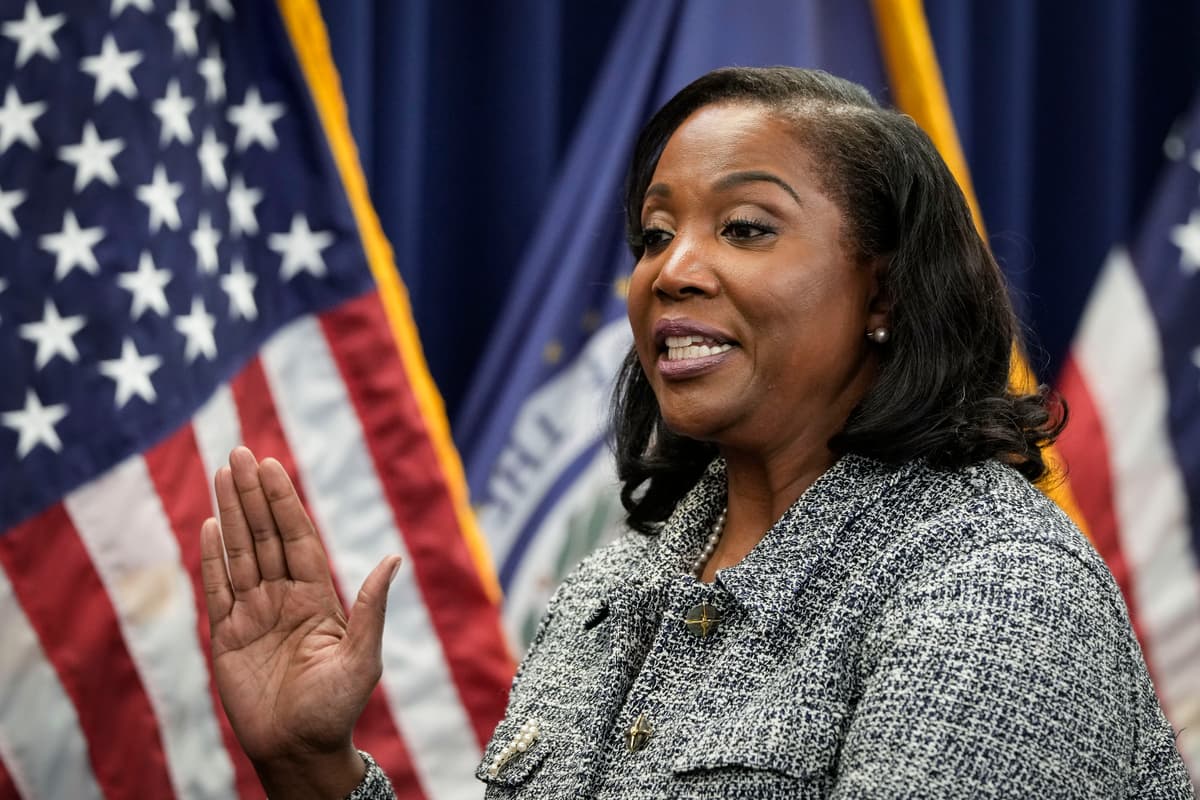
Lisa Cook takes the oath to serve as a member of the Board of Governors at the Federal Reserve System at the William McChesney Martin Jr. Building, May 23, 2022. Drew Angerer/Getty Images

The lawsuit against President Trump filed by a Fed governor, Lisa Cook, brings to the fore constitutional questions over the central bank’s purported “independence.” No matter how Ms. Cook’s suit fares in court, it’s a moment to weigh what kind of job awaits whoever turns out to be Mr. Trump’s choice to be the next head of the Fed. Will the position amount to a poisoned chalice, as it proved for Nixon’s nominee for Fed chairman, Arthur Burns? 

Federal tribunals, including the Supreme Court, will have to decide whether Mr. Trump can fire Ms. Cook — either for “cause,” as the Fed’s enabling law states, or via his Article II authority over executive branch agencies. Either way, Mr. Trump has undoubted power to nominate a new chairman, and he has made clear that his preference is a candidate who backs his goal of lower interest rates. That could prove a case of “déjà vu all over again.”

President Nixon addressed this at the swearing in of Burns, whose taking of the oath was met with an ovation. “You see, Dr. Burns,” Nixon said, “that is a standing vote of appreciation in advance for lower interest rates and more money.” Nixon paid lip service to the central bank’s autonomy, saying that the Fed “is independent, certainly independent of the President, although the Congress would suggest that it is not independent of the Congress.”

Yet, Nixon said: “I have some very strong views on some of these economic matters and I can assure you that I will convey them privately and strongly to Dr. Burns.” He added: “I respect his independence. However, I hope that independently he will conclude that my views are the ones that should be followed.” The question is whether that is really the role of a president — timid adviser to the man he hired to run the Fed.

In the event, Nixon did harangue Burns, economist Burton Abrams relates, “to engage in expansionary monetary policies prior to the 1972 election.” Nixon was alarmed by unemployment soaring to 6 percent by July 1971 from 3.9 percent in January 1970. Inflation was up, too. White House tapes from October 1971 feature Nixon telling Burns it was bull manure to fret over excess liquidity in the economy — an argument against a tighter money supply.

Yet the “easy monetary policy during this period helped spur a surge in inflation,” the Fed later admitted. It hardly helped, in retrospect, that Nixon adopted wage and price controls that only temporarily, and artificially, lowered prices. Worse, in August 1971 Nixon ended the last vestiges of the gold standard by ending America’s pledge to redeem at a 35th of an ounce of gold dollars presented to our treasury. Years of stagflation were the result.

Burns did try to prevent Nixon from closing the gold window. When Nixon did it anyway, the Fed chairman lamented: “What a tragedy for mankind.” Plus, too, for the Fed, which was created in 1913 to serve as a steward of the dollar’s value under the terms of the Gold Standard Act of 1900. That law’s gold convertibility requirement was written into the Federal Reserve Act. On Burns’ watch, the dollar shed 80 percent of its value in gold.

Even as the former publisher of the New Republic, Chris Hughes, leads an effort to rehabilitate Burns’s reputation, “history remembers” him, NPR says, as the chairman “who let inflation run rampant.” The case of Nixon and Burns reminds that presidential preferences and the national economic interest do not always coincide. That seems to mark a cautionary tale for anyone who would consider accepting Mr. Trump’s invitation to lead the Fed. 


The New York Sun

© 2025 The New York Sun Company, LLC. All rights reserved.

Use of this site constitutes acceptance of our Terms of Use and Privacy Policy. The material on this site is protected by copyright law and may not be reproduced, distributed, transmitted, cached or otherwise used.

The New York Sun

Sign in or  create a free account

or
By continuing you agree to our Privacy Policy and Terms of Use