‘MAGA or Marxism’: New York City Moderates Need To Build a New Movement or Party
Meanwhile, with Mamdani’s win, the Working Families Party and Democratic Socialists of America become the new establishment.
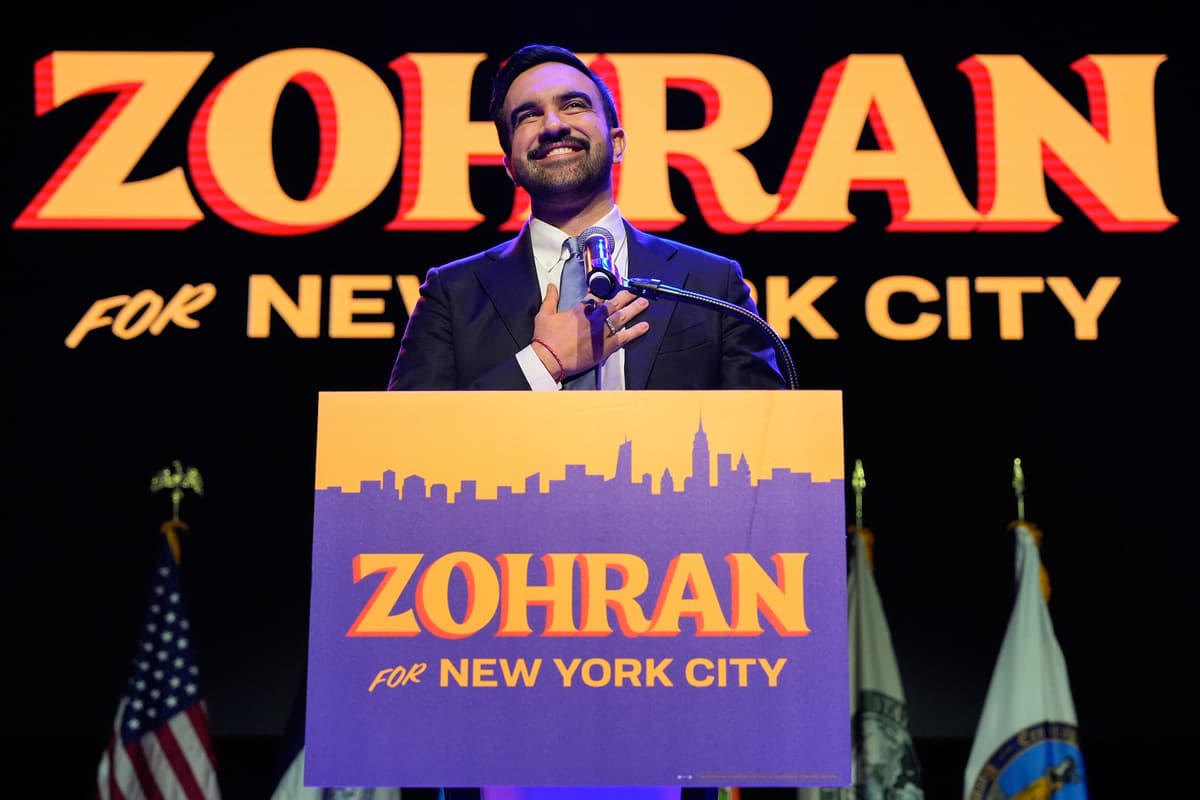

New York City’s moderate Democrats, Republicans, and independents are looking to next year’s governor’s race as a firewall against mayoral-elect Zohran Mamdani’s policies. A larger question Mr. Mamdani’s win poses is whether the GOP has surrendered city-wide elections to the left — and whether moderate Democrats are heading that way too.
“There is no home for moderate Democrats in New York City,” the head of an anti-Mamdani super PAC, Jason Meister, who advised President Trump on his 2024 campaign, told the Sun. “The takeaway from this election is it’s really MAGA or Marxism.”
That’s a grim assessment. President Trump may have made inroads in the five boroughs in 2024, but MAGA is not advancing in the Big Apple. The Democratic Socialists of America and Working Families Party are.
Mr. Mamdani ran a stellar social media campaign, but more importantly, he built a movement and social scene for his base of disaffected, downwardly mobile elites in gentrified neighborhoods of Brooklyn, Queens, and downtown Manhattan. He won South Asians and Blacks in the general election, but it was the “gentrifier” base that staffed his canvassing operation and donned “Hot Girls for Zohran” t-shirts as signifiers of an in-group.
The DSA recruited 100,000 volunteers for the Mamdani campaign. The DSA debate watch party the Sun attended felt like a singles mixer for Oberlin grads who’d otherwise be doom-scrolling in their Bushwick apartments. Politics gave them purpose, an antidote to loneliness. Mr. Mamdani won 65 percent of men and 82 percent of women under the age of 30.
Mr. Mamdani’s affordability pitch and DSA powered campaign — viral content, limited-edition merch, a scavenger hunt and other events, rallies — is now the playbook for progressive challengers across the city and nationwide. Several Mamdani allies, including Brad Lander, Chi Ossé, and Michael Blake, plan to primary establishment Democrats next year. There’s talk that Representative Alexandria Ocasio-Cortez may primary Senate Minority Leader Chuck Schumer.
“We need to build something that is counter to the DSA,” a head of one of Andrew Cuomo’s Super PACs told me last week, reflecting on the former governor’s loss. “The DSA is something for people to join, particularly younger people and people who are looking for change. It gives them a place to go. And we don’t really have a counter to that.”
Progressives spent the last two decades building the Working Families Party as their alternative line. Mr. Mamdani voted for himself on that line, and he likely would have challenged Mr. Cuomo on it — and lost — had the former governor won the Democratic primary. The WFP line functions as a check on mainstream Democrats, holding the threat of a leftwing challenger over their heads.
The WFP endorsed a slate of candidates in the Democratic primary. Cross endorsements and eight-to-one matching funds gave zero incentive for low-performing candidates to drop out of the race. The primary functioned as a taxpayer funded name-recognition campaign for the far left, including several of the candidates who are now promising to primary establishment Democrats.
Moderate Democrats will likely need to develop a comparable electoral apparatus to function as a firewall to the far-left creep of the party. New York is one of only a handful of states that allow fusion voting, where a candidate can run on multiple lines.
The Liberal Party used to function as a centrist third line. Mayors John Lindsay and Rudy Giuliani both ran and won on the Liberal Party line. A Democratic strategist, Hank Sheinkopf, tells me having that alternative line was critical to Mr. Giuliani because it allowed Democrats and independents to vote for him without voting Republican.
When I asked the head of the Cuomo super PAC whether centrists should create a Moderate Democrat Party to counter the Working Families Party and DSA, she demurred. “We need better communicators,” she said. “I think coming out of this experience there are a lot of questions about ranked choice voting and matching funds.”
In a touch of irony, Mr. Cuomo lost the Liberal Party its ballot access in the state in 2002, when he ran for governor on the line and dropped his bid before election day, failing to garner the requisite 50,000 votes to maintain ballot access.
As governor, Mr. Cuomo authorized new rules that make it harder for minor third parties to get ballot access in the state. For all the complaints about Mr. Cuomo’s independent line ballot placement this year, he did it to himself.
The city’s GOP isn’t faring much better and has “given up” winning citywide elections in New York, a former New York Republican Party finance chairman, Arcadio Casillas, tells me. Democrats outnumber Republicans in the city by six-to-one.
The city’s business class who may have voted Republican abandoned the GOP mayoral nominee, Curtis Sliwa, in droves. Several high profile Republicans, including President Trump, endorsed Mr. Cuomo as the best shot to beat Mr. Mamdani.
The New York Republican Party’s website has a “Stop Zohran” page, but there is zero mention of Mr. Sliwa. A Republican gubernatorial candidate, Congresswoman Elise Stefanik, meanwhile, features prominently.
“The Republican counties in New York City — the leadership — they have done zip. They are irrelevant,” Mr. Casillas says. “New York is really a money source for the national party.”
Moderate Democrats need to fight to avoid a similar fate. Scandal-plagued Mr. Cuomo was the wrong choice. A Democratic strategist, Michael Hardaway, told me on election night that a vote for Mr. Cuomo was a vote for “the status quo.” Hardly inspiring.
“If Democrats are smart, they’re going to ask themselves, why the excitement?” Mr. Hardaway said about Mr. Mamdani. “How do you bottle excitement?”
Mr. Mamdani, much like Mr. Trump, has the charisma X factor and railed against a broken system. Centrism, though, generally lacks the transgressive allure of extreme politics, whether from the left or the right.
A look at overwhelmingly liberal San Francisco offers one example of how to bottle centrist excitement and win. Fed up in 2022 with rampant public drug use, homeless encampments, and a far-left district attorney, Chesa Boudin, who refused to prosecute drug dealers and quality-of-life offenses, moderates fought to recall Mr. Boudin.
After that success, moderates worked to unseat Mayor London Breed and elect a Bloomberg-style moderate businessman, Daniel Lurie. They used social media to question liberal orthodoxies on harm reduction and the taxpayer-funded nonprofit industrial complex and to garner national attention to their cause. In a city ruled by liberal dogma, moderation became rebellion.
When Mr. Mamdani takes office, the DSA and WFP will become the establishment in New York City. Whether it’s starting a centrist competitor to the Working Families Party or organizing events, building mailing lists, and recruiting candidates, moderate Democrats better start working and adopt the energy and grit of an insurgent movement. A Mamdani administration will likely provide plenty of fodder. Four years will come sooner than one might think.