MAGA Wrath at Justice Amy Coney Barrett Is Long Forgotten as Conservative Trump Appointee Unveils Her New Book

The jurist could well be poised to reset the high court’s course — potentially for decades to come.
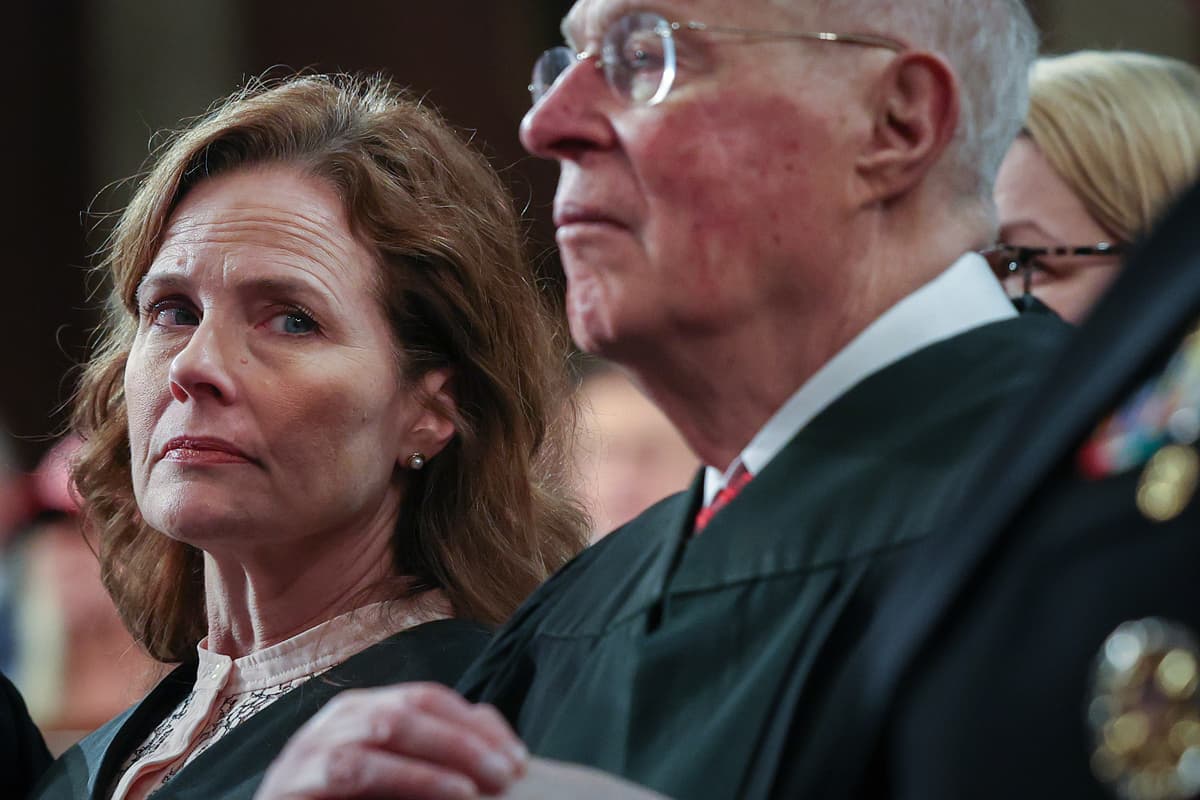

Win McNamee/Getty Images
Justices Amy Coney Barrett and Anthony Kennedy at the Capitol on March 4, 2025. Win McNamee/Getty Images

The release next week of Justice Amy Coney Barrett’s long-delayed new book, “Listening to the Law: Reflections on the Court and the Constitution,” could mark her emergence as one of the most consequential voices on the Roberts Court. 

Justice Barrett, the high court’s youngest justice at 53 years old, was named to the high bench by President Trump in 2020, replacing Justice Ruth Bader Ginsberg, who’d resisted calls to retire during a Democratic presidency and died in office during the first Trump presidency. Her passing offered the 45th president  the opportunity to fill a third Supreme Court vacancy. 

Justice Barrett, who served three years on the United States Court of Appeals for the Seventh Circuit, has also taught at Notre Dame Law School, her alma mater, and clerked for two conservative legal legends — Judge Laurence Silberman and Justice Antonin Scalia. Her advance for “Listening to the Law” was some $2 million, now the going rate for Supreme Court books.

The book deal between Justice Barrett and a conservative imprint of Penguin Random House was first announced in April 2021, when she was new to the court. In the years since, a justice that a legal scholar, Joshua Blackman, has called the “most taciturn and cautious of the judges,” has found her footing as something of a swing vote — along with a fellow conservative, Chief Justice Roberts — on a court that tilts rightward.

In excerpts from Justice Barrett’s book, published by CNN on Tuesday, she defends her vote in Dobbs v. Jackson Women’s Health Initiative to overturn Roe v. Wade and end the constitutional right to an abortion. The justice explains that ​​the “Court’s role is to respect the choices that the people have agreed upon, not to tell them what they should agree to.” Justice Barrett also shares that she celebrated by uncorking champagne after other justices joined a “particularly tricky” decision of hers on an unspecified case.

The champagne-worthy case could be Justice Barrett’s majority opinion in Trump v. CASA, the recent landmark decision that emerged from Mr. Trump’s push to eliminate birthright citizenship. The court eschewed deciding the case on the merits — though the question could return to the court this coming term — and instead grasped the opportunity  to sharply curtail the use of nationwide or universal injunctions by district court judges. 

The use of those rulings had skyrocketed in Mr. Trump’s second term, and had become the primary tool of Democrats to block the 47th president’s agenda. Since the current system allows Democrats to “judge shop” and bring cases before jurists appointed by Presidents Obama and Biden, the lowest tier of the federal judiciary had been gumming up Mr. Trump’s policy initiatives for months.

Justice Barrett’s opinion blocked the use of those injunctions “only to the extent that the injunctions are broader than necessary to provide complete relief to each plaintiff with standing to sue.” She reasoned that universal injunctions were unknown at the time of the Founding.

That opinion unleashed a fury from Justice Ketanji Brown Jackson, who is the court’s most liberal justice and who’s been clear that, as she puts it, “I’m not afraid to use my voice.” She accused the majority of creating a “zone of lawlessness” and contended that her colleagues’ ruling amounted to an “existential threat to the rule of law.” Justice Barrett responded: “We will not dwell on Justice Jackson’s argument. … We observe only this: Justice Jackson decries an imperial Executive while embracing an imperial Judiciary.”

That amounted to a spectacular rebuke from Justice Barrett, who reckoned that Justice Jackson’s argument was “tethered neither to …  sources nor, frankly, to any doctrine whatsoever.” Justice Jackson — who’s accused Mr. Trump of taking “a wrecking ball” to the government and “unleashing devastation” — for her part predicted that “executive power will become completely uncontainable, and our beloved constitutional Republic will be no more.”

Justice Barrett, though she joined the court’s conservatives in landmark rulings like Dobbs and Trump v. United States, still has weathered criticism from conservatives. Early in Mr. Trump’s second term she linked up with Chief Justice Roberts to order the administration to pay some $2 billion in foreign aid contracts. Justice Samuel Alito pronounced himself “stunned” by the failure to ensure that the “power entrusted to federal judges by the Constitution is not abused.”

Anger at Justice Barrett — a practicing Catholic — percolated throughout the conservative legal world. Mr. Blackman told the Sun that she ought to consider resigning. An informal legal adviser to Mr. Trump, Mike Davis, called her “a rattled law professor” and “weak and timid.” Another informal adviser to the president, Laura Loomer, called her a “DEI hire.”

Justice Barrett, whose children attended a Christian school in Indiana, also attracted scrutiny for recusing herself from a case involving a religious charter school. A deadlocked court kept in place a lower court ruling against the school. Footage from Mr. Trump’s joint address to Congress in March was interpreted by some as capturing Justice Barrett looking with disdain at Mr. Trump. 

In the excerpt published by CNN, Justice Barrett writes, “Before I joined the Court, I was sometimes frustrated by an opinion’s cryptic language or its failure to resolve fairly obvious points. Now I better appreciate that glossing over issues is often deliberate.” She also defends the high court’s use of the so-called shadow docket, writing, “As long as litigants continue filing emergency applications, the Court must continue deciding them.”

One of the more notorious moments of Justice Barrett’s career occurred during her confirmation hearings for the Seventh Circuit. In respect of religion, Senator Dianne Feinstein told her that  “the conclusion one draws is that the dogma lives loudly within you. And that’s of concern when you come to big issues that large numbers of people have fought for, for years in this country.”

That was seen as suggesting something like a religious test for office, which is absolutely barred by the Constitution. Justice Barrett references that exchange in her book, writing, “Some suggest that people of faith have a particularly difficult time following the law rather than their moral views.” Adds she: “I’m not sure why.”


The New York Sun

© 2025 The New York Sun Company, LLC. All rights reserved.

Use of this site constitutes acceptance of our Terms of Use and Privacy Policy. The material on this site is protected by copyright law and may not be reproduced, distributed, transmitted, cached or otherwise used.

The New York Sun

Sign in or  create a free account

or
By continuing you agree to our Privacy Policy and Terms of Use