Make-or-Break Week for Trump Presidency as Supreme Court Set To Weigh Legality of ‘Liberation Day’ Tariffs
If his powers to tax imports is limited, the president could lose a key stick he has been using to bend foreign nations to his will.
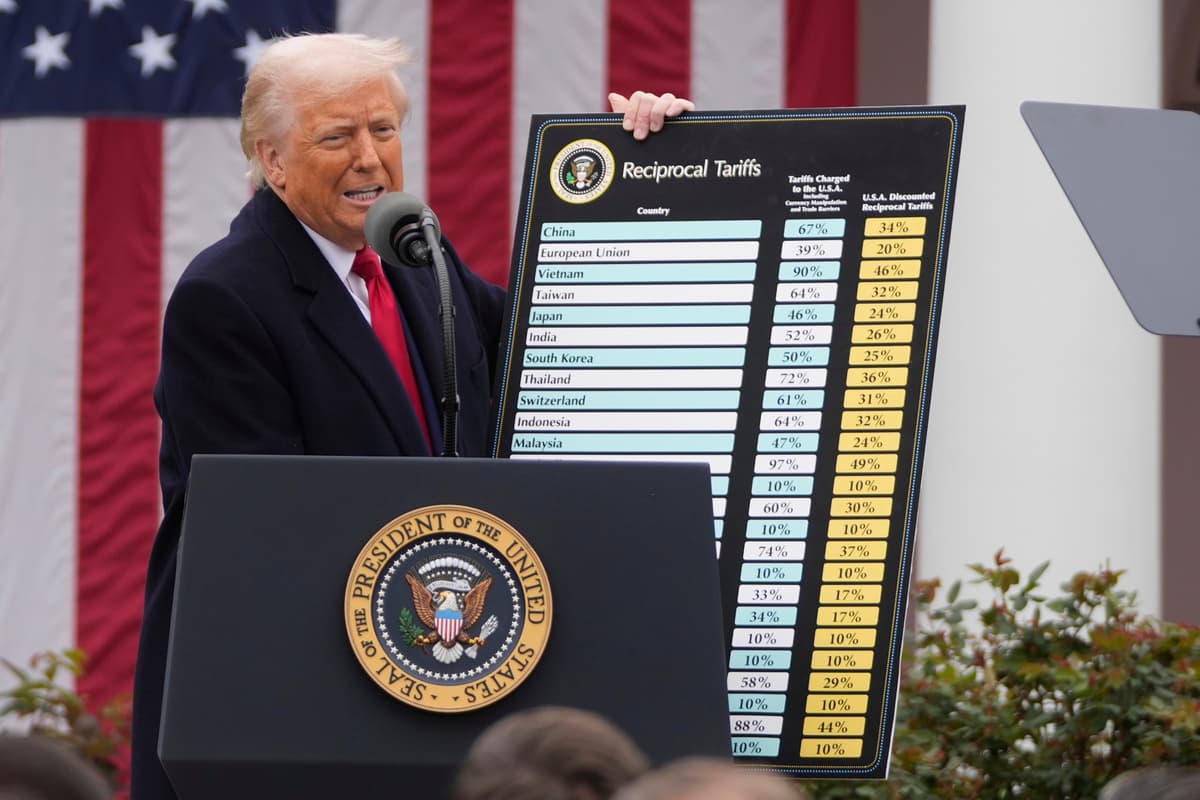

This week will be a fateful one at the Supreme Court for President Trump’s domestic and foreign policy agendas, with the justices set to hear arguments from petitioners seeking to limit his power to impose tariffs.
If his tariffs are scaled back or canceled altogether, he will lose a critical tool he has been using to bend foreign nations to his will. If the court does uphold his tariff powers, however, it could be one of the broadest expansions in modern history of an executive’s unilateral power over the economy.
The tariff uncertainty has made investors wary and businesses concerned since “Liberation Day” in April — the day Mr. Trump imposed across-the-board tariffs on nations that he sees as having high trade barriers for American products. Since then, he has wielded the tariff sword as a response to everything from Communist China’s rare earth mineral exports to a television ad from the Canadian province of Ontario.
Earlier this year, a group of small businesses and a band of Democratic-led states filed lawsuits to strike down the president’s tariffs. Two courts — the U.S. Court of International Trade and the U.S. Court of Appeals for the Federal Circuit — have declared some of those import taxes illegal. A second case, rising out of the federal courts at Washington, D.C., will also be heard after a group of small businesses sued Mr. Trump.
The Supreme Court has agreed to hear arguments for both cases — which have been consolidated — on Wednesday.
In response to the appellate court’s decision to uphold the striking down of his tariffs, the president declared that the country would be “literally destroyed” if the Supreme Court placed limits on his tariff authority.
“If these Tariffs ever went away, it would be a total disaster for the Country,” Mr. Trump wrote on Truth Social in August after the appellate court made its ruling. “It would make us financially weak, and we have to be strong. The U.S.A. will no longer tolerate enormous Trade Deficits and unfair Tariffs and Non Tariff Trade Barriers imposed by other Countries, friend or foe, that undermine our Manufacturers, Farmers, and everyone else.”
Last week, a flood of amicus briefs began flowing to the justices in opposition to Mr. Trump’s broad use of his tariff powers. One brief, filed by two conservative organizations — the Goldwater Institute and the John Locke Foundation — argues that Mr. Trump’s imposition of tariffs “runs contrary to everything” the Founding Fathers envisioned.
Law professors, think tank scholars, elected officials, and small businesses were among other amici who urged the court to strike down the tariffs.
The second case, brought by Learning Resources Inc., argues that Mr. Trump and his administration are seeking “breathtaking” new authorities. The law under which Mr. Trump has declared his “emergency” in order to impose the tariffs, the International Emergency Economic Powers Act, was signed in 1977, though it has never been invoked as expansively as it is now.
Attorneys for Learning Resources Inc. argue that the tariffs represent an illegal tax on consumers.
“Even if that were not the most natural reading of the text, basic principles of statutory construction confirm that, at a minimum, IEEPA does not convey the unlimited tariffing authority that the President claims here,” lawyers for the company wrote in their legal brief to the justices. “This Court is properly skeptical when the executive branch claims to discover in an old statute a breathtaking new power to remake the national economy.”
The attorney general of Oregon, Dan Rayfield, is the lead attorney for the blue states suing to stop the tariffs. In an interview with the Canadian news channel CTV, Mr. Rayfield says Mr. Trump’s rationale for his tariffs is indefensible legally.
“The president does not have the constitutional authority to do what he is doing right now. He does not have statutory authority to do what he is doing right now,” Mr. Rayfield said Saturday.
Some members of Congress want to see Mr. Trump’s import taxes canceled, though that is impossible because of changes made to House rules by Speaker Mike Johnson earlier this year. Last week, the Senate voted in a bipartisan way to cancel the president’s tariffs on Canada and Brazil, as well as his “Liberation Day” tariffs.
Typically, the House would then take up that resolution to kill the tariffs, though Mr. Johnson earlier this year included language in a procedural measure to block any lawmaker from filing those accompanying resolutions in the House. That moratorium on anti-tariff resolutions in the House is set to expire in January, though lawmakers could simply extend it again.
If the court does strike down his tariffs, Mr. Trump may get a blessing in disguise. Based on current polling, the president is deeply in the red when it comes to voters’ perceptions of his handling of the economy. A number of surveys released Sunday found that he has a deficit of about 20 to 25 percent when Americans are asked about his economic stewardship and his handling of inflation, and that his tariffs are the least popular of his initiatives.
His bigger concern, however, seems to be that he will no longer be able to unilaterally threaten and punish foreign nations which he deems insufficiently aligned with him. He has already imposed a 50 percent tariff on Brazil not for any reasons related to trade, but rather because a former right-wing Brazilian president — whom Mr. Trump likes — was prosecuted and convicted for trying to illegally overturn the results of his re-election defeat in 2022.