Mamdani’s Voter Base of Young, Superficially Educated Elites Is the Real Story of New York’s Mayoral Race

Ignorant of history and indoctrinated by leftism, these voters forget Thatcher’s warning: ‘The problem with socialism is that you eventually run out of other people’s money.’
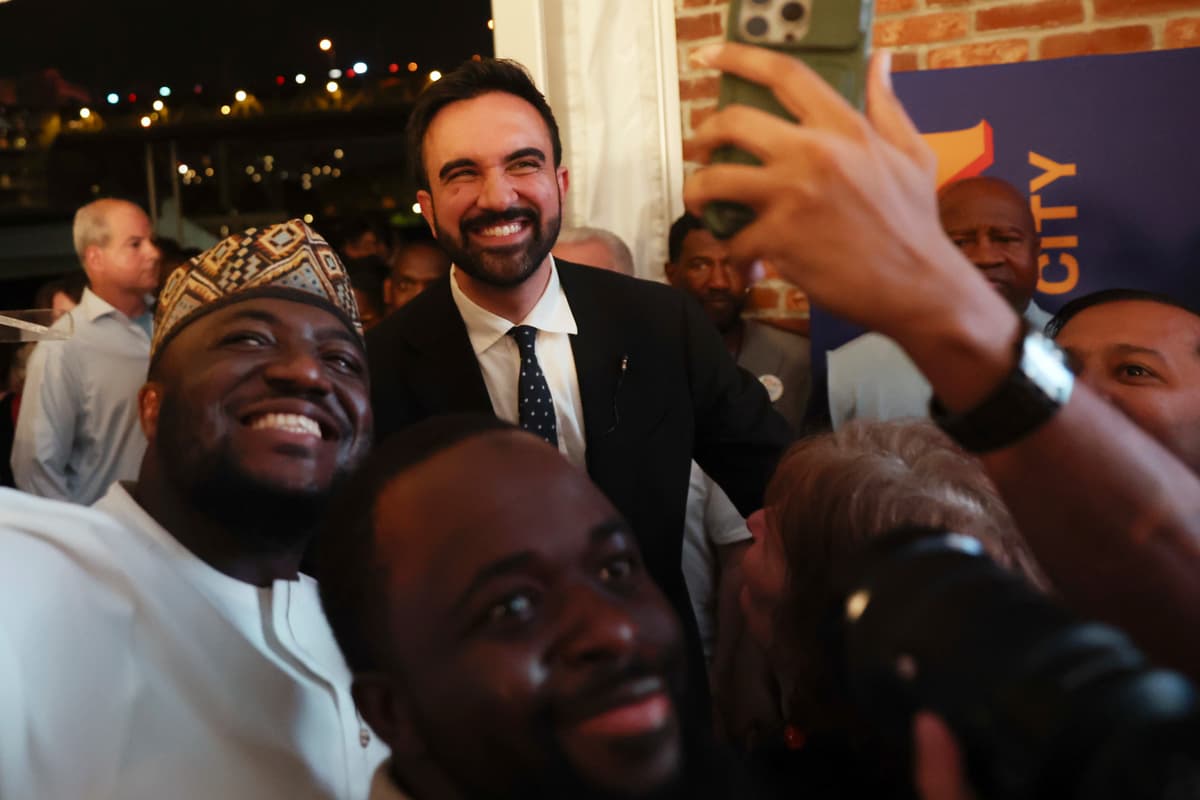

AP/Heather Khalifa
Democratic mayoral candidate Zohran Mamdani takes selfies with supporters after speaking at his primary election party, June 25, 2025. AP/Heather Khalifa

While the press fixates on Zohran Mamdani’s Marxist economic views, far-left cultural positions, and strong anti-Israel stance, they are missing a more significant story.

What has changed in America that thousands of successful, affluent young New Yorkers could vote for a socialist candidate whose core views and policies would unquestionably destroy the city and reject nearly every fundamental American value?

In the two-way Democratic primary, the young Ugandan-born Mr. Mamdani defeated a former governor, Andrew Cuomo, a traditional but personally damaged candidate, by 56 percent (545,334 votes) to 44 percent (428,530 votes).

The Mamdani voter coalition differs dramatically from initial expectations.

I would have assumed that a populist of Indian heritage, born in Africa, would have run strongest among minority communities and the most economically disadvantaged. However, Mr. Cuomo performed better among African Americans and lower-income voters, while Mr. Mamdani’s primary strength came from young elites.

We are witnessing a profound shift among an energetic, intelligent, and superficially well-educated segment of younger Americans. The term superficially applies here because many hold degrees from elite institutions that have indoctrinated them with misleading narratives and factually incorrect concepts about an imagined world.

The academic left has progressively adopted anti-American positions for over six decades. Consider, for example, the widely used economics textbook by Paul Samuelson, which repeatedly predicted the Soviet Union’s impending economic dominance. 

In the 1961 edition, Samuelson famously predicted that Soviet national income would surpass America’s. Despite his erroneous predictions, Samuelson received a Nobel Prize. 

Similarly, Paul Ehrlich’s 1968 book “The Population Bomb” made wildly inaccurate predictions, yet it remained influential due to its ideological appeal to the left.

It is this privileged yet indoctrinated — not truly educated — younger demographic driving Mr. Mamdani’s rise. Mark Twain’s observation applies aptly here: “It ain’t what you don’t know that gets you into trouble. It’s what you know for sure that just ain’t so.”

Mr. Mamdani’s campaign includes promises such as free buses, universal childcare, and government-run grocery stores funded by significant tax increases on the wealthy. 

In Mr. Mamdani’s fantasy world, government operates more efficiently than the private sector. Take his stance on rent control, for instance. The core appeal to the wealthy, brainwashed youth was his promise to solve rent control by “freezing” prices on the city’s rent-stabilized apartments. 

Yet, the fundamental housing issue in New York City is caused by existing rent control policies. Tightening these regulations further will inevitably reduce available housing and distort the market.

The ultimate flaw in Mr. Mamdani’s socialist-Marxist fantasy world is that money is mobile. If Mr. Mamdani raised taxes sufficiently to fund his fantasies, the city’s tax base would rapidly diminish. 

Following the historical pattern of socialist regimes like those under Juan Perón in Argentina, Fidel Castro in Cuba, and Hugo Chávez in Venezuela, Mr. Mamdani risks destroying the greatest city in America as wealthy individuals and businesses relocate. 

Mr. Mamdani’s claim, “I don’t think we should have billionaires,” suggests the question of who will fund his new promises. As Prime Minister Thatcher famously said, “The problem with socialism is that you eventually run out of other people’s money.”

Another fascinating aspect of this emerging Marxist-socialist-left coalition was captured by pollster John McLaughlin, who noted, “They leave out the scariest demographic: religion. These Mamdani Democrats are overwhelmingly secular. Harris won the secular vote huge. Trump won Protestants and Catholics big.” 

Mr. McLaughlin adds that “to truly understand these Metro-area voters, look at Georgia, where they elected Ossoff and may re-elect others like him. If you want to understand them culturally, ask about their religion.”

The rise of Mr. Mamdani illuminates the growing influence of a radical, left-wing coalition characterized by an anti-free market lifestyle. 

According to our polling at America’s New Majority Project, Mr. Mamdani’s social values appeal to just 10 percent to 20 percent of the broader American public. However, in certain urban centers and university towns, this coalition has become a militant minority, distinctly separated from the broader American electorate.

Two years ago, Chicago elected a socialist mayor dominated by the teachers’ union, resulting in disaster for the city. New York City may now be poised to repeat this scenario, potentially electing Mr. Mamdani who is dangerously out of touch with reality and risks undermining America’s greatest city.

This period will undoubtedly distinguish between higher education’s brainwashing and real-world practical learning.


The New York Sun

© 2025 The New York Sun Company, LLC. All rights reserved.

Use of this site constitutes acceptance of our Terms of Use and Privacy Policy. The material on this site is protected by copyright law and may not be reproduced, distributed, transmitted, cached or otherwise used.

The New York Sun

Sign in or  create a free account

or
By continuing you agree to our Privacy Policy and Terms of Use