
Minnesota Supreme Court Says Transgender Powerlifter Should Be Allowed To Compete in Women’s Events

The court says the decision to block transgender athletes from competing in women’s sports is ‘facially discriminatory.’
Anna Moneymaker/Getty Images
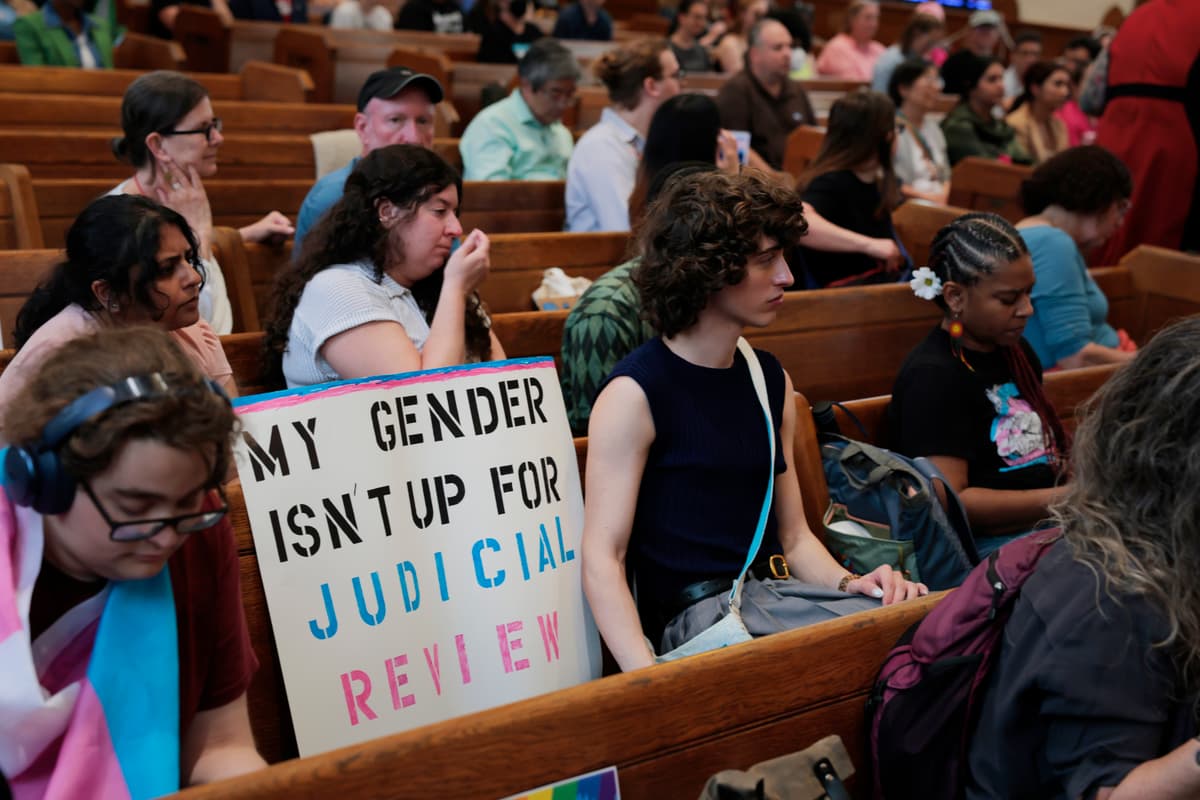
Activists attend a rally for transgender youth at Washington, D.C., on June 18, 2025. Anna Moneymaker/Getty Images

Minnesota’s Supreme Court says that a transgender powerlifter should be allowed to compete in women’s events, finding that USA Powerlifting’s prohibition on their participation violated the state’s antidiscrimination laws. 

The lawsuit was brought by JayCee Cooper, who alleges that USA Powerlifting, USAPL, engaged in discrimination. In 2018, USAPL prevented JayCee Cooper, who identifies as a woman, from competing in the women’s division. The powerlifter sued in 2021, arguing that the decision violated the Minnesota Human Rights Act. 

In a ruling on Wednesday, the Minnesota Supreme Court said that “a policy that expressly prohibits transgender women from competing in the women’s division of a powerlifting competition is facially discriminatory and constitutes direct evidence of discrimination based on sexual orientation.”

USAPL insists that it did not discriminate against the plaintiff. In a statement, the president of the organization, Larry Maile, said, “Our goal at USAPL is to create rules and a framework that uphold the principles of fair play, not to exclude anyone.”

“To support trans athletes, USAPL created an open MX division in 2021 to serve all gender identities, including transgender and nonbinary members. The organization welcomes trans referees in all competitions, open or otherwise,” he added. “Since science shows those who were born biologically male have a profound physical advantage over female-born athletes, our responsibility is to define legitimate categories to fairly place athletes within them.”

In 2023, a Ramsey County district court judge ruled in favor of JayCee Cooper. However, the USAPL appealed the ruling, and the Minnesota Court of Appeals partially overturned it, which the plaintiff appealed to the Minnesota Supreme Court.

The decision has been cast as a major case due to its potential impact on transgender athletes and their ability to compete on sports teams that do not match their biological sex. 

However, the impact of the decision may be short-lived, as the U.S. Supreme Court is slated to hear arguments this term on state laws banning transgender students from competing on sports teams that do not correspond to their biological sex. Opponents of the laws, such as the ACLU, have said the high court’s decision could have implications beyond school sports teams. 


The New York Sun

© 2025 The New York Sun Company, LLC. All rights reserved.

Use of this site constitutes acceptance of our Terms of Use and Privacy Policy. The material on this site is protected by copyright law and may not be reproduced, distributed, transmitted, cached or otherwise used.

The New York Sun

Sign in or  create a free account

or
By continuing you agree to our Privacy Policy and Terms of Use