
MoMA’s ‘Silent Movie Week’ Offers the Chance To Catch a Gem of the Genre, Walter Ruttmann’s ‘Berlin: Symphony of a Great City’
Trained as a painter, Ruttmann brought the heady innovations of early Modernism into his cinematic efforts, including the scurried momentum of Futurist painting and the spooky sonorities of Surrealism.
“Immersive” is an adjective that has been used with increasing frequency over the past decade or so, usually by public relations firms eager to describe events that blur the boundary between audiences and the works under perusal. Spectacle has always been with us, but most contemporary immersions — typically, a species of showroom overkill with vague intimations of avant-gardist provocation — cruise on the assumption that the viewer is, if not a halfwit, then insufficiently capable of aesthetic engagement. The difference between outreach and condescension can be hard to distinguish.
All of which was brought to mind upon watching Walter Ruttmann’s “Berlin: Symphony of a Great City“ (1927), a film that will open this year’s edition of “Silent Movie Week” at the Museum of Modern Art. Here is a motion picture that is wholly and utterly immersive. Give just a few minutes to this poetic and often haunting evocation of a day in the life of a city and you’re almost certainly in for the count. The means by which Ruttman, working alongside Karl Freund, Carl Mayer, and a handful of cinematographers, condense the mundane is as buoyant as it is entrancing. Witty, too.
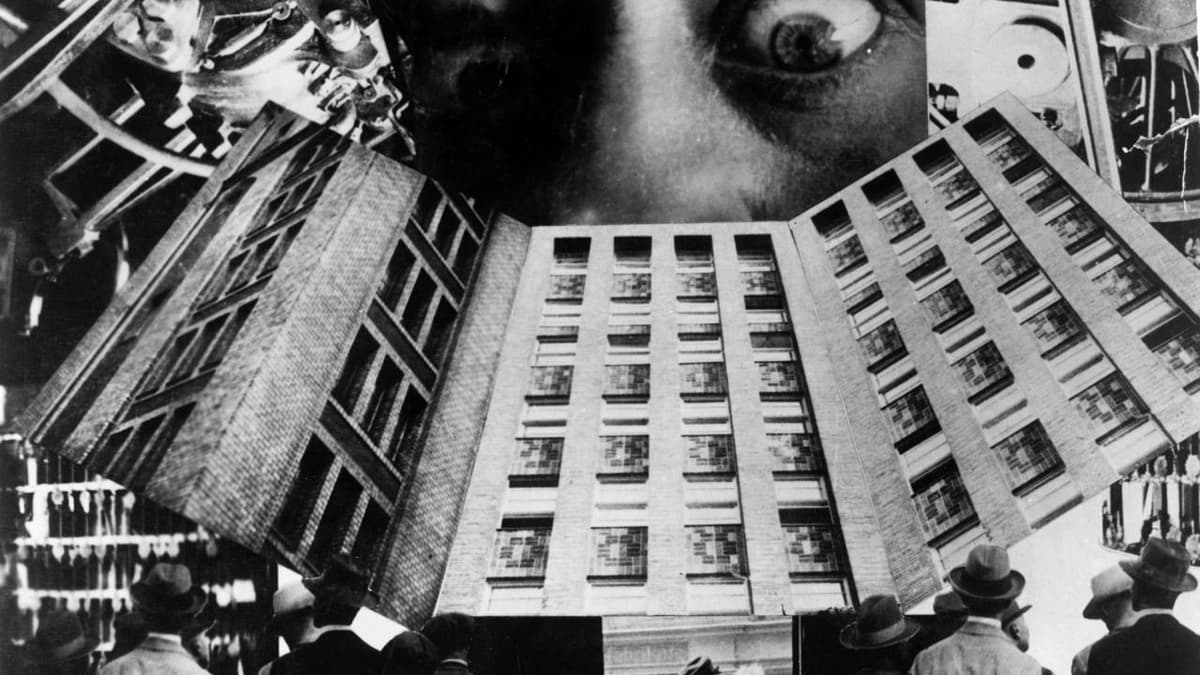
“Symphony of a City” is not a documentary, nor does it pretend to be. The picture is better likened to a Kurt Schwitters collage, being an accumulation of fragments chosen as much for their formal properties as for their ability to yoke a sense of place. Whatever “narrative” is to be divined is likely best touched upon by sociologists, and for good reason: Guttman’s movie encompasses a culture and a people wedged between two world wars and on the cusp of a murderous ideology. It can be difficult, here in 2025, to separate the film from the historical record.
The best art has a way of transcending its moment. If a variety of subsequent and conflicting critical takes on “Symphony of a City” offer anything, it’s an indication that the picture has proved too slippery an entity to pigeonhole as a polemic. Ruttmann did, admittedly, prove himself amenable to likening human endeavors to animal behaviors — factory and office workers as cattle and sheep, say — but he and his colleagues otherwise tap into the machine-tooled cadence, as well as the flesh-and-blood necessities, of modern life. It is a surprisingly humane document.

“Symphony of a City” is usually compared to Dziga Vertov’s self-proclaimed “experimentation in … cinematic communication,” “Man With A Camera” (1929), and the lesser-known “Manhatta” (1921), a short film co-directed by the photographer Paul Strand and the painter Charles Sheeler. Ruttmann’s film is less strident in tone than the former and more comfortable with metaphor than the Americans proved to be. The editing is alternately pointed and fluid, and some scenes — the opening of a suite of windows, for instance — lightly choreographed.
Trained as a painter, Ruttmann brought the heady innovations of early Modernism into his cinematic efforts. The scurried momentum of Futurist painting is part-and-parcel of the mix, as are the spooky sonorities of Surrealism and, less so, the psychological grievances of Expressionism. Let’s not forget that Ruttman’s colleagues, Freund and Mayer, worked on “The Last Laugh” (1924) and “The Cabinet of Dr. Caligari” (1920). The film’s cataloguing of this, that, and the other thing also brings to mind the photographer August Sander’s epochal suite of portraits, “People of the 20th Century.”
Once the National Socialists took power, Ruttmann tooled his skills for the official propaganda machine — a career turn that must’ve vexed Jewish colleagues Freund and Mayer, who had since decanted for, respectively, Hollywood and London. It’s worth noting that the Nazis ultimately showed him the door for being altogether too Russian in his artistic tastes.
How burdened “Berlin: A Symphony of a City” is by the travails of history is due more, I think, to retrospect than artifact. New Yorkers can judge for themselves. The Museum of Modern has done right by highlighting an achievement that is more than the sum of its inheritances.