

Move Over, Taylor Swift — King David Rules as Songwriter Supreme With ‘Psalms in Medieval Life’ at the Morgan Library

The prayers written by the ‘sweet singer of Israel’ have retained their hold for millennia.
The Morgan Library & Museum via the Metropolitan Museum of Art
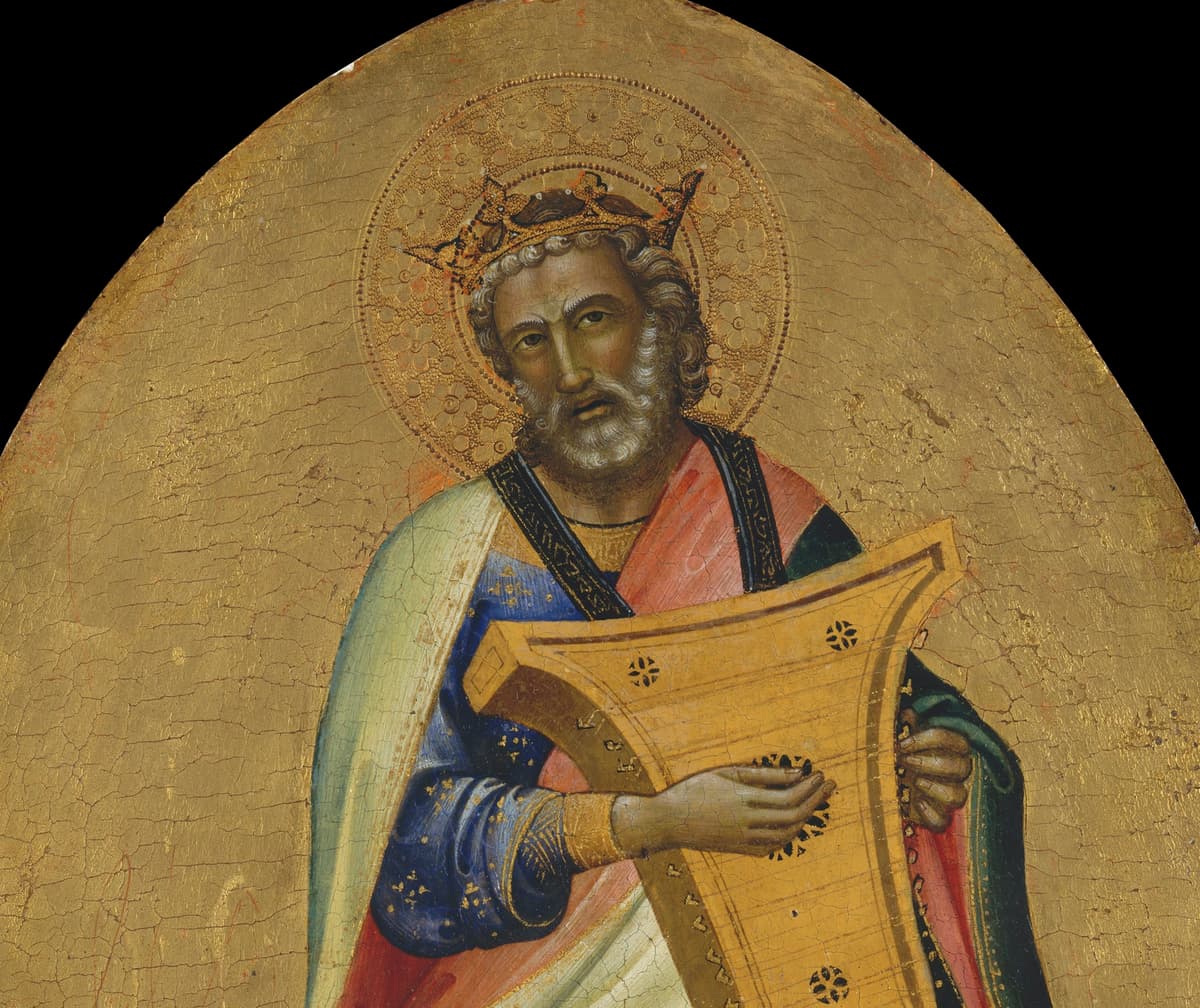
'King David as Psalmist' by Lorenzo Monaco, ca 1408-1410. Florence, Italy. Detail. The Morgan Library & Museum via the Metropolitan Museum of Art

The pop star Taylor Swift’s newest album, “The Life of a Showgirl,” is breaking streaming records, but for longevity, the Psalms, traditionally ascribed to King David, will be hard to beat. That is the conclusion one reaches at “Sing a New Song: The Psalms in Medieval Art and Life,” just up at the Morgan Library. The star is the book of the Hebrew Bible that is both the longest and the most popular. 

The Bible calls David the “sweet singer of Israel,” but he was a monarch as well as a crooner. The boy, who slew Goliath with a slingshot and soothed the mad King Saul with his harp, grew up to become king himself, first at Hebron and then at his new capital, Jerusalem. His dearest wish was to build a Temple to God, but that honor would pass to his son, Solomon. David’s blood-stained hands were ruled ineligible. Yet his 150 Psalms became a sanctuary in sound.

The Morgan’s focus, though, is the ravishing visual life of the Psalms. The show aims to trace “the impact of the Psalms on people in medieval Europe from the sixth to the sixteenth century.” These were centuries of piety, when monks lavished a lifetime on illuminated manuscripts of the Psalms — called “Psalters”— and lay people and priests ordered their prayers with liturgical aids like Breviaries and Missals in an era of incense and stained glass.

More manuscript copies of the Psalms survive than any other biblical text. A 14th century bestseller — “The Book of Hours” — organized  prayers in eight sections meant to be said at regular intervals throughout the day. It was based on the Psalms. The show’s curator, Roger Wieck, contends that “Psalms permeated the intellectual culture of medieval Europe.” They were puzzled over by theologians and cried over by those seeking health and daily bread.

Chanting clerics, from 'The Windmill Psalter,' England, 13th century. Detail.
Chanting clerics, from ‘The Windmill Psalter,’ England, 13th century. Detail. Carmen González Fraile for the Morgan Library & Museum

Before the Psalms were Christian and Latin, they were Jewish and Hebrew. Scholars reckon, though, that some 95 percent of Hebrew manuscripts from the Middle Ages have been destroyed. Books as well as people were liable to be burned. The Morgan has a gorgeous Hebrew Tehillim that is one of the first books ever printed in David’s mother tongue. The type is so clear that it could be read in synagogue today. The righteous still recite all 150 Psalms daily.

The exhibition’s oldest object is a tattered parchment in Aramaic — the language of Jesus and the Babylonian Talmud — that has survived from an ancient Jewish community in Egypt. It dates from some 300 years before the common era. Fast forward 16 centuries and a Crusader Bible from Paris is illustrated in vivid reds and blues, with verses in Latin and Judeo-Persian snaking around images of David slaying Goliath and sawing off the giant’s head.

The Psalmist takes center stage in a 15th century from Florence by Lorenzo Monaco. Draped in royal robes and sporting a halo, this is not the dashing young hero who made love and war. It is a vision of a weary king who has spent his life with a sword in his hand and who has seen his family ripped apart by tragedy and prophets chastise him for his own shortcomings. He writes in Psalms 6 that “I am weary with groaning / My eyes are wasted by vexation.”

If Monaco’s David depicts the Psalmist in Renaissance style — and offers a rewarding contrast with Donatello’s sinuous David in bronze — an older visual language is on display in a ninth century Hermeneiai, or book of Psalm readings, from Coptic Egypt. The volume’s frontispiece offers a Virgin and Child that blends Byzantine and ancient Egyptian styles, alluding to the motif of Isis nursing her son Horus. David is therefore linked to the pharaohs.

The enduring power of the Psalms — to Bruges from Babylon — is that they manage to feel intensely intimate and timelessly universal. David writes, and millions have affirmed, that “In distress I called on the LORD / The Lord answered me and brought me relief.” Hebrew has the same word, shira, for both song and poem. The best songs share that same eternal quality. As Ms. Swift puts it: “I mind my business / God’s my witness that I don’t provoke.” 


The New York Sun

© 2025 The New York Sun Company, LLC. All rights reserved.

Use of this site constitutes acceptance of our Terms of Use and Privacy Policy. The material on this site is protected by copyright law and may not be reproduced, distributed, transmitted, cached or otherwise used.

The New York Sun

Sign in or  create a free account

or
By continuing you agree to our Privacy Policy and Terms of Use