Muslim Brotherhood’s Hidden Agenda in Sudan’s Civil War Reflects Islamist Push To Control Northeast Africa and Red Sea

The Sudanese army’s alignment with the brotherhood threatens global economic stability and American national security interests.

AP/Marwan Ali, file
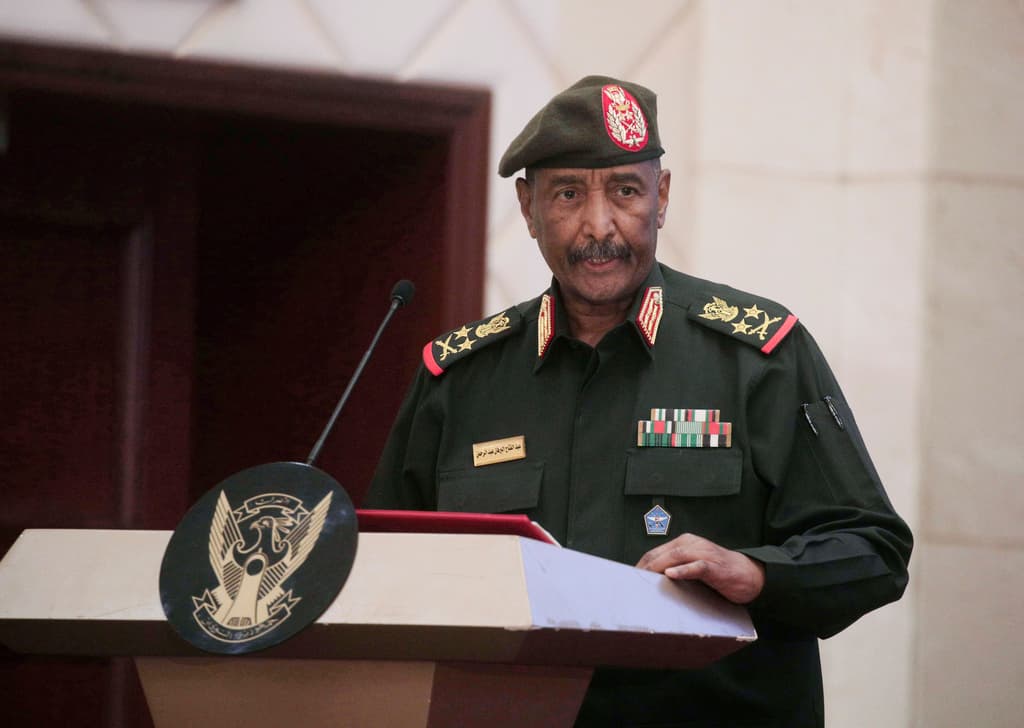
Sudan's army chief, General Abdel-Fattah Al-Burhan, at Khartoum, December 5, 2022. AP/Marwan Ali, file

Sudan is engulfed in a brutal civil war, driven by a strategic agenda of the Muslim Brotherhood to dominate Northeast Africa and the Red Sea region. At the center of this conflict is the Sudanese Army, led by General Abdel Fattah Al-Burhan, whose actions and alliances reflect alignment with Islamist forces pursuing this regional master plan. 

For Washington, this situation is critical, as allowing the Muslim Brotherhood to control Sudan and, by extension, the Red Sea’s maritime trade routes would threaten global economic stability and American national security interests.

In 1989, the Sudanese Army overthrew a civilian government, establishing a harsh Islamist regime under General Omar Al-Bashir. For nearly 30 years, this regime, initially influenced by an Islamist ideologue, Hassan Al-Turabi, committed atrocities, including genocides in South Sudan and Darfur, and supported global terrorism. 

Sudan became a safe haven for Osama bin Laden between 1992 and 1997. Al Qaeda forged ties in Sudan with Egyptian Islamic Jihad, laying the groundwork for attacks like the 1995 assassination attempt on President Hosni Mubarak and the 1998 American embassy bombings in Kenya and Tanzania. 

FILE - Sudanese soldiers from the Rapid Support Forces unit secure the area where Gen. Mohammed Hamdan Dagalo attends a military-backed tribe's rally, in the East Nile province, Sudan, June 22, 2019.
Sudanese soldiers from the Rapid Support Forces unit in the East Nile province, June 22, 2019. AP/Hussein Malla

The regime also facilitated Iran’s missile smuggling to Hamas and supported the Lord’s Resistance Army in Uganda.

After Al-Bashir’s ouster in 2019 amid public protests, General Al-Burhan seized power, overthrowing a transitional civilian government in 2021. By 2023, tensions between Sudan’s army and its former allies, the Rapid Support Forces, erupted into a devastating civil war. 

This conflict is not merely a power struggle but part of a broader Muslim Brotherhood strategy to control Sudan through the Sudanese army and, by extension, the strategic Northeast Africa and Red Sea region, a key geopolitical and economic corridor.

The ranks of Sudan’s army are now infiltrated by Islamist groups aligned with the Muslim Brotherhood’s vision. These include the Al-Bara Bin Malik Brigade, the military wing of Sudan’s Islamist Movement, the Bunyan Al-Marsous Brigade, and former Darfur rebels from the Justice and Equality Movement, led by Sudan’s finance minister, Jibril Ibrahim. 

Members of a Chad police unit patrol the border with Sudan as refugees flee the civil war there, May 22, 2023.
Members of a Chad police unit patrol the border with Sudan as refugees flee the civil war there, May 22, 2023. Henry Wilkins and Arzouma Kompaoré (VOA) via Wikimedia Commons

Many of these fighters, including ex-members of Al-Bashir’s National Intelligence and Security Service, have joined Sudan’s army to bolster its numbers against the Rapid Support Forces. 

General Al-Burhan, often portrayed as a moderate, has either enabled or acquiesced to this Islamist surge within the military, raising concerns about his intentions.

Far from distancing itself from its dark past, Sudan’s army under General Al-Burhan continues to protect figures from the Al-Bashir regime, including the former dictator himself, and has been accused of war crimes. 

The army has also renewed ties with Iran, receiving arms, including drones, to fuel its war efforts, mirroring the Al-Bashir era’s collaboration with Tehran. These actions suggest Sudan’s army is not a force for stability but a vehicle for the Muslim Brotherhood’s agenda to consolidate power in Sudan and project influence across the Red Sea region.

The Red Sea is a vital artery for global trade, with some 10 percent to 15 percent of the world’s maritime commerce, including oil and gas shipments, passing through its waters. 

In this image provided by the U.S. Navy, the amphibious dock landing ship USS Carter Hall and amphibious assault ship USS Bataan transit the Bab al-Mandeb strait on Aug. 9, 2023. The top commander of U.S. naval forces in the Middle East says Yemen’s Houthi rebels are showing no signs of ending their “reckless” attacks on commercial ships in the Red Sea. But Vice Adm. Brad Cooper said in an Associated Press interview on Saturday that more nations are joining the international maritime mission to protect vessels in the vital waterway and trade traffic is beginning to pick up. (Mass Communications Spc. 2nd Class Moises Sandoval
The United States Ships Carter Hall and Bataan transit the Bab al-Mandeb strait, linking the Red Sea and the Indian Ocean, on August 9, 2023. United States Navy via AP

Control of Sudan’s Red Sea coast by the Muslim Brotherhood would grant the group significant influence over these critical trade routes, potentially disrupting global supply chains and increasing costs for energy and goods. 

For America, this poses a direct threat to economic stability and national security, as disruptions in the Red Sea could ripple through global markets, impacting consumers and businesses here.

A Sudan dominated by the Muslim Brotherhood could serve as a hub for extremist ideologies and terrorist activities, threatening American allies in the region like Egypt, Saudi Arabia, and Israel. 

The group’s historical ties to Al Qaeda and its renewed partnership with Iran heighten the risk of Sudan becoming a base for anti-Western operations, too, undermining American efforts. 

Amid this Islamist effort to reshape the region’s geopolitical landscape, Washington cannot afford to let the Muslim Brotherhood establish a stronghold in Sudan.


The New York Sun

© 2025 The New York Sun Company, LLC. All rights reserved.

Use of this site constitutes acceptance of our Terms of Use and Privacy Policy. The material on this site is protected by copyright law and may not be reproduced, distributed, transmitted, cached or otherwise used.

The New York Sun

Sign in or  create a free account

or
By continuing you agree to our Privacy Policy and Terms of Use