Mystery Deepens Over Court Delay in Ruling on Trump’s Appeal of Letitia James’s $500 Million Fraud Verdict
An appellate court has yet to decide whether New York’s attorney general’s signature victory is lawful.
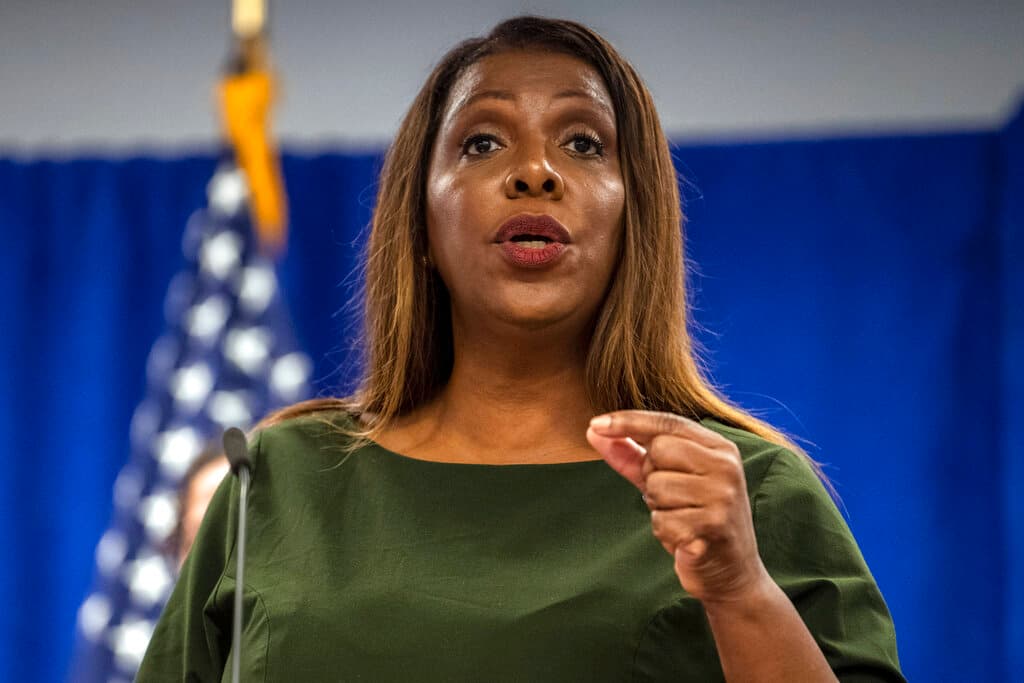

Some 300 days have passed since a New York appellate court heard President Trump’s arguments for why the mammoth fraud verdict against him, his two adult sons, and his business ought to be vacated — and it’s been radio silence from the court since.
The fraud verdict secured by New York’s attorney general, Letitia James, was a signature courtroom victory for a prosecutor who campaigned on promising to shine “a bright light into every dark corner” of Mr. Trump’s real estate empire.
Ms. James was aided by an agreeable judge, Arthur Engoron, who concluded before trial that Mr. Trump’s real estate valuations were shot through with “persistent fraud” and, in addition to the approximately $500 million fine, imposed an independent chaperone and other punitive measures.
The attorney general accused the Trumps of exaggerating property values to banks in order to secure favorable loan terms and insurance policies. Mr. Trump’s defense team argued that the banks and insurers were pleased by the transactions — rendering the alleged fraud “victimless” — and that the property values were not falsified.
Mr. Trump appealed that verdict, and a five-judge panel of New York’s Supreme Court Appellate Division, First Judicial Department — the first review court — appeared skeptical of Judge Engoron’s work. During oral arguments on September 26, 2024, the judges asked Ms. James’s team whether this was in essence a “commercial dispute.” Another judge concluded that “the immense penalty in this case is troubling.”
The Sun’s courtroom reporter reckoned that “several of the appeals court judges appeared skeptical of the verdict.” One judge concluded that Mr. Trump’s “misrepresentations” almost entirely “concerned subjective evaluations of properties and businesses.” That could suggest interest in overturning Judge Engoron’s verdict. After that verdict was handed down, Mr. Trump posted to Truth Social that there “were No Victims, No Damages, No Complaints.”
Mr. Trump also called the verdict an “unAmerican judgment against me, my family, and my tremendous business” and a “Complete and Total SHAM.” During the trial, he locked horns with Judge Engoron, who imposed a gag order, and also with Judge Engoron’s law clerk, Allison Greenfield. Mr. Trump called her, without evidence, “Schumer’s girlfriend,” referring to the Democratic Senate minority leader.
Mr. Trump’s defense team — before they too were gagged — complained that she was “co-judging” and “rolling her eyes.” Ms. Greenfield, who sat directly beside Judge Engoron on the bench, has since won her own New York City judicial seat in an election.
The First Department’s presiding justice, Judge Dianna Renwick, during oral arguments appeared sympathetic to Ms. James, venturing at one point that the relevant fraud statute “does start off with, ‘To protect honesty and integrity in the marketplace,.” While she did not go as far as Judge Engoron — he reckoned that Mr. Trump’s conduct “shocked the conscience” — her line of questioning indicated she, unlike her colleagues, is likely to side with Ms. James.
The New York Post reports that the average time between oral arguments and verdict is just less than 30 days, though that interval climbs to 140 days for signed decisions. Both of those lengths of time are far short of the time that has passed since Judge Engoron’s verdict was debated. That could suggest that a single judge or a group of judges is holding up the release of a verdict. Whichever side loses when the verdict is finally released will be able to appeal to New York’s court of appeals, which is the highest appellate court in the Empire State.
Despite the appeals process, the judgment is already a major burden on Mr. Trump. He had to scramble to come up with a $500 million bond to put in escrow pending the resolution of the case. He ultimately got the number down to $175 million and secured the loan from a California billionaire who made his fortune in subprime car loans.
In the meantime, Mr. Trump’s Department of Justice has opened a criminal investigation of its own into alleged misrepresentations Ms. James made on mortgage documents connected to properties in Virginia and Brooklyn. She could potentially face criminal prosecution in the matter.
Ms. James’s attorney, Abbe Lowell — his fees are being paid in part by New York’s taxpayers — calls the possibility of criminal charges “the next salvo in President Trump’s revenge tour against Attorney General James.” Mr. Lowell, who has also represented Hunter Biden and Jared and Ivanka Trump, accuses the administration of “cherrypicking” evidence in order to build a case against his client.
In an ironic twist, the charges that could be handed up against Ms. James echo the allegations that led to the verdict she secured against Mr. Trump. She is accused of exaggerating the size of a Brooklyn home to secure loan terms and claiming a modest Norfolk home as her primary residence even though her position obligates her to reside primarily in New York. It is also alleged that Ms. James and her father signed loan documents claiming to be husband and wife.
_________________
Correction: Abbe Lowell is the name of Ms. James’s lawyer. An earlier version misspelled his first name.