
NASA Fast-Tracking Program To Put Nuclear Reactor — on the Moon

‘We want to get there first and claim that for America.’
SpaceX
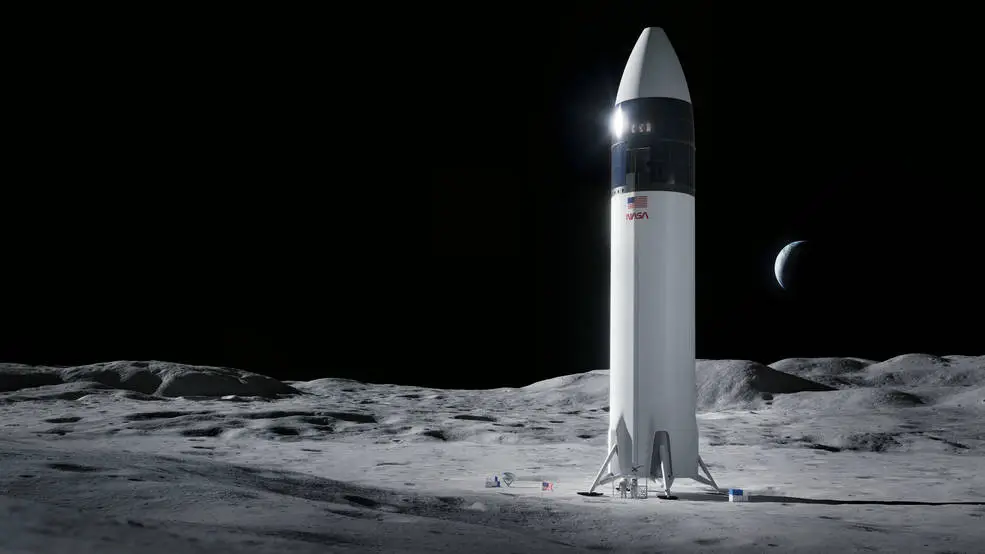
An artist's conceptual image of the Artemis III spacecraft on the moon. SpaceX

Saying we are falling behind China in the next race to the moon, the transportation secretary, Sean Duffy, is accelerating plans to build a mini-nuclear reactor to deploy to the moon.

“We’re behind. If we’re going to engage in the race to the moon and the race to Mars, we have to get our act together,” Mr. Duffy, who is also the interim administrator of NASA, said on Tuesday.

NASA for years has been studying using fission systems to provide power on the moon and eventually Mars. They are relatively small and lightweight and are powerful enough to enable “robust operations,” the space agency says.

Mr. Duffy has now issued a directive to solicit proposals to build a 100 kilowatt nuclear reactor to send to the moon by 2030. “We’re not talking about massive technology. We’re not launching this live,” Mr. Duffy said.

“If we’re going to be able to sustain life on the moon to then go to Mars, this technology is critically important,” Mr. Duffy added.

China and Russia have launched a joint project to design a reactor for the moon, which they hope to have on the lunar surface by 2035.

The Trump administration is worried that the country that gets the first reactor to the moon could declare a “keep-out zone” that could affect plans for any other country.

There are also concerns about China potentially using a moon base to conduct space warfare, including taking out United States satellite systems.

NASA has been working for several years with the Department of Energy and the nuclear industry to design a fission power system that would provide at least 40 kilowatts of power. NASA says that would be enough power to continuously run 30 households for 10 years. This new directive would more than double the power.

“If we’re going to be able to sustain life on the moon to then go to Mars, this technology is critically important,” Mr. Duffy said.

In 2018 it successfully demonstrated a new nuclear reactor power system that could enable long-duration crewed missions to the moon, Mars, and destinations beyond.

“We’ve spent hundreds of million dollars studying, can we do it?” Mr. Duffy said. “We are now going to move beyond studying and we have given direction to go and let’s start to deploy our technology to move to actually make this a reality.”

NASA is in the midst of planning missions to the moon as part of the Artemis program. Mr. Duffy said Artemis II will launch next year and send a crew of astronauts around the moon. Artemis III will then send a manned mission to the lunar surface for six days to explore the region near the lunar South Pole.

That will be followed by unmanned flights to ship assets to the moon for future crews to build a base under the Artemis IV mission.

“This is critically important. There is a certain part of the moon everyone knows is vast. We have ice there. We have sunlight there. We want to get there first and claim that for America,” Mr. Duffy said.


The New York Sun

© 2025 The New York Sun Company, LLC. All rights reserved.

Use of this site constitutes acceptance of our Terms of Use and Privacy Policy. The material on this site is protected by copyright law and may not be reproduced, distributed, transmitted, cached or otherwise used.

The New York Sun

Sign in or  create a free account

or
By continuing you agree to our Privacy Policy and Terms of Use