

New Book Makes Clear That Desi Arnaz Was Much More Than ‘Mr. Lucille Ball’

Arnaz was a behind-the-scenes innovator in the fledgling medium of television, which at the time was frowned upon. The payoff from his decision to throw his lot in with the small screen was significant.
Via Wikimedia Commons
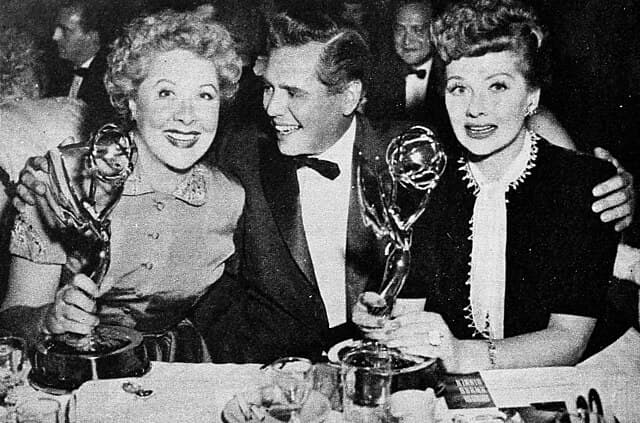
Desi Arnaz flanked by Vivian Vance and Lucille Ball at the 6th Primetime Emmy Awards, 1954. Via Wikimedia Commons

“Desi Arnaz: The Man Who Invented Television”
By Todd Purdum
Simon & Schuster, 368 Pages

In October of 1940, a syndicated columnist for the International News Service, Inez Robb, wrote of a new star on the horizon, an entertainer who had established himself as a nightclub performer and Broadway actor, and was now headed for the silver screen. This up-and-comer had “snapping black eyes, sleek black hair and flashing white teeth.” He is, the redoubtable journalist concluded, “the universally understandable Latin answer to a maiden’s prayer.”

Desi Arnaz (1917-86) answered to a lot of maidens during his lifetime, and prayer had little to do with it. His liking of the ladies was flagrant and unceasing. At the onset of World War II, Arnaz was part of the Hollywood Victory Caravan, a group of entertainers who traveled around the country selling government bonds as a means of supporting the troops. Egos were put on hold for the cause of a common good, but Arnaz’s libido was not: His antics put him in the doghouse with his fellow celebrities.

All the while, Arnaz’s bride of two years, Lucille Ball, was ensconced in their Los Angeles home. In 1942, she was not yet the Lucy whom America would come to love, but, rather, a second-tier ingenue who, though consistently put to work, struggled to create a distinctive cinematic presence. The couple met on the set of George Abbott’s “Too Many Girls” (1940), a musical based on the hit Broadway play in which Arnaz and his bongo doled out “the jungle rhythms of the year’s most sensational dance … the Conga!”

Arnaz was a bit player in “Too Many Girls,” while Ball was the lead. Her love interest in the picture was a journeyman actor, Richard Carlson, now best remembered for his roles in a handful of science-fiction films. Behind the cameras, the flirting between Ball and Arnaz commenced instantaneously. Was Desi’s pick-up line really, “Do you know how to rumba?” If so, it worked: The pair were inseparable during the remainder of the filming. A little less than six months later, they eloped.

Desi Arnaz and Lucille Ball. Leonard Mccombe/The LIFE Picture Collection/Shutterstock

As Todd Purdum notes in his new book, “Desi Arnaz: The Man Who Invented Television,” the pairing of Lucy and Desi was, from the outset, tempestuous. Both were ambitious, driven, and prone, in equal parts, to fits of neediness and jealousy. Mr. Purdum quotes from the often florid correspondence between the two and tells a story about their initial divorce, in 1944. After attending court to receive the official paperwork, Ball made a beeline to Arnaz’s apartment and promptly bedded him. California law had a one-year ban on cohabitation after the decree had been assigned. Lucy had, to decisive effect, put a nix on the divorce.

Mr. Purdum’s bio is a corrective to Arnaz’s public image as a hot-headed Cuban given to malapropisms. As the subtitle makes plain, Arnaz was more than “Mr. Lucille Ball” — a designation that he found infuriating. He was a behind-the-scenes innovator in the fledgling medium of television, which at the time was frowned upon: The new technology was seen as a decisive step down the ladder of the entertainment hierarchy. With their respective movie careers in a lull, Desi and Lucy took a gamble and threw their lot in with the small screen. The payoff was significant.

While proving his mettle as a comic performer — a talent he honed with admirable doggedness as Ricky Ricardo — Arnaz established standard-setting precedents in the formatting, production, and distribution of television programs. Through a confluence of happenstance, a knack for cultivating talent, and a wily organizational savvy, Arnaz transformed Desilu Productions into a major force in popular entertainment and, in the process, became not only wealthy but powerful. When “I Love Lucy” became the no. 1 show in the United States, word came down from the corporate powers-that-be: “Don’t f— around with the Cuban!”

The Cuban’s life after his divorce from Ball in 1960 — there was no last-minute reprieve this time around — was something of a muddle, what with the drinking, the many women, and the general air of aimlessness. Arnaz kept his hand in the business: He oversaw Ball’s subsequent sitcom, the popular if less than epochal “The Lucy Show,” and earned the ire of a FBI director, J. Edgar Hoover, for how the agency was depicted in the Arnaz-produced hit television series “The Untouchables.” Still, the glow had faded, the riches depleted, and illness crept up on him. Arnaz died of lung cancer at the age of 69.

Mr. Purdum has written a clear and convincing book, an honest accounting of a hard-working, sometimes self-destructive, and often very funny man who became an industry innovator, proud American, and cultural lodestar.


The New York Sun

© 2025 The New York Sun Company, LLC. All rights reserved.

Use of this site constitutes acceptance of our Terms of Use and Privacy Policy. The material on this site is protected by copyright law and may not be reproduced, distributed, transmitted, cached or otherwise used.

The New York Sun

Sign in or  create a free account

or
By continuing you agree to our Privacy Policy and Terms of Use