
New China Trade Feud, North Korean Saber-Rattling Raise Tensions Ahead of Asia-Pacific Summit

President Trump, announcing a huge new tariff on China, says he now sees little point to going ahead with an expected meeting with President Xi Jinping.
Korean Central News Agency/Korea News Service via AP
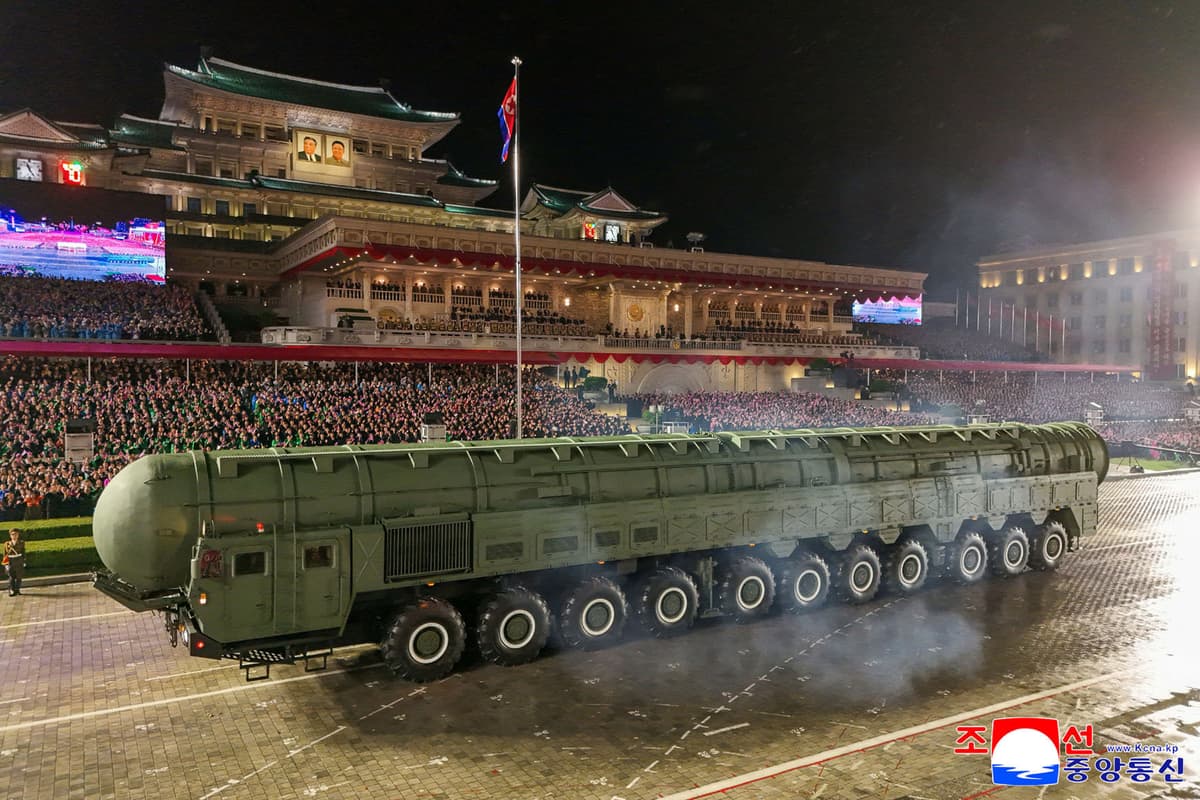
This photo provided by North Korean government shows what it says is a new intercontinental ballistic missile, the Hwasong-20, during a military parade at Pyongyang, North Korea, on October 10, 2025. Korean Central News Agency/Korea News Service via AP

Tensions are ratcheting up in Northeast Asia after North Korea showed off its latest long-range missile and President Trump threatened “massive” new tariffs on Communist China.

 The danger of a costly trade war with China escalated after Beijing announced new controls on the export of rare earths needed in electronic items, notably computers. Stocks descended on Wall Street in the biggest drop-off since April as investors worried about Mr. Trump’s threat to impose an additional 100-percent tariff on Chinese products. 

The turmoil jeopardized prospects for the success of a meeting in South Korea this month of leaders of the 21 economies in the Asia-Pacific Economic Cooperation group, which Mr. Trump and China’s president, Xi Jinping, have both said they will attend.  Regardless of whether they stick to script, the chances of more than a bow and a handshake are not good. 

In North Korea, leader Kim Jong-un warned of  “the growing nuclear war threats by the U.S. imperialists” while reviewing a nighttime parade of the North’s most advanced weaponry, including the latest version of the Hwasong-20, an intercontinental ballistic missile capable of reaching targets anywhere in North America. 

On the 80th anniversary of the founding of the ruling Workers’ Party of North Korea, Mr. Kim said the North faces “constant and tenacious pressure, interference and threats of aggression by outside forces,” according to the English-language version of his speech carried by Pyongyang’s Korean Central News Agency.

He refrained, however, from attacking the usual targets of the North’s rhetoric – America, Japan and South Korea – preferring to let the military might on parade speak for the North’s growing strength as a regional power tightly allied with China and Russia.

The chasm between those powers and Washington deepened when Mr. Trump said he saw “no reason” to meet Mr. Xi at the APEC gathering after China announced new “export controls” that the party paper Global Times insisted are needed “to safeguard national security and interests.”

The controls, it said, covered “rare earth mining, smelting and separation, magnetic material manufacturing, and rare earth secondary resource recycling.” Those materials are critical to the manufacture of many consumer electronic products as well as much modern military hardware.

Mr. Trump, promising to impose a 100-percent tariff on China on top of  the current 30 percent, charged on Truth Social that by regulating the export of rare earths China  is seeking to “hold the world captive.” He hinted at “many other countermeasures” besides the tariff that he said were “under serious consideration.”

The threat level might go down in the run-up to the APEC meeting in the ancient South Korean city of Gyeongju at the end of the month, but the faceoff will inevitably drive China closer to North Korea, which it rescued in the Korean War and keeps on life support with oil and food.

In a message to Mr. Kim, Mr. Xi said the two leaders  had “opened a new chapter” in friendship between their nations and congratulated him for working to “develop the economy and improve the people’s living standards.”

Mr. Xi did not attend the parade, sending his number two, Premier Li Qiang, but he fondly recalled Mr. Kim’s visit to Beijing last month for the 80th anniversary of Japan’s surrender in World War II.

Like Mr. Xi, Russia’s President Putin dispatched his faithful number two, Dmitry Medvedev, who once filled in for him as president. Firmly under the thumb of Mr.  Putin, Mr. Medvedev joined the festivities along with the leader of Vietnam, To Lam, who rules his free-wheeling capitalist society as general secretary of the communist party.

“Despite the rain, Kim Jong Un oversaw the event alongside top officials from China, Russia and Vietnam,” said an independent South Korean website, NK Pro, as North Korean troops “who fought in the Ukraine war marched through Kim Il Sung Square.”

The parade, it said, “featured over 40 major weapons systems, including new solid-fuel ICBMs, hypersonic glide vehicles, drones, and advanced artillery, providing key insight into North Korea’s latest capabilities.”

Mr. Kim,  who held intensive talks with all the visiting leaders, gave the impression of shedding his “reclusive image” while “broadening his diplomatic outreach,” according to South Korea’s Yonhap News.

The tone of the parade, however, fortified his refusal to consider doing away with his missiles and nukes regardless of whether he rushes to the truce village of Panmunjom, on the North-South line, for a meeting with his old friend Mr. Trump during APEC.


The New York Sun

© 2025 The New York Sun Company, LLC. All rights reserved.

Use of this site constitutes acceptance of our Terms of Use and Privacy Policy. The material on this site is protected by copyright law and may not be reproduced, distributed, transmitted, cached or otherwise used.

The New York Sun

Sign in or  create a free account

or
By continuing you agree to our Privacy Policy and Terms of Use