New Documentary Features Verdi’s Greatest Source of Pride, a Home for Aging Singers

Yvonne Russo’s documentary, “Viva Verdi!,” addresses the sacrifices made for art, the vagaries of aging, and the encroachment of mortality.

Via La Monte Productions
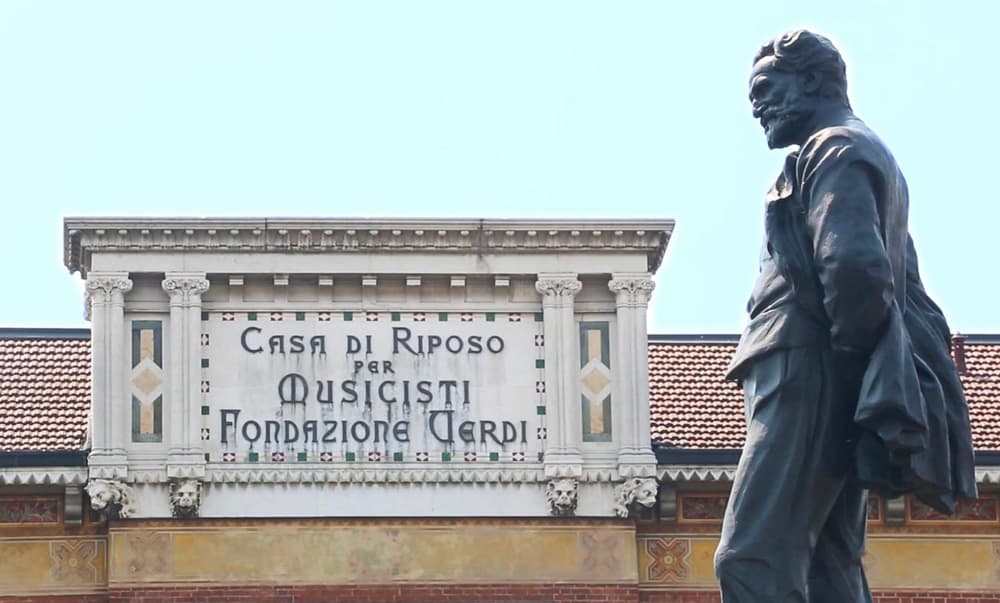
The Casa di Riposo per Musicisti, founded in 1896 by Giuseppe Verdi, is the subject of a new documentary. Via La Monte Productions

A film takes a lot of time in the making and distribution, so it’s not a surprise that several of the people we get to know during the course of Yvonne Russo’s documentary, “Viva Verdi!,” have since gone on to their great reward. Given the age and, in some cases, frailty of Ms. Russo’s subjects, this observation shouldn’t necessarily count as a spoiler. Besides, the picture’s epilogue contains a factoid that a critic should not divulge. Let’s just say that “Viva Verdi!” ends on a heartening note.

“Viva Verdi!” is, in fact, a heartening movie about topics that tend to be sobering: among them, the sacrifices made for art, the vagaries of aging, and the encroachment of mortality. Whilst producing a program about Milan for National Geographic, Ms. Russo discovered Casa Verdi on Piazza Michelangelo Buonarroti. Described as a “museum house” by its director of activities, Ferdinando Dani, the Casa di Riposo per Musicisti is a retirement home for musicians who are, pace its founder Giuseppe Verdi, “not favored by fortune.”

Verdi classified the institution as “among my works, the one I like best … for accommodating old singers.” An artist’s life is not always as remunerative as the talents of a given individual – a truth Verdi came to realize given the fate of many of his colleagues, as well as the singular nature of his own extraordinary success. 

Work commenced on Casa Verdi in 1896 with the proceedings overseen and paid for by the artist, then 83 years old. The architect, Camillo Boito, was the brother of Verdi’s librettist, Arrigo, and the facilities opened for tenancy in 1902. Since then, some 1,500 “guests of Verdi” have lived on the premises, which also functions as a conservatory for music students from around the world. Tenor Massimiliano D’Antonio, an Italian by way of Tübingen, Germany, came to Casa Verdi to learn from “older singers [who] have some secrets that we can’t find in any books.”

Among the most garrulous of Casa Verdi‘s population is octogenarian baritone Claudio Giombi, a bear of a man with an unruly shock of white hair and a demeanor that could be described as – that’s right – operatic. Ms. Russo includes a televised clip of Mr. Giombi from a 1994 version of “Don Pasquale” at La Scala, as well as a brief snippet of him performing alongside Luciano Pavarotti in “La bohème” at New York City’s own Metropolitan Opera House. He moved to Casa Verdi when the health of his wife, the British actress Catherine Feller, began to fail, and has taken to mentoring young musicians with considerable gusto.

Tina Aliprandi in “Viva Verdi.” Via La Monte Productions

Early on in “Viva Verdi!” we watch as Mr. Giombi teaches a group of twenty-somethings – a singer, a harpist, a pianist, and a young man on an anomalous electric guitar – about the vital role nature plays in creativity and how to go about “marrying performance with sound.” He challenges the students to create a song on the fly. The exercise is less important for the quality of the music than the energy created by the players. Mr. Giombi shares a laugh with his students about the resulting mish-mash. It’s a lovely moment.

Lest you think that Ms. Russo over-sentimentalizes her charges, we are also given glimpses of how the infirmities of age can affect one’s singing range and, on a more mundane level, finding the way to one’s apartment. Among the most endearing figures is Chitose Matsumoto. After studying at the Tokyo University of Art, she made her way to Rome and impressed the cognoscenti with her take on the character of Gilda in Verdi’s “Rigoletto.” Matsumoto talks about the difficulties she encountered as a foreigner in Italy, and the acceptance she ultimately received. 

“If I could meet Giuseppe Verdi,” she exclaims, “I would give him a big hug because he was the only one who thought of us, poor musicians.” “Viva Verdi!” is an eminently huggable entertainment.


The New York Sun

© 2025 The New York Sun Company, LLC. All rights reserved.

Use of this site constitutes acceptance of our Terms of Use and Privacy Policy. The material on this site is protected by copyright law and may not be reproduced, distributed, transmitted, cached or otherwise used.

The New York Sun

Sign in or  create a free account

or
By continuing you agree to our Privacy Policy and Terms of Use