

New Exhibition Explores Auguste Rodin’s Unexpected Connections With Egyptian Art

‘Beyond anything,’ Rodin averred, ‘Egyptian art attracts me; it is pure. An elegance of spirit adorns all its works.’
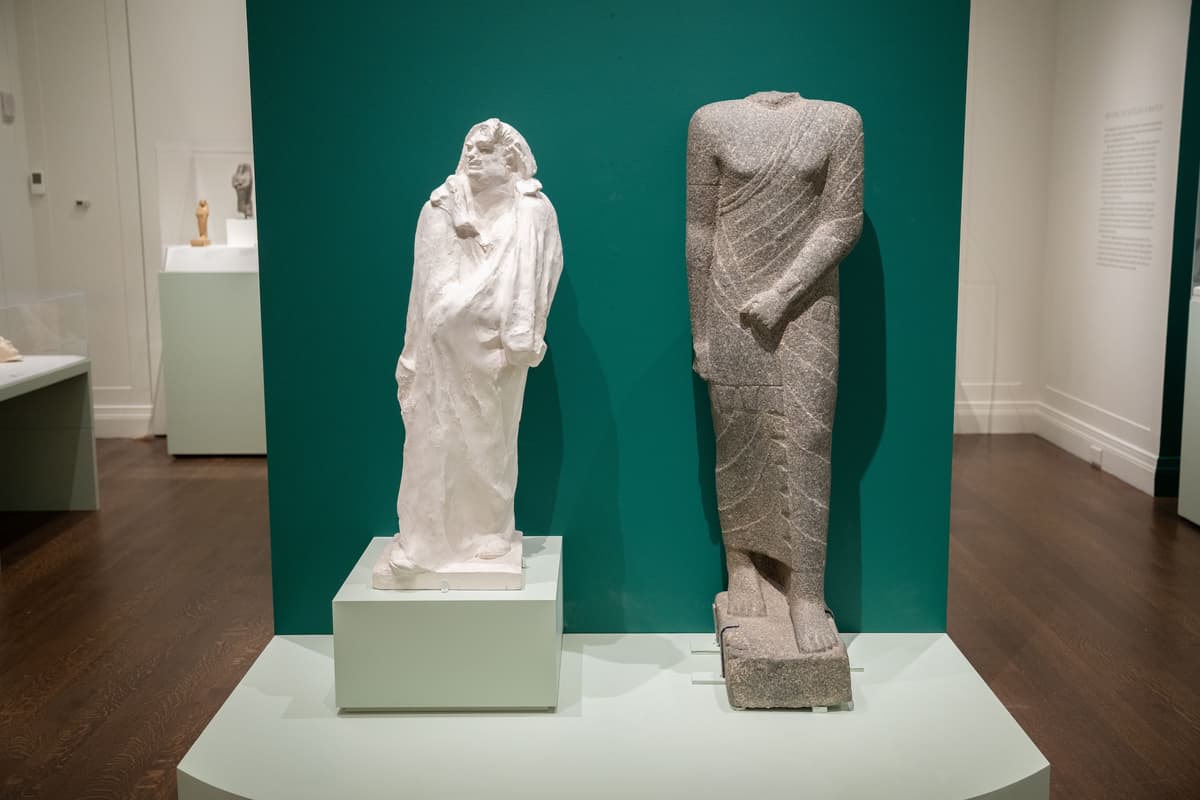
Institute for the Study of the Ancient World at NYU
Installation View of 'Rodin's Egypt.' Institute for the Study of the Ancient World at NYU

When news came in over the transom of an exhibition that would draw a connection between the work of French sculptor Auguste Rodin (1840-1917) and the art of ancient Egypt, many of us scratched our heads in puzzlement. 

The link between Rodin’s roughhewn effigies and the muscularity of Hellenistic sculpture is as plain as the Grecian nose on your face, but what could the creator of something as extravagant as “The Gates of Hell” (1880-1917) have in common with the regimented contours of a typical Egyptian reliquary?

A show at the Institute for the Study of the Ancient World at New York University, “Rodin’s Egypt,” comes to the Upper East Side courtesy Paris’s Musée Rodin, and through the offices of a curator in its employ, Bénédicte Garnier. Ms. Garnier has been hard at it for a decade-and-a-half, prompted, in no small part, by the collection of art and artifacts Rodin amassed during his lifetime. 

Of the 6,000 objects the sculptor had in his possession, more than a sixth consisted of items from Egypt. “Beyond anything,” Rodin averred, “Egyptian art attracts me; it is pure. An elegance of spirit adorns all its works.” Talk about putting your money where your mouth is.

“Rodin’s Egypt” comes on the heels of Ms. Garnier’s 2023 showcase at the Musée Rodin, “Rodin’s Dream of Egypt.” That show included some 400 items, a feat that the ISAW couldn’t match if it wanted, given its modestly scaled galleries. Still, an array of some 60 artifacts, sculptures, and out-and-out curiosities proves more than diverting and is sometimes provocative. I mean, what’s up with the eerie, flesh-like Hanako mask, a piece very unlike the majority of Rodin’s corpus?

“Hanako” was the stage name of Ōhta Hisa, a Japanese actress who spent a significant part of her career performing in Europe. In an essay included in the exhibition catalogue, an ISAW assistant curator, Carl Walsh, writes of how Rodin forewent a precise likeness of the kabuki performer, opting for something that embodied the range of emotions in her signature stage act, a re-enactment of ritual suicide, or hara-kiri. The mask was modeled with glass that had been crushed into a paste. The resulting patina is translucent and tender, seemingly capable of being bruised. Can you say that about “The Thinker”?

“Hanako Mask, Type E” is displayed between two funerary portraits from the Roman era, dating from between the years 100 and 150: The one is of a woman, the other a child. Both were culled from Rodin’s personal collection, and so it is with the rest of “Rodin’s Egypt,” barring a loan or three from the Metropolitan Museum of Art. 

Auguste Rodin, ‘Le Succube’ (1888). Via Musée Rodin

The pieces are displayed in order to underline correspondences of form and subject, among the most striking being the pairing of “Le Succube” (1888), a bronze that has the compressed energy of a fist, and a diminutive model of a considerably less torsioned sphinx from the Ptolemaic period.

The discrepancies between the two pieces are evident, but this is less the case with the juxtaposition of “Torse de Jeune Femme cambrée” (1909) and “Standing statue of King Nectanebo I” (380-365 B.C.). The Rodin piece is overscaled and expressionistic, coursing with an unnerving erotic energy. The surviving portion of King Nectanebo is given to a composure that corresponds to the cultural norms under which it was crafted. The naturalism of each piece is powered by a profound knowledge and appreciation of the human form. The conversation between the two is electric.

This kind of dynamism is absent from the ISAW’s second gallery — containing, as it does, Egyptian antiquities and only Egyptian antiquities — but that’s to say it’s merely sublime. Of peculiar interest is a fragment of a limestone relief, again from the Ptolemaic period, that features the image of a falcon on one side and rams on another. Rodin hired an artisan from the Japanese community at Paris, Kichizô Inagaki, to craft a proper armature in which it could be displayed. 

The grande éminence of French sculpture was enamored of Inagaki’s gifts, so much so that he scheduled a two-man exhibition of their work to be titled “Stone and Wood.” The advent of World War I put paid to that venture, and it is but one provocative byway amongst many in this jewel box exhibition.


The New York Sun

© 2025 The New York Sun Company, LLC. All rights reserved.

Use of this site constitutes acceptance of our Terms of Use and Privacy Policy. The material on this site is protected by copyright law and may not be reproduced, distributed, transmitted, cached or otherwise used.

The New York Sun

Sign in or  create a free account

or
By continuing you agree to our Privacy Policy and Terms of Use