New South Korean Leader Presses Case Against Predecessor While Seeking Closer Ties With North Korea

A sign of the shifting outlook toward North Korea is the government’s desire to describe North Korea not as the South’s ‘main enemy’ but simply as a ‘threat.’ This despite the North increasing its military commitments to Russia.
Suh Myung-geon/Yonhap via AP
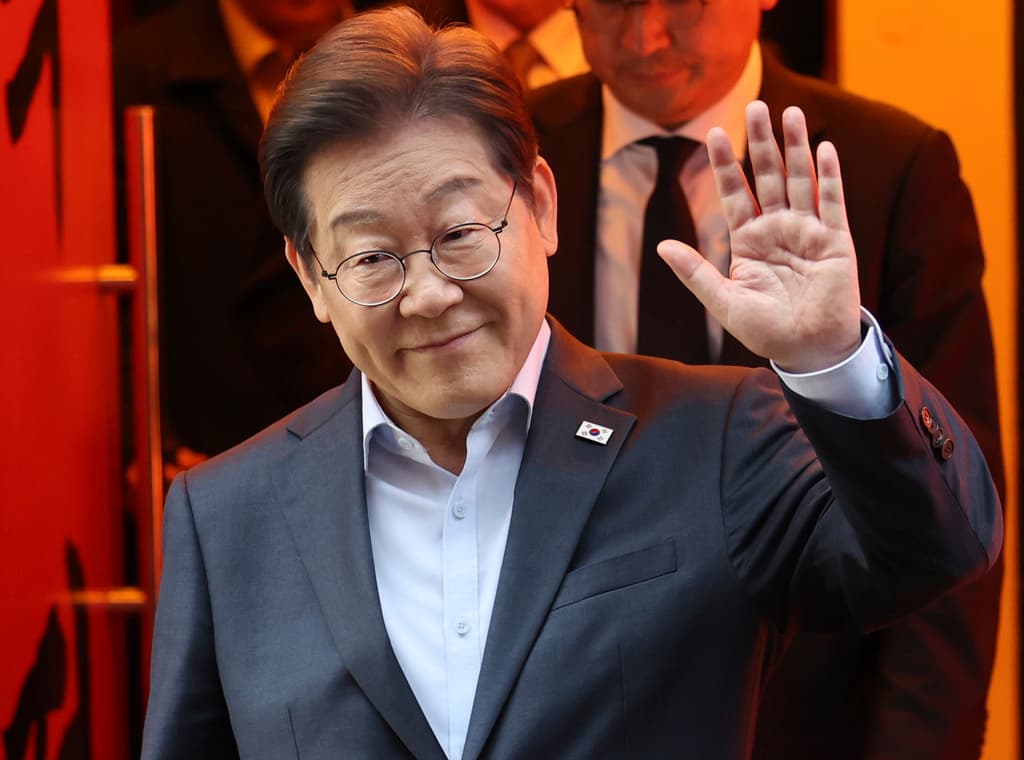
South Korea's new president, Lee Jae-myung, campaigning at Seoul, May 1, 2025. Suh Myung-geon/Yonhap via AP

South Korea’s new president, Lee Jae-myung, is looking for vengeance against his disgraced predecessor, Yoon Seok-yul, while longing for reconciliation with North Korea.

Mired in corruption scandals dating from his years as a provincial governor and city mayor, Mr. Lee and his leftist allies are counting on a court to find the conservative Mr. Yoon guilty of insurrection for his abortive attempt at imposing martial law in December. They have expanded the case against Mr. Yoon after persuading the court to jail him a second time after a four-month respite.

In a test of strength between South Korea’s leftists and rightists, leftist investigators and prosecutors are demanding Mr. Yoon submit yet again to questioning despite his repeated refusal to respond.

The betting is that the court will impose a lengthy prison term on Mr. Yoon regardless of what he says at a trial that could simmer on for months if not years while prosecutors also turn against his leading confederates, notably his former defense minister, also in jail. The defense minister and top military and police officers are accused of having convinced Mr. Yoon of the need for declaring martial law as the way to destroy Mr. Lee and his Minju, or Democratic Party, which controls the national assembly.

The case is dividing a society in which Mr. Yoon gained widespread support for tightening bonds with Tokyo and Washington before his failure to repress his leftist foes.

A right-wing Korean American professor, Morse Tan, who served as ambassador at large at the Department of State during the first Trump presidency, has just arrived at Seoul, looking into claims that “fraud” helped loft Mr. Lee to the presidency in the “snap election” last month after Mr. Yoon’s ouster.

Mr. Tan is meeting with Korean conservatives, who claim that authorities are repressing any investigation into the results of the election in which Mr. Lee easily defeated his conservative opponent. Mr. Tan, along with many other conservative critics, believes that China played an active role in influencing voters to oppose conservatives while actually rigging the balloting.

For Mr. Lee, leaving the case against Mr. Yoon to his prosecutors, the deepest challenge is to overcome years of confrontation with North Korea, whose leader, Kim Jong-un, has not only strengthened his alliance with Russia’s president but is also improving ties with China’s. Mr. Lee would like to dispel the impression of three against three — North Korea, China, and Russia versus America and longstanding allies South Korea and Japan.

A sign of the shifting outlook toward North Korea is the government’s desire to describe North Korea not as the South’s “main enemy” but simply as a “threat.” The incoming unification minister, Chung Dong-young, said at an assembly hearing he did not agree when asked if North Korea was an “enemy.”

Mr. Lee, however, faces strong opposition to attempts at inter-Korean reconciliation in the aftermath of a visit to Pyongyang by Russia’s foreign minister, Sergey Lavrov, during which Mr. Kim promised to expand his armed support for Russia in terms of both manpower and weapons.

One dividend of the visit: agreement to send thousands more North Korean troops to Russia in the next few years and also to manufacture drones to Russian specifications. “They will have a range of 800 miles,” a South Korean conservative commentator, who asked not to be identified, tells the Sun. “They can hit anywhere in the South and also in Japan.

The Times of London, reporting from Kyiv, quoted Ukraine’s military intelligence arm as stating: “Cooperation with Russia has offered North Korea broad opportunities to modernize its armed forces,” significantly increasing “the threat to the U.S. and its regional allies — South Korea and Japan.”  The report said it was “highly likely” that North Korea’s “willingness to use military force in its foreign policy will grow.”


The New York Sun

© 2025 The New York Sun Company, LLC. All rights reserved.

Use of this site constitutes acceptance of our Terms of Use and Privacy Policy. The material on this site is protected by copyright law and may not be reproduced, distributed, transmitted, cached or otherwise used.

The New York Sun

Sign in or  create a free account

or
By continuing you agree to our Privacy Policy and Terms of Use