Newsom, Flipping Democratic Article of Faith, Backs Rich States Over Ones on ‘Welfare’
‘Seventy-one percent of the country’s GDP,’ the governor says, ‘comes from blue counties.’
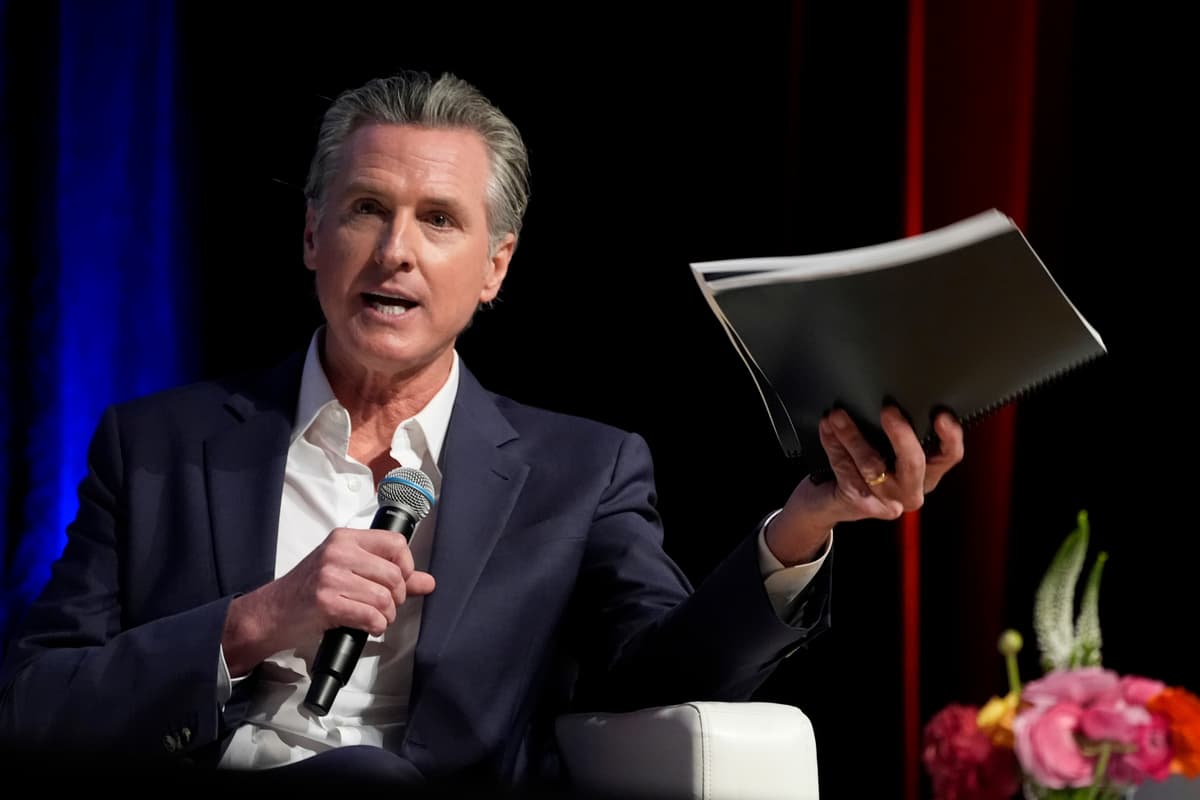
Governor Newsom is reversing the Democratic Party’s stance that the rich don’t pay enough taxes. Saying on Monday that blue state donors “support” red “welfare states,” the Californian lurched into the issue of fairness with remarks 180 degrees out of phase with his party’s stance on wealthy individuals.
“California,” Mr. Newsom told a podcaster, Shawn Ryan, “provides $83.1 billion more than we receive from the federal government.” Texas, he said, “receives $71.1 billion more than they” give. The Lone Star State’s GDP was $2.7 trillion in 2024 against California’s $4.1 trillion, according to the Bureau of Economic Analysis.
Mr. Newsom said that “nine out of 10 of the donor states are Trump states,” later referring to them as “dependent states,” and “welfare states.” Although he said, “I don’t mean that pejoratively,” he referred to President Trump as “a son of a b—” for the “Newscum” nickname.
“Seventy-one percent of the country’s GDP,” Mr. Newsom said, mocking critics, “comes from blue counties, these same crack-up counties with all these crazy liberals that can’t get out of their own … way and the world’s come to an end. It’s 71 percent of the economy.”
Mr. Newsom sounded a lot like the caricature Democrats often paint of their opponents when talking about income tax rates. Republicans, they tell us, want “tax cuts for the rich,” when the moral thing to do is squeeze them for more because they’re not paying “their fair share.” It’s an argument based on envy that ignores inconvenient facts.
IRS data released in November show that the top 1 percent of earners paid 40 percent of all federal income tax in 2022 at an average rate of 25.09 percent. The bottom 50 percent, taxed at a 3.74 percent average, contributed just 3 percent.
Divided into equal parts, the top 50 percent of wage earners account for 97 percent of all income tax receipts. Their rate averaged 15.87 percent, more than four times what those in the bottom half paid to deliver the remaining revenue.
Mr. Newsom’s complaints about wealthy states paying too much are as old as the republic. Coming out of the Revolutionary War, some states were deep in debt after funding their part in the fight for independence. Others had come through the crisis without bankrupting themselves.
Solving this problem was a top priority if the states were to be united in fact as well as name, but the federal government had to tread with care. Americans in New England had little in common with those in the Carolinas and neither had kinship with those on the frontier. They felt no obligation to share each other’s burdens.
In President Washington’s Cabinet, the Treasury secretary, Alexander Hamilton, floated a solution: The Compromise of 1790. It called for the federal government to assume all that red ink from the 13 states so they could start the American experiment on equal footing with clean financial slates.
Some northern states, where the bulk of fighting had occurred, were struggling to pay back foreign creditors. Virginia was almost debt-free; so President Madison, then a congressman, opposed Hamilton’s idea for the same reason that those who paid their student loans bristled at President Biden’s forgiveness proposal.
President Jefferson, then secretary of state, invited Madison and Hamilton over for a parley. In what became known as the Dinner Table Bargain, they found agreement on the debt and fixed the future capital city’s future location in part of Virginia. Hamilton’s plan, which Congress had rejected twice, passed on the third try.
Over the course of 250 years, resentment between states has lingered as it has between rich and poor. Some people are blessed with looks and opportunity. Some states have ports, natural resources, and population. Los Angeles County alone has more people than 40 states. Equality of opportunity can be guaranteed, not equal results.
“I’m … proud of my state,” Mr. Newsom said. The other stars on the flag have much to boast about, too, as do Americans who build wealth. Rather than pitting them against each other, the governor might sit down at Jefferson’s dinner table and promote fair, consistent policies that strengthen the country instead of dividing it.
___________
Correction: Shawn Ryan is the name of the podcaster. An earlier version contained a misspelling.