
Norman Rockwell’s Family Says Artist Would Be ‘Devastated’ by Use of His Iconic Work by DHS
DHS says it ‘will continue using every tool at its disposal to keep the American people informed as our agents work to Make America Safe Again.’
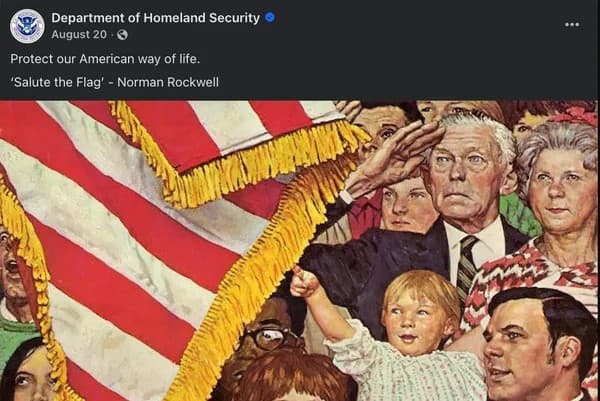
The family of famed Americana artist Norman Rockwell is railing at the Department of Homeland Security for using the painter’s iconic artwork in social media posts, saying that he would be “devastated” to see his work being used “for the cause of persecution.”
In an opinion piece for USA Today, Rockwell’s son, along with his grandchildren and great-grandchildren, expressed their outrage over DHS using three of his paintings in a series of posts on various social networks, saying they “appeared without authorization” from the estate.
The family says it is less offended by any potential copyright infringement than by the labels that DHS appended to the images.
“Protect our American way of life,” reads the label under one painting showing more than a dozen almost all-white Americans standing under the Stars and Stripes as they pledge allegiance.
In another painting used by DHS, “construction workers crawl ant-like over a close-up of the upraised torch in the hand of the Statue of Liberty,” according to the family. In the third, “a craggy Daniel Boone in raccoon-skin cap gazes off into the distance against a purple background, cradling his rifle.”
The offending labels, the family says, are “Manifest Heroism” and a quote from Calvin Coolidge: “Those who do not want to be partakers of the American spirit ought not to settle in America.”
The family says the scarcity of people of color in Rockwell’s paintings “has led those who are not familiar with his entire oeuvre to draw the conclusion that his vision was of a White America, free of immigrants and people of color.”
“But nothing could have been further from the truth.”
The artist was “profoundly shaken” during the Civil Rights Movement and became motivated to speak out against racism, the family says.
In January 1964, Rockwell’s painting “The Problem We All Live With” appeared in Look magazine, one month before his 70th birthday. The work was inspired by the experience of Ruby Bridges, a 6-year-old girl who, in 1960, was escorted by federal marshals to integrate her New Orleans public school.
The painting depicts a young black girl flanked by several U.S. marshalls walking past a wall bearing a scrawled racial epithet and splattered stains from rotten tomatoes that had been thrown in her direction.
“But perhaps most haunting of all is that title: ‘The Problem We All Live With,’” the Rockwell family said in the opinion piece. “An eternal present tense, inviting us to engage with the ravages of racism in our society, to open our eyes to the injustice and violence.”
“If Norman Rockwell were alive today, he would be devastated to see that not only does the problem Ruby Bridges confronted 65 years ago still plague us as a society, but that his own work has been marshalled for the cause of persecution toward immigrant communities and people of color.”
DHS officials appear unmoved by the family’s criticism. In a statement provided to the Hill, the agency said it “will continue using every tool at its disposal to keep the American people informed as our agents work to Make America Safe Again.”