North Korea Open to Another Trump Summit Even as It Stands Firm Against Denuclearization
While another meeting with Kim Jong-un could burnish Trump’s case for a Nobel Peace Prize, the president needs to recognize that times have changed since he last saw Kim more than six years ago.
North Korea is now indicating it’s open to talking to President Trump — a step that could enhance his campaign for a Nobel Peace Prize.
The younger sister of North Korea’s leader, Kim Jong-un, who often enunciates policies on his behalf, came out with a surprisingly pleasant, almost sentimental perspective on the bond formed between Messrs. Kim and Trump during their meetings in 2018 and 2019.
In a statement published in English by Pyongyang’s Korean Central News Agency, Kim Yo-jong, in her role as vice department director of the central committee of the ruling Workers’ Party, said, “I do not want to deny the fact that the personal relationship between the head of our state and the present US president is not bad.”
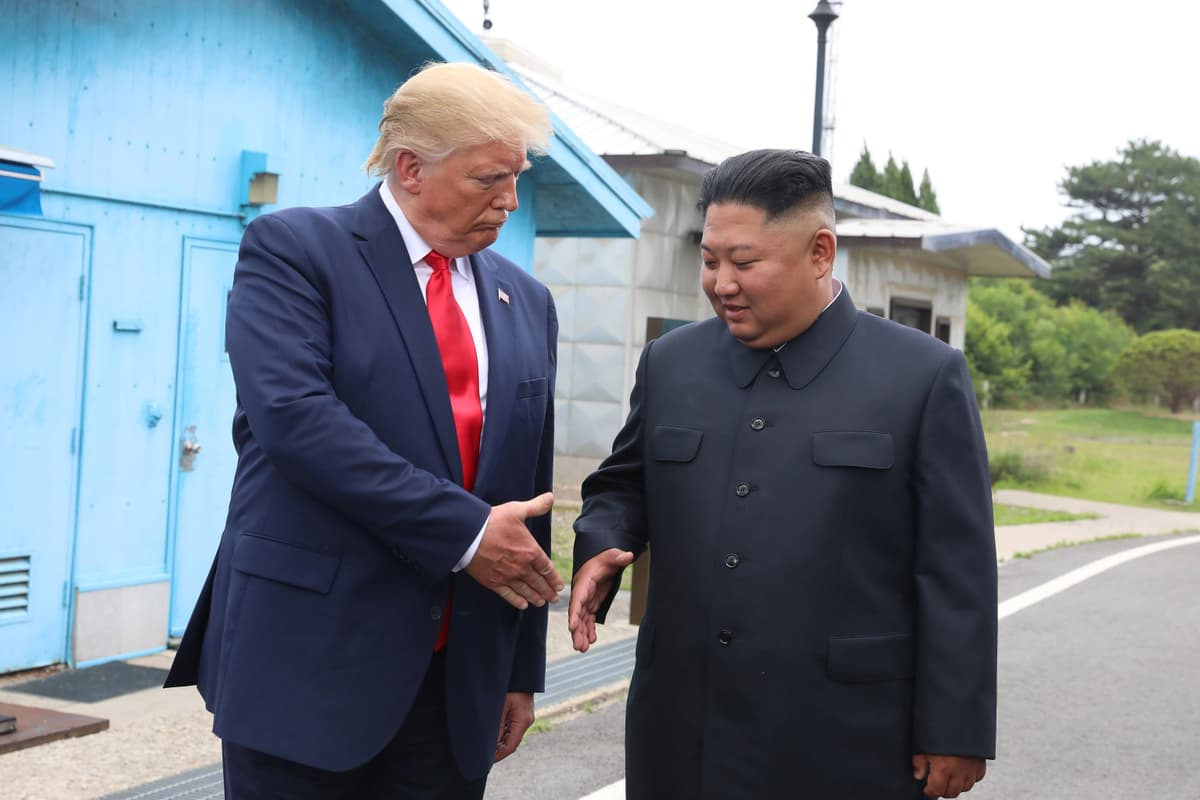
For a woman who has slashed at American and South Korean leaders for years, that line all but acknowledges that her brother shares the ”love” that Mr. Trump has said they formed at their first summit in Singapore in June 2018. Not even the failure of their second summit, at Hanoi in February 2019, or their brief, impromptu meeting at Panmunjom on the North-South line in June 2019 seems to have diminished her brother’s affection for the American president.
There is at least one catch: North Korea is no more willing to consider giving up its nuclear weapons now than it was at any of those summits. “The recognition of the irreversible position of the DPRK [Democratic People’s Republic of Korea] as a nuclear weapons state and the hard fact that its capabilities and geopolitical environment have radically changed should be a prerequisite for predicting and thinking everything in the future,” she stated. “No one can deny the reality and should not misunderstand.”
That statement lets Mr. Trump know that if he does again meet with his old pal, Mr. Kim, he’s not going to come out of it with anything more than a statement of their great friendship, and possibly a vague promise to work together for a “nuclear-free” Korean peninsula.
For Mr. Trump, the advantage might be that the Nobel Prize committee at Oslo — which gave the Nobel to South Korea’s late president, Kim Dae-jung, after he met Mr. Kim’s father, Kim Jong-il, in the first North-South summit in June 2000 — would no doubt be impressed by another Trump-Kim summit.
Ms. Kim went to great lengths to appear firm but conciliatory, which is enough, perhaps, to keep the prospect of a fourth Trump-Kim summit alive.
“There should be a minimum judgment to admit that it is by no means beneficial to each other for the two countries possessed of nuclear weapons to go in a confrontational direction,” she stated. ‘If so, it would be advisable to seek another way of contact on the basis of such new thinking.”
She did not, however, want to raise false hopes.
“If the personal relations between the top leaders of the DPRK and the United States are to serve the purpose of denuclearization,” she said, “it can be interpreted as nothing but a mockery of the other party.” She added: “If the United States fails to accept the changed reality and persists in the failed past, the DPRK-US meeting will remain as a ‘hope’ of the US side.”
Mr. Trump appears caught between the dream of inter-Korean rapprochement and the undying Korean-American alliance, dating from the Korean War that ended in an armistice signed at Panmunjom 72 years ago, July 27, 1953. On the anniversary Sunday, he proclaimed the alliance “ironclad” but has said on several occasions he would like to meet Mr. Kim again and resume the dialogue.
Toward that end, he has the support of South Korea’s new liberal president, Lee Jae-myung, who’s been firmly rebuffed in his own quest for a summit with Mr. Kim but would welcome whatever Mr. Trump can do. One byproduct of the process could be that Mr. Trump may withdraw some of America’s 28,500 troops from Korea and forgo intense joint exercises with the South Koreans — moves that the South’s left-leaning president may endorse.
With visions of a Nobel, however, Mr. Trump needs to recognize that times have changed since he last saw Mr. Kim more than six years ago. “Any attempt to deny the position of the DPRK as a nuclear weapons state,” Ms. Kim said, “will be thoroughly rejected.” To which she added, not closing the door to dialogue, “The DPRK is open to any option in defending its present national position.”