Not Just Decorations: Stolen Halloween Skeleton Bares Hidden Cost When Crime Breaches the Social Contract

We commonly talk about public safety in terms of violent crime, patrol strength, and policy. Yet cities depend just as much — perhaps more — on something quieter: shared norms of restraint.

Jena Ardell/Getty Images
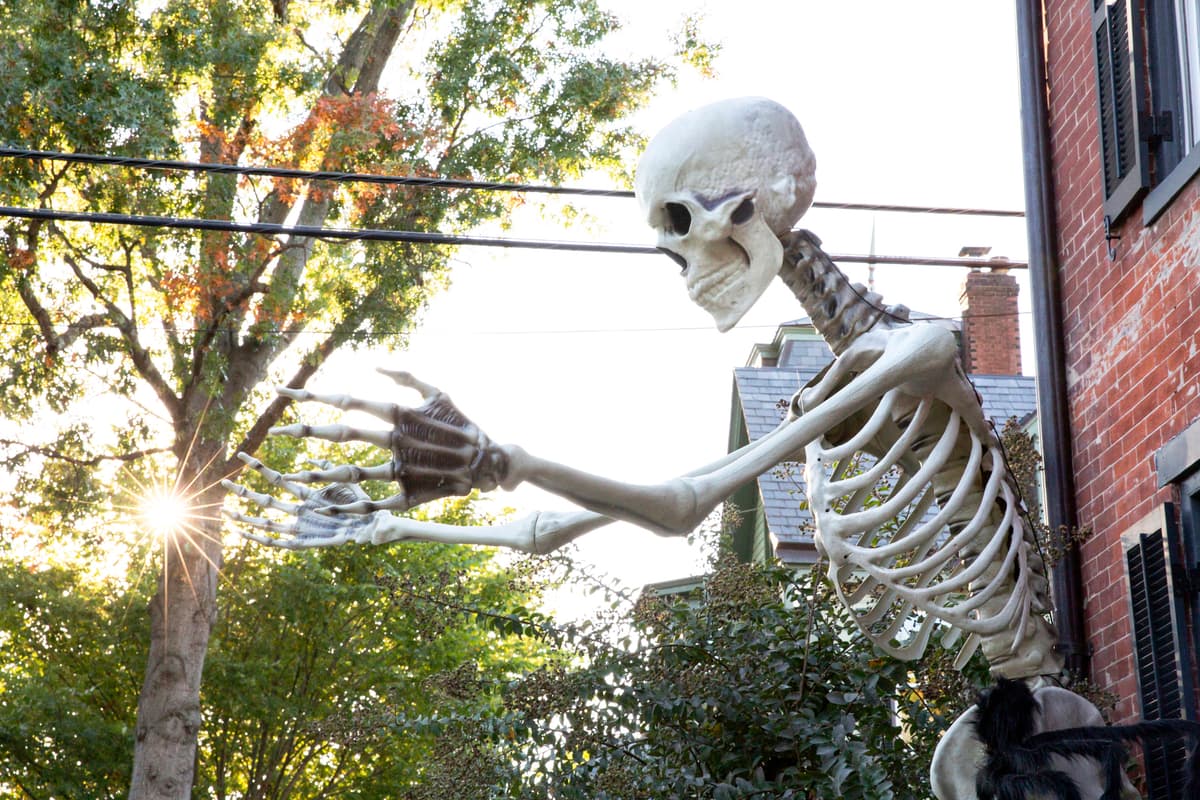
Halloween decorations, including a 12-foot skeleton. Jena Ardell/Getty Images

Last weekend, my son and I finally set up the Halloween display he had been waiting for since summer. 

Months ago, he had picked out a twelve-foot skeleton — three times as tall as he is — from a big-box retailer and he talked about it constantly: where it would stand, how we would secure it, how the neighborhood children would react. 

When we brought the giant box up from storage, he was euphoric, directing the assembly with the seriousness and precision of an engineer. We spent nearly an hour clicking each bone into place. 

Then we strung warm orange lights along the railing and hung two gauzy white ghosts that fluttered when the breeze moved through the street. 

When we stepped back, he looked at it with a quiet, satisfied pride. We had created something joyful and public together — something that announced: we live here, and we care. Happy Halloween.

By morning, everything was gone. The lights torn down. The ghosts taken. The twelve-foot skeleton — this huge plastic colossus that excited him for months — vanished completely.

To my surprise, my son didn’t shout. He didn’t rage. He just stared, confused, and then cried in the stunned way a child cries when he learns something the world had been postponing. 

He asked, “Why would someone take it and ruin our display before the holiday?” I had no real answer that I could share with him. He wanted to call the police and I made excuses for not calling them, knowing full well that calling the police would have been pointless. The city has made it clear what is enforceable and what is merely regrettable. A child’s anticipation belongs to the latter category.

The sidewalk that day was still damp from the night’s rain. Leaves stuck to the concrete. A neighbor walking her dog gave a sympathetic nod — the kind that acknowledges something happened but stops short of asking. The quiet made the absence feel heavier.

We commonly talk about public safety in terms of violent crime, patrol strength, and policy. Yet cities depend just as much — perhaps more — on something quieter: shared norms of restraint. 

The understanding that we leave intact the small things others care about. A planter. Chalk drawings. A child’s seasonal display. These gestures of care are what tell us we live among neighbors, not strangers.

And crucially, as James Q. Wilson observed, order is upheld not only by rules and enforcement, but by “countless small, informal controls” exercised by ordinary people — controls so woven into daily life that we notice them only when they fray.

That fraying is visible everywhere. The pandemic accelerated retreat into private worlds. Headphones on, eyes averted, street life treated as background rather than belonging. Without shared presence, shared responsibility evaporates. And without shared responsibility, the public realm slowly becomes no one’s concern.

Halloween, of all occasions, should resist that. It is one of the last civic rituals that asks strangers to trust one another; children knock on doors, and adults answer not as individuals, but as neighbors. The decorations are the signal that such trust is still possible. When those vanish, the ritual thins too.

People will say: these were just decorations. But the scale of an act is not the same as its meaning. A city that cannot protect the smallest expression of childhood delight will not protect the larger, harder things either: trust, cooperation, shared purpose. Civic life erodes from the edges inward.

My son did not cry over plastic bones. He cried because he learned something about the city he lives in — that what he built with care could be undone without consequence. That lesson, absorbed young, becomes a posture toward the world.

So we rebuilt. I had to take a stand even if it cost me some money that wasn’t budgeted. 

Not because it solved the civic problem. And not because the replacements were safer. But because my son needed to see that we do not withdraw from public life simply because someone else has. 

We bought new lights, two more ghosts, and — though it could not replace the first — a new skeleton. This one was a little crooked, slightly absurd, and it made him laugh again. We assembled it slowly. The joy this time was quieter, but steadier.

Cities endure not when everything is protected, but when people insist on caring anyway. The real work of civic repair begins on the block, in the ordinary willingness to maintain the shared world.

When we finished rehanging the lights, dusk was settling in. The new skeleton stood — imperfect, shorter than before and a little off-kilter, but it was ours. My son stepped back, hands in his pockets, and nodded once, as if to say: this is still worth doing.

The lesson wasn’t that decorations can be taken.

The lesson was that we put them up again.


The New York Sun

© 2025 The New York Sun Company, LLC. All rights reserved.

Use of this site constitutes acceptance of our Terms of Use and Privacy Policy. The material on this site is protected by copyright law and may not be reproduced, distributed, transmitted, cached or otherwise used.

The New York Sun

Sign in or  create a free account

or
By continuing you agree to our Privacy Policy and Terms of Use