Nuclear Proliferation Raises Risks of Atomic Conflict 80 Years After Hiroshima
How much longer can the world’s luck hold?
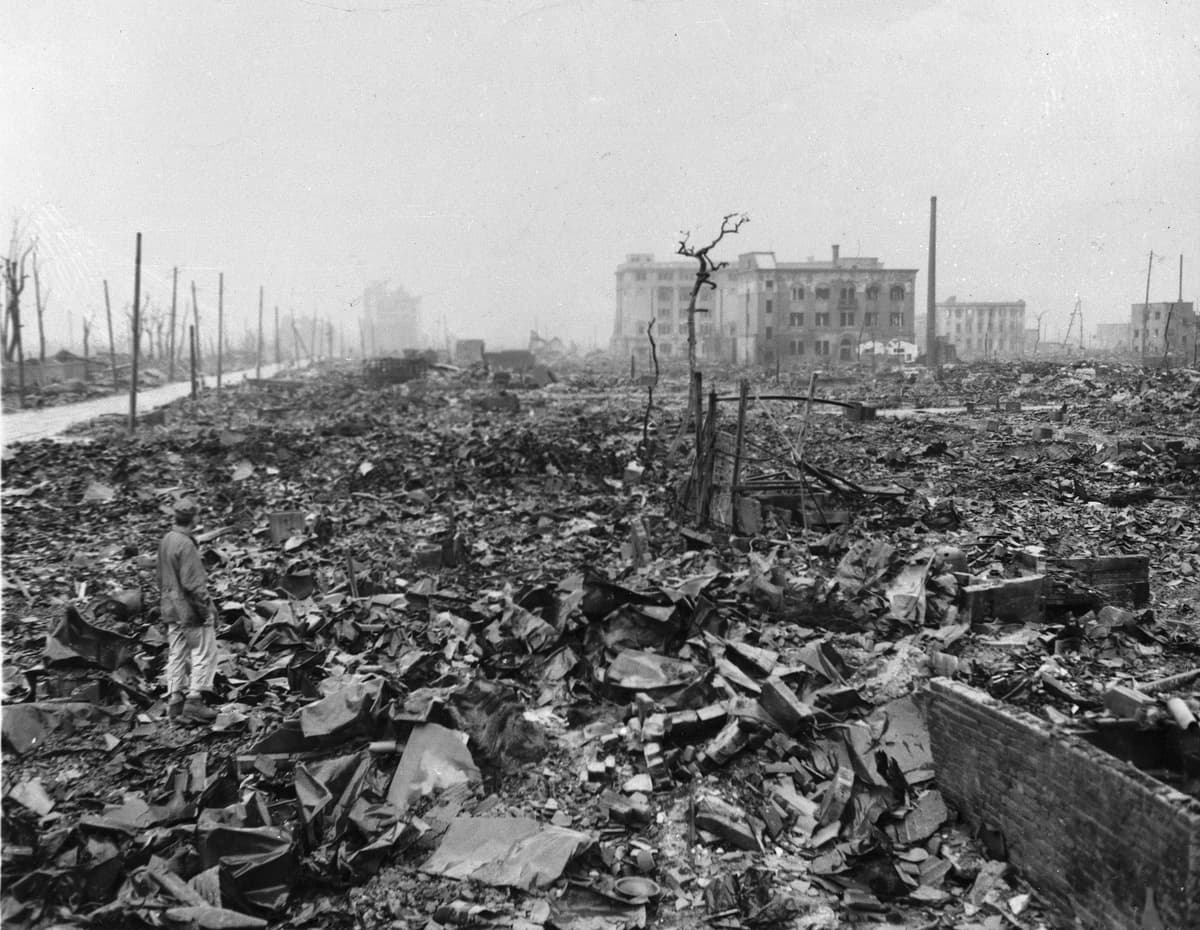
As was his wont on long flights, Colonel Paul Tibbets, piloting a B-29, puffed on his pipe as, 80 years ago Wednesday, he transported humanity from one geopolitical era to another. His radio operator was watching for an “abort” signal if Japan surrendered before the B-29 reached its target.
Historian Antony Beevor, writing in Foreign Affairs, noted that Hiroshima and Nagasaki effectively ended “the first modern conflict in which far more civilians were killed than combatants.” Which suggests that technological virtuosity advanced as morality regressed.
Yet, Mr. Beevor wrote, Japan’s military government was “prepared to sacrifice millions of Japanese civilians by forcing them to resist an Allied invasion with only bamboo spears and explosives strapped to their bodies. By 1944, some 400,000 civilians a month were dying from famine in areas of East Asia, the Pacific, and Southeast Asia that were occupied by Japanese forces.”
Mr. Beevor added, “The Allies also wanted to save the American, Australian, and British prisoners of war who were starving to death in Japanese camps — or being slaughtered by their captors on Tokyo’s orders.”
Five months before Hiroshima, a single night of incendiary American bombing killed 100,000 in Tokyo. Two atomic bombs probably reduced the war’s quantity of violence and death. Consider this when reading M.G. Sheftall’s “Hiroshima: The Last Witnesses,” which chronicles the end of what he calls civilization’s “prenuclear innocence.”
In a March 21, 1963, news conference, five months after the Cuban missile crisis, President Kennedy said, “Personally, I am haunted by the feeling that by 1970 … there may be 10 nuclear powers instead of four, and by 1975, 15 or 20.”
Although that did not happen, nuclear proliferation could result from President Trump’s McGovernite “come home, America” impulse, his disdain for allies and skepticism about alliances. Nations, from South Korea to Poland, that no longer feel protected under the American nuclear umbrella might want their own.
Mr. Trump’s vice president recently said the eruption of military violence between two implacably hostile nuclear powers, India and Pakistan, was “fundamentally none of our business.” Oh? The United States has no serious stake in preserving the eight-decade norm against crossing the nuclear threshold? Did Vice President Vance think Iran’s nuclear ambitions were “fundamentally” none of our business when the administration of which he is an adornment sent the B-2s to Iran?
The war-shattered Soviet Union was prostrate when in August 1949 — just 51 months after the May 8, 1945, end of World War II in Europe — it detonated a nuclear weapon. China was a preindustrial peasant society with a per capita annual income of $85.50 when it became a nuclear power in 1964. Pakistan had a per capita annual income of $424 when it became one in 1998. North Korea struggles to make shoes but is making missiles to deliver its nuclear weapons intercontinental distances.
Any sufficiently determined nation can acquire the know-how to join the nuclear club. Iran has been seriously determined for decades. And when have economic sanctions caused a large nation (Iran’s population: 92.5 million) to surrender what it considered a vital national security interest? So, perhaps only serious military action — war — can keep Iran out of the nuclear club.
Iran might reasonably think that if Saddam Hussein had acquired nuclear weapons, Iraq would still hold Kuwait. Various potential nuclear powers have recently seen Vladimir Putin demonstrate the utility of possessing nuclear weapons: The Russian president has inhibited some forms of assistance to Ukraine by intimating the possible use of such weapons (e.g., moving some into Belarus).
Johns Hopkins University’s Hal Brands said, “China’s nuclear force doubled between 2020 and 2023.” He says there is “an autocratic bloc more cohesive than anything the United States has faced in generations.” Three members (Russia, China, North Korea) are nuclear powers.
Iran might become a fourth. In 2004, President George W. Bush’s national security adviser, Condoleezza Rice, said the “international community” would not “allow the Iranians to develop a nuclear weapon.” In 2012, President Obama said: “I do not have a policy of containment. I have a policy to prevent Iran from obtaining a nuclear weapon.” Seven years ago, Mr. Trump said, “There is no longer a nuclear threat from North Korea.”
Thucydides said three things cause wars: honor, fear, and interest. Come Wednesday, 29,220 days will have passed since the first use of a nuclear weapon, and 29,217 since the second. What in humanity’s carnage-strewn history of honor-driven angers, rational and irrational fears, and ideologically defined interests suggests there will not be a third, and then others?
The Washington Post