

Philip Roth and the Battle Cry of the Jewish, Straight, White, Male Genius
A new biography takes the measure of one of the last century’s literary lions — a ‘wild man with Purell in his pocket.’
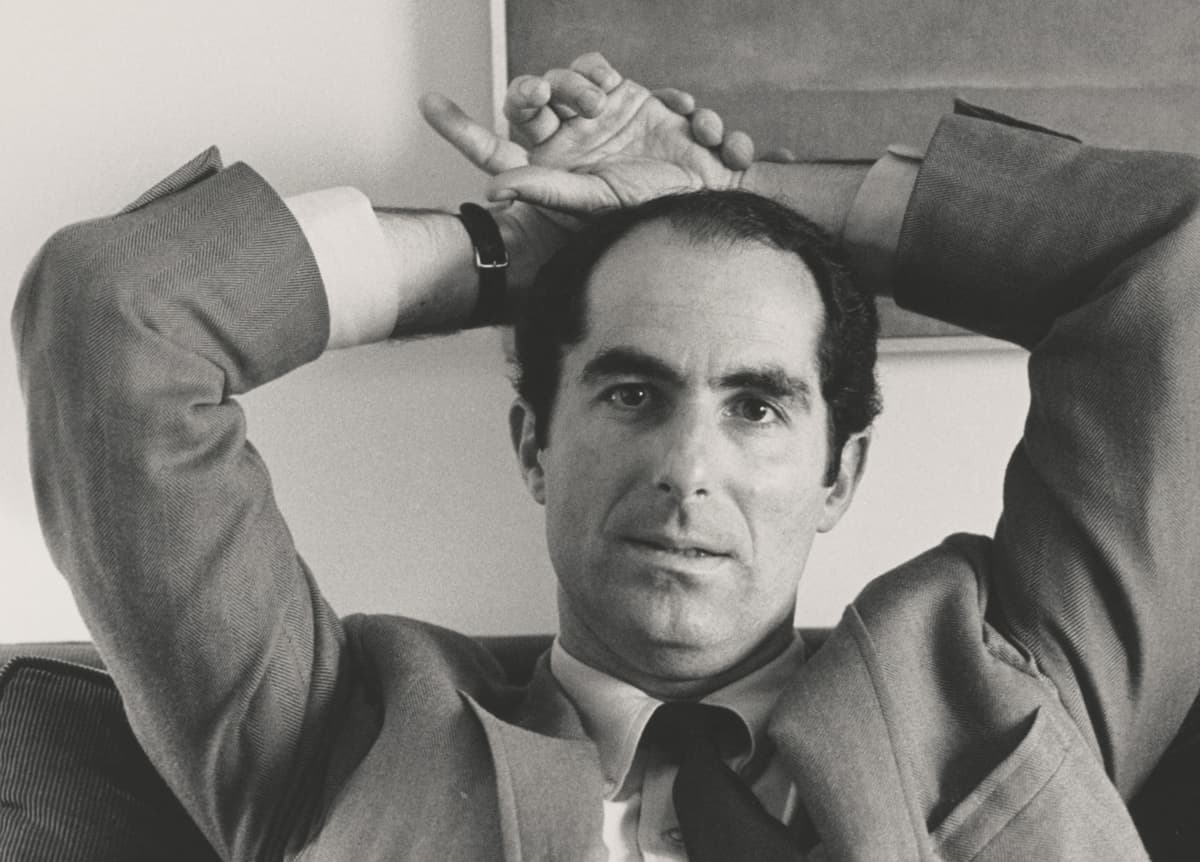
‘Philip Roth: Stung by Life’
By Steven Zipperstein
Yale University Press, 368 pages
The novelist Philip Roth has been dead less than a decade but his career already seems contemporary with the Tyrannosaurus Rex. The colossus of the 20th century is everything that is out of fashion in today’s demimonde: Jewish, white, male, straight. Yet a new biography by the Stanford scholar Steven Zipperstein makes the case that this dinosaur might have been the last literary giant. The critic Alfred Kazin credited him with altering the “literary weather.”
Mr. Zipperstein’s “Philip Roth: Stung By Life” is the latest entry in a troubled sequence of biographies of Roth. His handpicked Boswell was Ross Miller, the estranged nephew of the playwright of “Death of a Salesman” and “The Crucible.” Roth and Miller, though, had a bitter falling out. Next was Blake Bailey, who managed a 900-page doorstopper. The book was pulped by the publisher after Bailey was accused of rape.
Then there was Roth himself, for whom his own life was an endlessly renewable creative resource. He created a series of fictional alter egos — the most enduring of which was Nathan Zuckerman — and even a character named “Philip Roth.” Mr. Zipperstein’s svelte sally, part of Yale’s “Jewish Lives” imprint, delivers plenty of scoops and gossip. Its focus, though, is how Roth’s life fed his art. This is not only a writer’s life, but a writing life.
Mr. Zipperstein, who has written books about Ahad Ha’am, the Kishinev Pogrom, and the Jews of Odessa, is well-suited to present Roth’s life in a Jewish context. James Joyce’s biographer, Richard Ellmann, opposed the “erratic and provisional” surface of Joyce’s life with the “splendid extravagance” of his prose. Mr. Zipperstein relates that Roth’s friends considered him “a wild man with Purell in his pocket.”
The author of “Portnoy’s Complaint,” “American Pastoral,” “The Counterlife,” “The Ghostwriter” and some 25 other books was born at Newark in 1933, just across the water from the literary mandarins of Manhattan. The critic Mark Schechner, born in the same city a few years later, describes it as a place where “to be a hustler was a term of high praise, as high almost as being a mensch.” Like Joyce, Roth in his fiction returned endlessly to his hometown.
Roth’s formative years were the 1940’s, and there is about him none of the dissolution and drift that characterized the gurus and flower-petaled prophets of the 1960s. He was susceptible to the pull of a short skirt and a blonde bob, but also of the opposing force of tradition and conformity, of fathers and sons. The monk devoted to his craft and the bon vivant dedicated to the electric effect of desire coexisted in Roth, who insisted on writing two pages a day.
Mr. Zipperstein explains that Roth’s father Herman “broadcasted his loves (family, Newark, FDR, boxing, Israel) as loudly as his hatreds (Nixon, antisemitism, all criticism of Israel).” Roth called his father, about whom he would write the quietly devastating “Patrimony,” as “a cross between Captain Ahab and Willy Loman.” Roth would never have children, but his own childhood — its romps, repressions, and messy joys — proved literary gold.
Nowhere more than in “Portnoy’s Complaint,” from 1969. It was such a smashing success — its humor and obscenity have hardly dimmed after more than a half-century — that it earned Roth a date with Jackie Kennedy. Not bad for a boy from Weequahic, the Jewish section of Newark. Quoting it, one paper related, became a “national sport.” One reviewer called it a blend of “the Marx Brothers, ‘Catch-22,’ Lenny Bruce, Freud” and much else besides.
By 1971 there were three million copies of “Portnoy” in print. The critic Adam Kirsch calls its success “an unrepeatable feat … the result of a perfect cultural storm … America’s fascination with Jews and Jewish humor was at its peak.” The book was debated on talk shows and parodied in Mad Magazine. Along with the earlier “Goodbye, Columbus” it confirmed Roth as a star. He wrote many more masterpieces, and quite a few clunkers.
This critic, like all readers of Roth, has his favorites. “The Ghostwriter” is a flawless gem. “American Pastoral” rates not far beyond “Moby Dick” and “Huckleberry Finn” in the long running derby for the Great American Novel. “The Counterlife” and “Operation Shylock” are the best novels written about Israel by an American. “Sabbath’s Theater” is so strong and dark that it can feel like an unexpected sequel to “King Lear.”
“The Human Stain” remains the most powerful fictional treatment of campus pathologies and cancel culture on offer, three decades after it was written. Roth’s steely devotion, though, meant that he wrote whole bookshelves, and not all of them are crowded with masterpieces. Hillel Halkin judges that some of Roth’s early work lacks the “feeling given us by the best writing that no force on earth could have prevented it from being written.”
When Roth died in 2018 the scholar Ruth Wisse admitted that the “first fan letter I ever wrote was to Philip Roth in 1959.” She relates how she ultimately became disillusioned, because she grasped that “at the heart of his fiction … is distrust of Jewishness and secondarily of America as home to that Jewishness. Cold kasha … his work was never plainly happy in the way a well-matched bride and groom enchant family and guests at their wedding.”
Mr. Zipperstein lands at a different destination. He celebrates Roth’s prose as “forever luscious” and pointing toward the “stunningly complex, wondrous, and exasperating workings of the world.” The last word, though, ought to be Roth’s. In a late work, “Everyman,” Roth writes of the pleasures of swimming and that moment when from “the low slant of inland sunlight glittering across the water he knew it was time to go.”