

McLaren’s McL 6GT Brings Back the Manual Transmission
By ROSS ANDERSON
|From ‘A Midsummer Night’s Dream,’ a play whose speeches are full of poetry, and more than that: full of a writer’s palpable delight in making poetry, the deep pleasure of giving characters poetry to say.

Published:
Updated:
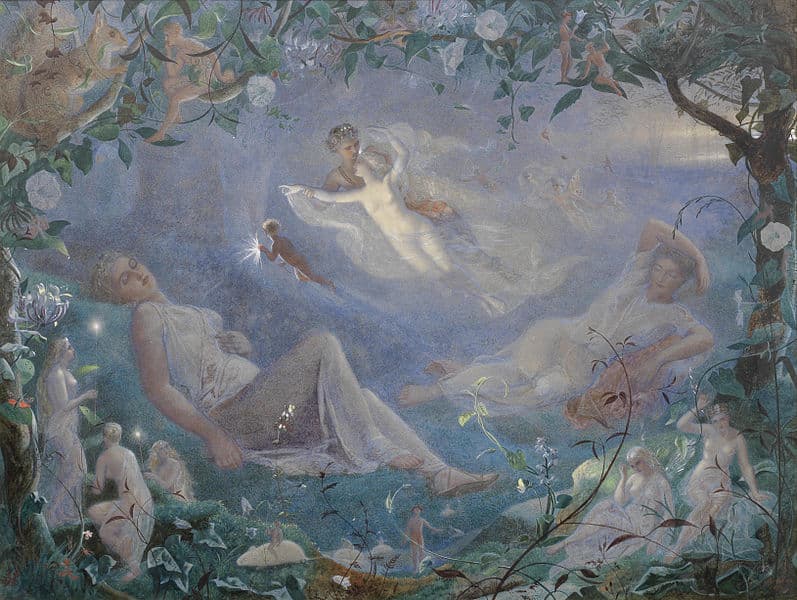
Here on the brink of Midsummer — June 24 this year, when the day stretches out to its longest at the solstice — what could be more fitting than a snippet from that heady supernatural revel by William Shakespeare (1554–1616), “A Midsummer Night’s Dream?” It’s a play whose speeches are full of poetry, and more than that: full of a writer’s palpable delight in making poetry, the deep pleasure of giving characters poetry to say.
Think, for example, of Act II, Scene I, and Titania’s exchanges with Oberon, who demands of her a changeling boy whom she has in her retinue. She keeps the boy, she says, for the sake of his dead mother, her friend and follower. What we savor first is not the sentiment but the language of it: the two women who “gossiped” in the “spicèd Indian air,” the pregnant girl who “with pretty and with swimming gait” would imitate the sails grown “big-bellied by the wanton wind.” Even as it opens a divide that will drive the play’s action, this speech constitutes the most beautiful no in all the English language.
Yet before Titania and Oberon cross paths, on this strange daylit night in the forest, their henchmen meet. The scene opens with Oberon’s sidekick, Puck. “How now, spirit?” Puck says to another fairy. “Whither wander thou?” The other fairy’s reply is today’s Poem of the Day, a speech whose rhymed tetrameter lines — in contrast to the five-foot blank verse that characterizes most of the play’s dialogue — clip along breathlessly, full of hurry, as he hastens to decorate the forest for his queen’s all-night dancing, feasting, and lovemaking.
By ROSS ANDERSON
|
By THE NEW YORK SUN
|
By THE NEW YORK SUN
|
By LUKE FUNK
|
By LUKE FUNK
|
By THE NEW YORK SUN
|
By BRADLEY CORTRIGHT
|
By GEORGE WILLIS
|Here on the brink of Midsummer — June 24 this year, when the day stretches out to its longest at the solstice — what could be more fitting than a snippet from that heady supernatural revel by William Shakespeare (1554–1616), “A Midsummer Night’s Dream?” It’s a play whose speeches are full of poetry, and more than that: full of a writer’s palpable delight in making poetry, the deep pleasure of giving characters poetry to say.
Think, for example, of Act II, Scene I, and Titania’s exchanges with Oberon, who demands of her a changeling boy whom she has in her retinue. She keeps the boy, she says, for the sake of his dead mother, her friend and follower. What we savor first is not the sentiment but the language of it: the two women who “gossiped” in the “spicèd Indian air,” the pregnant girl who “with pretty and with swimming gait” would imitate the sails grown “big-bellied by the wanton wind.” Even as it opens a divide that will drive the play’s action, this speech constitutes the most beautiful no in all the English language.
Yet before Titania and Oberon cross paths, on this strange daylit night in the forest, their henchmen meet. The scene opens with Oberon’s sidekick, Puck. “How now, spirit?” Puck says to another fairy. “Whither wander thou?” The other fairy’s reply is today’s Poem of the Day, a speech whose rhymed tetrameter lines — in contrast to the five-foot blank verse that characterizes most of the play’s dialogue — clip along breathlessly, full of hurry, as he hastens to decorate the forest for his queen’s all-night dancing, feasting, and lovemaking.
Cancel anytime
By continuing you agree to our Privacy Policy and Terms of Service.