

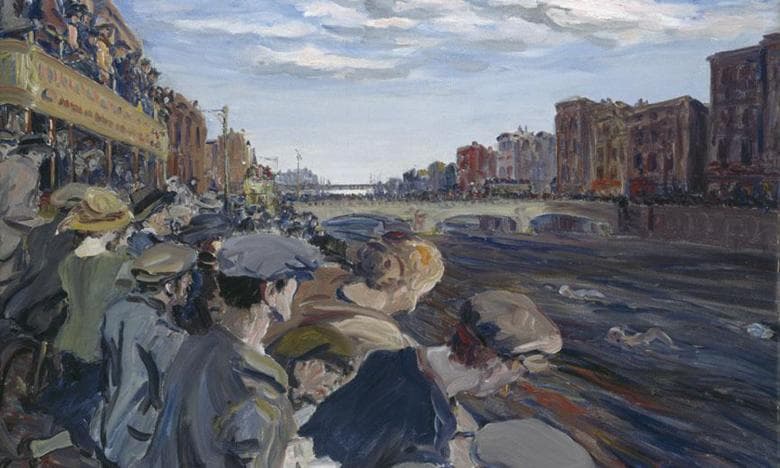
From ‘Dracula’ to ‘Ulysses,’ Ireland’s Literary Genius Enchants at New York’s Oldest Museum
By A.R. HOFFMAN
|George William Russell’s poem reflects that curiously delicate sadness of his era, which no other time in English poetry has ever quite matched.
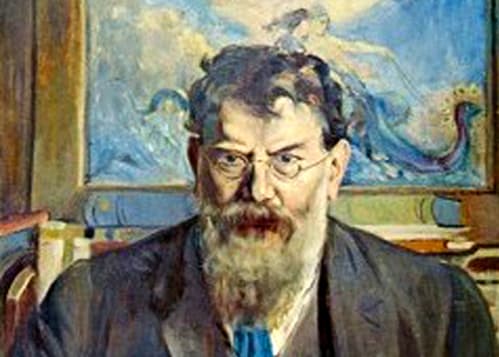
George William Russell (1867–1935), who wrote under the pseudonym “AE,” was an organizer for an Irish agricultural association, helping establish rural credit societies and cooperative banks. Along the way, he was also a painter, a publisher, a Nationalist patriot, and an advocate of theosophy (the cut-rate mysticism of Madam Blavatsky, which captured some attention from the goofy and the lonely in those fin-de-siècle days).
But it was as a figure in the Irish Literary Revival, from around 1890 to 1910, that he gained the most attention — primarily as a poet. A tour of America in the 1930s brought out crowds to applaud his work and buy his books, while he regaled those enthralled Americans with tales of famous Irish writers from William Butler Yeats to James Joyce.
In “Immortality,” today’s Poem of the Day, AE indulges a little of the kind of mysticism that he put in such poems as “By the Margin of the Great Deep.” A little of that love-is-life pop philosophy that he put in such poems as “Brotherhood.” And a whole lot of that curiously delicate sadness of the era, which no other time in English poetry has ever quite matched. In two quatrains of an interesting meter — three seven-foot lines, capped with a five-foot line — AE urges an unselfconscious dwelling within the “fire of love.”
By A.R. HOFFMAN
|
By JOSEPH CURL
|
By DONALD KIRK
|
By DAVID JONES
|
By ALEX ZDAN
|
By JOSEPH CURL
|
By DAVID JONES
|
By CARL ROLLYSON
|George William Russell (1867–1935), who wrote under the pseudonym “AE,” was an organizer for an Irish agricultural association, helping establish rural credit societies and cooperative banks. Along the way, he was also a painter, a publisher, a Nationalist patriot, and an advocate of theosophy (the cut-rate mysticism of Madam Blavatsky, which captured some attention from the goofy and the lonely in those fin-de-siècle days).
But it was as a figure in the Irish Literary Revival, from around 1890 to 1910, that he gained the most attention — primarily as a poet. A tour of America in the 1930s brought out crowds to applaud his work and buy his books, while he regaled those enthralled Americans with tales of famous Irish writers from William Butler Yeats to James Joyce.
In “Immortality,” today’s Poem of the Day, AE indulges a little of the kind of mysticism that he put in such poems as “By the Margin of the Great Deep.” A little of that love-is-life pop philosophy that he put in such poems as “Brotherhood.” And a whole lot of that curiously delicate sadness of the era, which no other time in English poetry has ever quite matched. In two quatrains of an interesting meter — three seven-foot lines, capped with a five-foot line — AE urges an unselfconscious dwelling within the “fire of love.”
Cancel anytime
By continuing you agree to our Privacy Policy and Terms of Service.
Cancel anytime