

Netanyahu Says Israelis Foiled ‘9/11-Style’ Attack as Israel, UAE Launch Joint Investigation
By JOTAM CONFINO
|This is not the London of tanners and chandlers, whores and beggars. At least for an instant, on one brilliant autumn morning, it is Wordsworth’s London: silent and shining, a vision.

Published:
Updated:
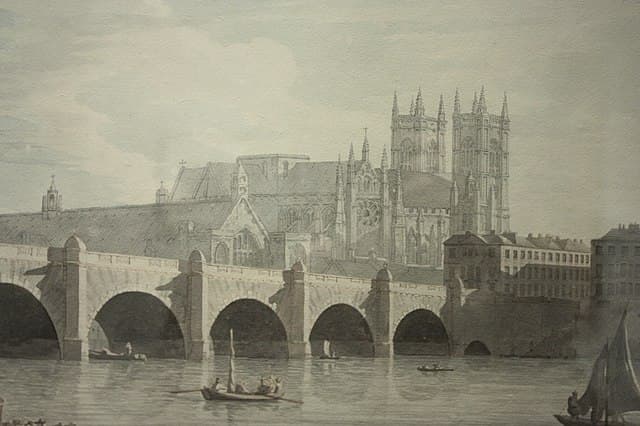
Begin with an outrageous claim, they say. For example: “Earth has not any thing to show more fair: / Dull would he be of soul who could pass by / A sight so touching in its majesty,” about London at the dawn of the nineteenth century, of all unlikely things. William Wordsworth (1770–1850) makes just that claim, of course, at the start of this famous sonnet, in which a sleeping cityscape early in the morning becomes charged with the sublime. The sonnet form is Italianate, with an abbaabbacdcdcd rhyme scheme, but the spirit is pure English Romantic exaltation. This is not the London of tanners and chandlers, whores and beggars. It is not the London of slop jars emptied into streets, not the London whose air Thomas Tryon once characterized as “unwholesome,” filled with “stinking, gross, sulphurous Smoaks.” At least for an instant, on one brilliant autumn morning, it is Wordsworth’s London: silent and shining, a vision.
By JOTAM CONFINO
|
By SHAILI SINGH
|
By DEAN KARAYANIS
|
By ALEX ZDAN
|
By A.R. HOFFMAN
|
By MATTHEW RICE
|
By STEPHEN MOORE
|
By MATTHEW RICE
|Begin with an outrageous claim, they say. For example: “Earth has not any thing to show more fair: / Dull would he be of soul who could pass by / A sight so touching in its majesty,” about London at the dawn of the nineteenth century, of all unlikely things. William Wordsworth (1770–1850) makes just that claim, of course, at the start of this famous sonnet, in which a sleeping cityscape early in the morning becomes charged with the sublime. The sonnet form is Italianate, with an abbaabbacdcdcd rhyme scheme, but the spirit is pure English Romantic exaltation. This is not the London of tanners and chandlers, whores and beggars. It is not the London of slop jars emptied into streets, not the London whose air Thomas Tryon once characterized as “unwholesome,” filled with “stinking, gross, sulphurous Smoaks.” At least for an instant, on one brilliant autumn morning, it is Wordsworth’s London: silent and shining, a vision.
Already have a subscription? Sign in to continue reading
Cancel anytime
By continuing you agree to our Privacy Policy and Terms of Service.
Cancel anytime