


Sylvia Plath and the Art That Flows From Rejection
By CARL ROLLYSON
|John Clare was a poetic outlier: the sole occupant of his own peculiar sphere.
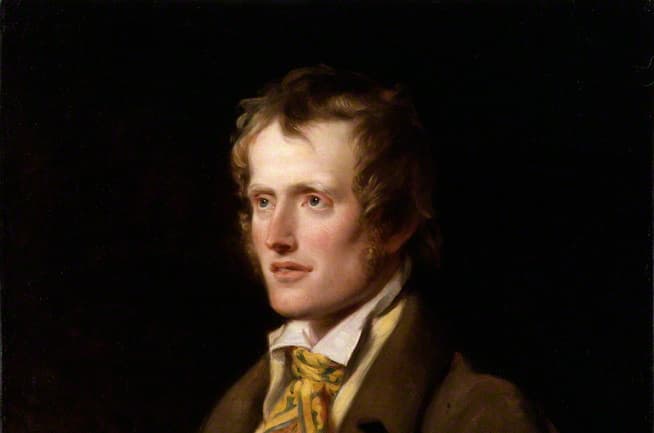
Like Sir Walter Scott, John Clare (1793–1864) was a straddler of eras. Unlike Scott, however — who was anchored in Romanticism while pointing to the Victorian Pre-Raphaelites — Clare was a poetic outlier: the sole occupant of his own peculiar sphere. His poem “A Look at the Heavens,” which ran as the Sun’s Poem of the Day last June, renarrates Psalm 19 as a personal experience of what Wordsworth would have called the Sublime. Clare (no revolutionary, but a devout and orthodox Anglican) simply called it God.
Today’s poem, again, envisions an upheaval in the natural world as an experience of biblical proportions. We can readily imagine how, to the sensitive Clare, a storm at night would be an exercise in sensory overwhelm. The woods would seem to be “sobbing,” the rain to bring bad tidings of things to come. Twice the poem uses the word “deluge,” calling to mind the obliterating flood of Genesis. In the moment, the storm’s human observers — the cotter, the “fearing dame,” and the speaker himself — half-persuade themselves that God might forget his promise to Noah.
In this whole long, single pentameter stanza, where many lines begin with the hammer-stroke of a trochee as if to echo a burst of wind or the lashings of the rain, the strangest moment occurs at line ten — where, in the chaos of the storm, language itself turns strange. Though “glabber” is a Scots word for liquefied mud, we seem to be indoors around a fire, with “flaze” apparently signifying gazing at the fire — the people talking until a frightened woman hushes them to listen to the storm’s ferocity. Only when the wind has blown itself out, and the end of the world hasn’t happened, can anyone go to bed.
By CARL ROLLYSON
|
By JOTAM CONFINO
|
By JOTAM CONFINO
|
By MATTHEW RICE
|
By MATTHEW RICE
|
By AVI SHAFRAN
|
By A.R. HOFFMAN
|
By STEPHEN MOORE
|Like Sir Walter Scott, John Clare (1793–1864) was a straddler of eras. Unlike Scott, however — who was anchored in Romanticism while pointing to the Victorian Pre-Raphaelites — Clare was a poetic outlier: the sole occupant of his own peculiar sphere. His poem “A Look at the Heavens,” which ran as the Sun’s Poem of the Day last June, renarrates Psalm 19 as a personal experience of what Wordsworth would have called the Sublime. Clare (no revolutionary, but a devout and orthodox Anglican) simply called it God.
Today’s poem, again, envisions an upheaval in the natural world as an experience of biblical proportions. We can readily imagine how, to the sensitive Clare, a storm at night would be an exercise in sensory overwhelm. The woods would seem to be “sobbing,” the rain to bring bad tidings of things to come. Twice the poem uses the word “deluge,” calling to mind the obliterating flood of Genesis. In the moment, the storm’s human observers — the cotter, the “fearing dame,” and the speaker himself — half-persuade themselves that God might forget his promise to Noah.
In this whole long, single pentameter stanza, where many lines begin with the hammer-stroke of a trochee as if to echo a burst of wind or the lashings of the rain, the strangest moment occurs at line ten — where, in the chaos of the storm, language itself turns strange. Though “glabber” is a Scots word for liquefied mud, we seem to be indoors around a fire, with “flaze” apparently signifying gazing at the fire — the people talking until a frightened woman hushes them to listen to the storm’s ferocity. Only when the wind has blown itself out, and the end of the world hasn’t happened, can anyone go to bed.
Cancel anytime
By continuing you agree to our Privacy Policy and Terms of Service.
Cancel anytime