


British Greens Bring Back ‘Zionism Is Racism’
By THE NEW YORK SUN
|The author of today’s poem is, yes, that William Morris, late of the British Arts and Crafts movement and the Socialist League, and whose friends were the Pre-Raphaelite painters and poets.
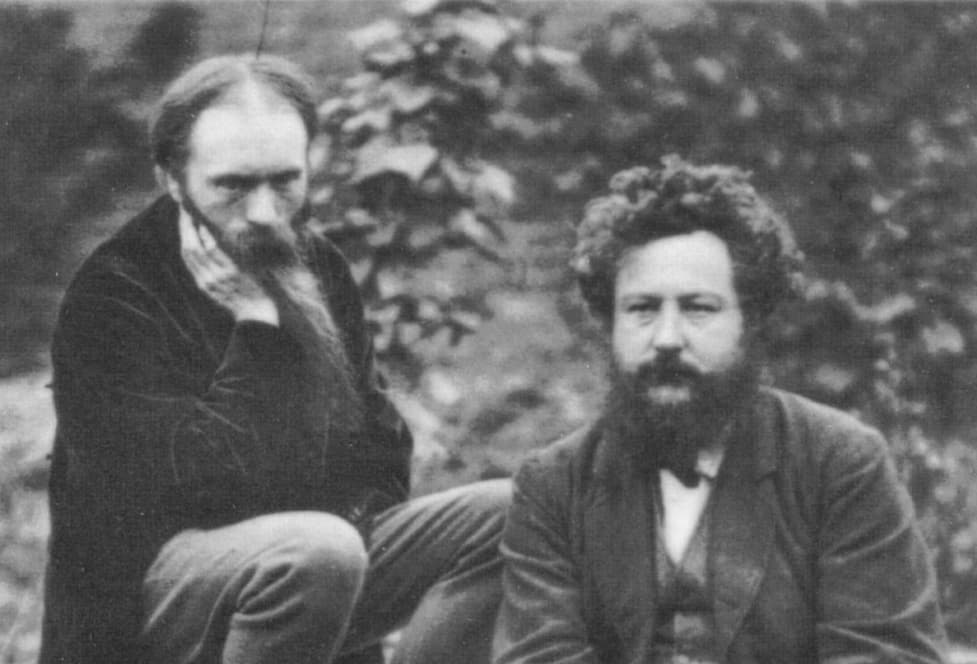
How many people, on seeing the name of William Morris (1834–1896), think first of wallpaper or chairs? Not that the thought is wrong. The author of today’s Poem of the Day is, after all, that William Morris, late of the British Arts and Crafts movement and the Socialist League. That William Morris, whose friends were the Pre-Raphaelite painters and poets.
In fact, it’s easy for us to think of such people as Dante Gabriel Rossetti, whose poems have appeared in the Sun, as genuine artists, while Morris remains relegated in our imaginations to the role of set designer. We see Rossetti writing, painting, and collecting wombats. Meanwhile, through the same imaginative historical telescope of dubious reliability, we see Morris designing some stained glass or the odd tapestry, overseeing his teams of apprentices plucked from the Industrial Home for Destitute Boys in Euston, and feeling perhaps a bit sick that the market for his textiles, wallpapers, and furniture consisted largely of the very middle-class Victorian households which, on principle, he despised.
But during his lifetime, Morris was more famous as a poet than as a designer. Author of “The Life and Death of Jason,” which retold the ancient Greek legend of the Golden Fleece, translator of the Icelandic Eddas and Sagas, Morris attained literary celebrity with his epic poem, “The Earthly Paradise,” finished in 1870 and later published by Morris’s own Kelmscott press. The poem’s structure of twenty-four interlaced Viking-themed tales was meant as homage to Chaucer, for whom one of the Kelmscott typefaces, all designed by Morris, was named.
Today’s elegiac Poem of the Day, excerpted from that longer work, reads like a highly compressed sonnet, with its pentameter lines and its ababbcc rhyme scheme. Its paradoxes — “the changeless seal of change,” the “fair death” of things that in life “were fair” — highlight the strangeness of the season when autumn gives way to winter, lonely and seemingly eternal. The speaker’s chafing at these images reflects the fever in his heart. Though the world lays itself to rest at the year’s waning, there is no rest in him.
By THE NEW YORK SUN
|
By DAVID MASTIO
|
By MATTHEW RICE
|
By ALEX ZDAN
|
By MATTHEW RICE
|
By GEORGE WILLIS
|
By MARIO NAVES
|
By JOSEPH CURL
|How many people, on seeing the name of William Morris (1834–1896), think first of wallpaper or chairs? Not that the thought is wrong. The author of today’s Poem of the Day is, after all, that William Morris, late of the British Arts and Crafts movement and the Socialist League. That William Morris, whose friends were the Pre-Raphaelite painters and poets.
In fact, it’s easy for us to think of such people as Dante Gabriel Rossetti, whose poems have appeared in the Sun, as genuine artists, while Morris remains relegated in our imaginations to the role of set designer. We see Rossetti writing, painting, and collecting wombats. Meanwhile, through the same imaginative historical telescope of dubious reliability, we see Morris designing some stained glass or the odd tapestry, overseeing his teams of apprentices plucked from the Industrial Home for Destitute Boys in Euston, and feeling perhaps a bit sick that the market for his textiles, wallpapers, and furniture consisted largely of the very middle-class Victorian households which, on principle, he despised.
But during his lifetime, Morris was more famous as a poet than as a designer. Author of “The Life and Death of Jason,” which retold the ancient Greek legend of the Golden Fleece, translator of the Icelandic Eddas and Sagas, Morris attained literary celebrity with his epic poem, “The Earthly Paradise,” finished in 1870 and later published by Morris’s own Kelmscott press. The poem’s structure of twenty-four interlaced Viking-themed tales was meant as homage to Chaucer, for whom one of the Kelmscott typefaces, all designed by Morris, was named.
Today’s elegiac Poem of the Day, excerpted from that longer work, reads like a highly compressed sonnet, with its pentameter lines and its ababbcc rhyme scheme. Its paradoxes — “the changeless seal of change,” the “fair death” of things that in life “were fair” — highlight the strangeness of the season when autumn gives way to winter, lonely and seemingly eternal. The speaker’s chafing at these images reflects the fever in his heart. Though the world lays itself to rest at the year’s waning, there is no rest in him.
Cancel anytime
By continuing you agree to our Privacy Policy and Terms of Service.
Cancel anytime