
From ‘Dracula’ to ‘Ulysses,’ Ireland’s Literary Genius Enchants at New York’s Oldest Museum
By A.R. HOFFMAN
|Keats plunges headlong into the trope of reading as exploration, adventure, and discovery. To open Chapman’s Homer, the poem asserts, is to enter a new world of marvels.

Published:
Updated:
In 1611, the English poet, playwright, and classicist George Chapman (1559–1634) published a complete translation of Homer’s “Iliad.” Thus, for the first time, did the ordinary seventeenth-century English reader hear this voice of antiquity in a modern tongue.
The publication of Chapman’s work was an event in ways that are hard for us to appreciate. In 1651, the Presbyterian minister-poet Samuel Sheppard (1624–1655) eulogized Chapman’s achievement:
What none before durst ever venture on
Unto our wonder is by Chapman done,
Who by his skill hath made Great Homer’s song
To vaile its bonnet to our English tongue,
So that the learned well may question it
Whether in Greek or English Homer writ?
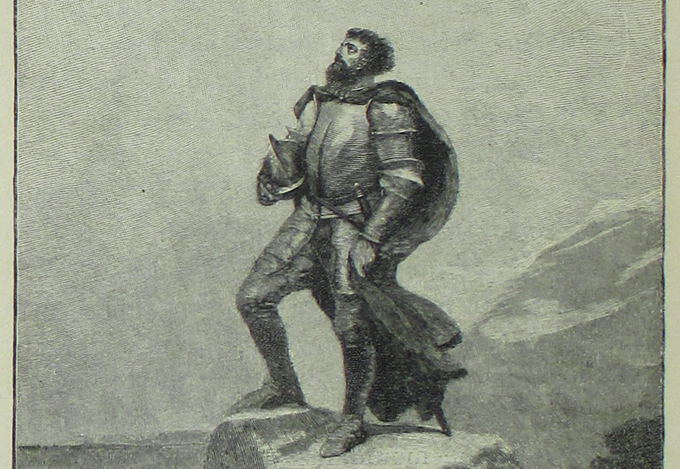
But by far the most famous tribute to Chapman’s achievement — the sole reason many of us in the twenty-first century remember Chapman’s name at all — is the sonnet by John Keats (1795–1821), today’s Poem of the Day. What’s striking in this Petrarchan sonnet, especially in contrast to Sheppard’s poem, is that instead of a plodding sermon-in-couplets praising Chapman, Keats plunges headlong into the trope of reading as exploration, adventure, and discovery.
To open Chapman’s Homer, the poem asserts, is to enter a new world of marvels. And even if it Keats got his Spanish explorers wrong — it was Balboa, not “stout Cortez,” who first beheld the Pacific Ocean — we can’t help being struck, ourselves, at the end of the poem, by their “wild surmise,” as they fall silent on that “peak in Darien.” This, says Keats, without having to belabor his point — this is what it’s like. And even if we’ve never opened Chapman ourselves, we know what he means.
By A.R. HOFFMAN
|
By JOSEPH CURL
|
By DONALD KIRK
|
By DAVID JONES
|
By ALEX ZDAN
|
By JOSEPH CURL
|
By DAVID JONES
|
By CARL ROLLYSON
|In 1611, the English poet, playwright, and classicist George Chapman (1559–1634) published a complete translation of Homer’s “Iliad.” Thus, for the first time, did the ordinary seventeenth-century English reader hear this voice of antiquity in a modern tongue.
The publication of Chapman’s work was an event in ways that are hard for us to appreciate. In 1651, the Presbyterian minister-poet Samuel Sheppard (1624–1655) eulogized Chapman’s achievement:
What none before durst ever venture on
Unto our wonder is by Chapman done,
Who by his skill hath made Great Homer’s song
To vaile its bonnet to our English tongue,
So that the learned well may question it
Whether in Greek or English Homer writ?
But by far the most famous tribute to Chapman’s achievement — the sole reason many of us in the twenty-first century remember Chapman’s name at all — is the sonnet by John Keats (1795–1821), today’s Poem of the Day. What’s striking in this Petrarchan sonnet, especially in contrast to Sheppard’s poem, is that instead of a plodding sermon-in-couplets praising Chapman, Keats plunges headlong into the trope of reading as exploration, adventure, and discovery.
To open Chapman’s Homer, the poem asserts, is to enter a new world of marvels. And even if it Keats got his Spanish explorers wrong — it was Balboa, not “stout Cortez,” who first beheld the Pacific Ocean — we can’t help being struck, ourselves, at the end of the poem, by their “wild surmise,” as they fall silent on that “peak in Darien.” This, says Keats, without having to belabor his point — this is what it’s like. And even if we’ve never opened Chapman ourselves, we know what he means.
Cancel anytime
By continuing you agree to our Privacy Policy and Terms of Service.
Cancel anytime