

Iowa’s Attorney General Threatens To Sue California Over Its Effort To Block Paramount’s Merger With Warner Bros. Discovery
By BRADLEY CORTRIGHT
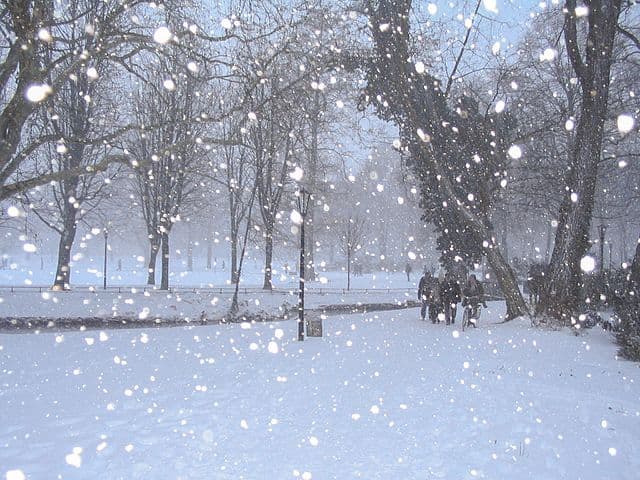
|After a brief but potent sketch of the winter day, in which the sky itself appears to turn into snow as it falls, the speaker experiences a flash of insight.

Published:
Updated:
Missouri poet Charles Bertram Johnson (1880–1958) spent his life at a remove from the urban East Coast milieu that characterized his more famous Harlem Renaissance contemporaries. His biographical details are relatively scanty. For much of his adult life he was a schoolteacher and a preacher, work that seems to have occupied a great deal of his creative energy. His slim literary output amounts to one book of poems and two smaller pamphlets.
Yet, inspired in youth by the poems of Paul Laurence Dunbar, he made a modest reputation for himself as a poet. Though he published some dialect poems in the style of Dunbar, as well as some devotional verse, he received recognition (again, modest) for his lyric poems. Introducing Johnson in the 1923 “Negro Poets and Their Poems,” Robert T. Kerlin describes him as a kind of lesser Sara Teasdale, which even admirers of Sara Teasdale might consider to be damning with faint praise.
Still, there’s something apt in the comparison. In today’s Poem of the Day, we see a winter scene, not unlike so many of Teasdale’s, presented in language that is at once simple, direct, and imagistic, but with undercurrents of emotional complexity. Teasdale’s poems often evoke beauty, especially wintry beauty, to highlight the distant but present turbulence of a war-troubled world. Johnson’s “Snow” is a single ababccdd octet, its primarily trimeter lines disturbed by shifts to tetrameter in lines three and seven. After a brief but potent sketch of the winter day, in which the sky itself appears to turn into snow as it falls, the speaker experiences a flash of insight, in which the “shroud” of snow hints at larger threats.
By BRADLEY CORTRIGHT
|
By LUKE FUNK
|
By GEORGE WILLIS
|
By WILL FRIEDWALD
|
By MATTHEW RICE
|
By MATTHEW RICE
|
By JENNIFER DOHERTY
|
By SALENA ZITO
|Missouri poet Charles Bertram Johnson (1880–1958) spent his life at a remove from the urban East Coast milieu that characterized his more famous Harlem Renaissance contemporaries. His biographical details are relatively scanty. For much of his adult life he was a schoolteacher and a preacher, work that seems to have occupied a great deal of his creative energy. His slim literary output amounts to one book of poems and two smaller pamphlets.
Yet, inspired in youth by the poems of Paul Laurence Dunbar, he made a modest reputation for himself as a poet. Though he published some dialect poems in the style of Dunbar, as well as some devotional verse, he received recognition (again, modest) for his lyric poems. Introducing Johnson in the 1923 “Negro Poets and Their Poems,” Robert T. Kerlin describes him as a kind of lesser Sara Teasdale, which even admirers of Sara Teasdale might consider to be damning with faint praise.
Still, there’s something apt in the comparison. In today’s Poem of the Day, we see a winter scene, not unlike so many of Teasdale’s, presented in language that is at once simple, direct, and imagistic, but with undercurrents of emotional complexity. Teasdale’s poems often evoke beauty, especially wintry beauty, to highlight the distant but present turbulence of a war-troubled world. Johnson’s “Snow” is a single ababccdd octet, its primarily trimeter lines disturbed by shifts to tetrameter in lines three and seven. After a brief but potent sketch of the winter day, in which the sky itself appears to turn into snow as it falls, the speaker experiences a flash of insight, in which the “shroud” of snow hints at larger threats.
Cancel anytime
By continuing you agree to our Privacy Policy and Terms of Service.