

Suede’s American Problem: The Britpop Band That Never Broke Through Stateside
By ALEXANDER LARMAN
|Think of William Carlos Williams’s free verse as a form of poetry, though he thought of it as the rejection of form.
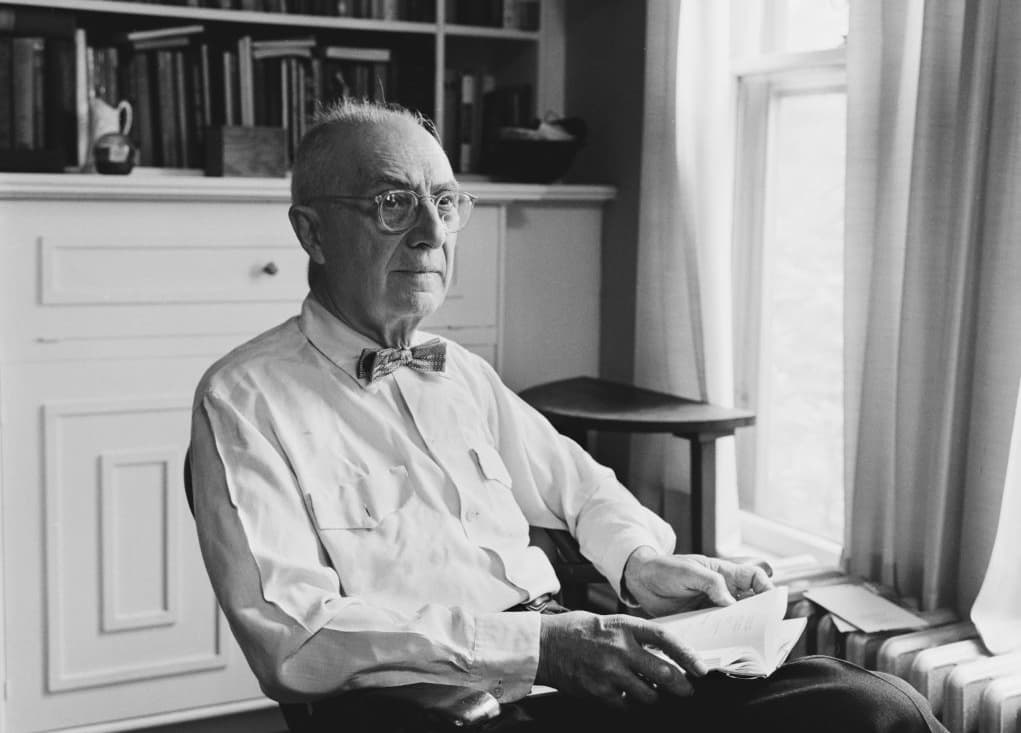
It was a hundred years ago — and so, in time, even the most modern of modern writers become the distant past — that William Carlos Williams (1883–1963) opened a 1923 collection of poetry and prose with the words “By the road to the contagious hospital / under the surge of the blue . . . ” And so Williams opens his book with the spring season of his book’s title, “Spring and All.” The most famous part of the book is the 22nd section, which contains Williams’s heavily anthologized — over-anthologized — poem, “The Red Wheelbarrow.” But the first section of “Spring and All” captures something essential about his craft.
A medical doctor at Paterson, New Jersey, Williams gives us an image of spring as what he sees driving on the road to a hospital. First he sees the broad strokes: the sky, the muddy fields, “patches of standing water / the scattering of tall trees.” But then the rush of details emerges in the spring, like the quick flash of vision from a moving car: “the reddish / purplish, forked, upstanding, twiggy / stuff of bushes and small trees.” The language become the language of birth as “It quickens.”
It’s hard to image a more accurate description of spring as the filling in of details than Williams’s line “One by one objects are defined.” And he concludes with the fullness of the season: “the profound change / has come upon them: rooted, they / grip down and begin to awaken.” The key may be to think of William Carlos Williams’s free verse as a form of poetry, though he thought of it as the rejection of form. In “Spring and All [‘By the road to the contagious hospital’]” the rush of the words matches the rush of scenery seen from a car, to give us the rush of wakening spring.
By ALEXANDER LARMAN
|
By DAVID JONES
|
By JOSEPH CURL
|
By JOSEPH CURL
|
By GEORGE WILLIS
|
By DAVID JONES
|
By JOSEPH CURL
|
By DEAN KARAYANIS
|It was a hundred years ago — and so, in time, even the most modern of modern writers become the distant past — that William Carlos Williams (1883–1963) opened a 1923 collection of poetry and prose with the words “By the road to the contagious hospital / under the surge of the blue . . . ” And so Williams opens his book with the spring season of his book’s title, “Spring and All.” The most famous part of the book is the 22nd section, which contains Williams’s heavily anthologized — over-anthologized — poem, “The Red Wheelbarrow.” But the first section of “Spring and All” captures something essential about his craft.
A medical doctor at Paterson, New Jersey, Williams gives us an image of spring as what he sees driving on the road to a hospital. First he sees the broad strokes: the sky, the muddy fields, “patches of standing water / the scattering of tall trees.” But then the rush of details emerges in the spring, like the quick flash of vision from a moving car: “the reddish / purplish, forked, upstanding, twiggy / stuff of bushes and small trees.” The language become the language of birth as “It quickens.”
It’s hard to image a more accurate description of spring as the filling in of details than Williams’s line “One by one objects are defined.” And he concludes with the fullness of the season: “the profound change / has come upon them: rooted, they / grip down and begin to awaken.” The key may be to think of William Carlos Williams’s free verse as a form of poetry, though he thought of it as the rejection of form. In “Spring and All [‘By the road to the contagious hospital’]” the rush of the words matches the rush of scenery seen from a car, to give us the rush of wakening spring.
Cancel anytime
By continuing you agree to our Privacy Policy and Terms of Service.