

Tom Kim Earns Gold and Military Exemption With Victory at Asian Games
By GEORGE WILLIS
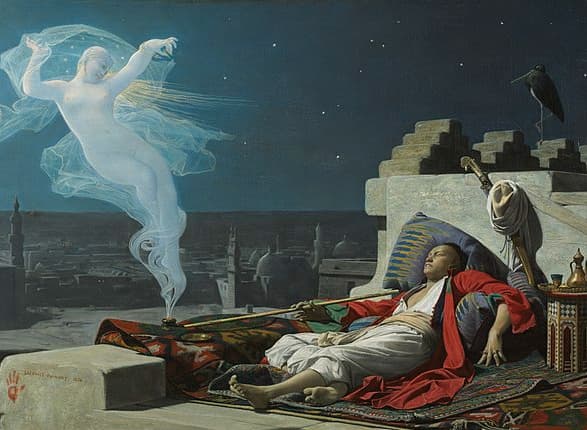
|Arthur Symons pictures the opium smoker as a kind of living Egyptian mummy, subjectively swathed in cerements and wrapped in a wondrous and timeless night.

Published:
Updated:
Arthur Symons (1865–1945) occupies a curious place in English literature: a decadent who lived until the 1940s, a poet and playwright who regularly published in the Yellow Book and other fin-de-siècle magazines, and an early proponent of the use of drugs as a way to open the doors of perception. He was also the author of “The Symbolist Movement in Literature” (1899), as influential a book of literary criticism as has ever been published — introducing the likes of William Butler Yeats and T.S. Eliot to a new range of French poets: Arthur Rimbaud, Jules Laforgue, Stéphane Mallarmé, and all the rest who seemed to his English readers the very definition of a new poetry.
Back in 1889, however, Symons had published a sonnet called “The Opium-Smoker,” which is as stern a description of drug use as literature provides. It’s also a fine use of the turn from the octave (the first eight lines of a sonnet) to the sestet (the final six lines). In the opening, Symons pictures the opium smoker as a kind of living Egyptian mummy, subjectively swathed in cerements and wrapped in a wondrous and timeless night. And then, in a brutal volta, the poet describes the objective reality of the drug-filled life: “Also I have this garret which I rent, . . . / This crust, of which the rats have eaten part” — and more: “This soul at pawn and this delirious heart.”
By GEORGE WILLIS
|
By HOLLIE McKAY
|
By DAVID JONES
|
By JOSEPH CURL
|
By THE NEW YORK SUN
|
By LAURA THOMPSON
|
By DAVID MASTIO
|
By DONALD KIRK
|Arthur Symons (1865–1945) occupies a curious place in English literature: a decadent who lived until the 1940s, a poet and playwright who regularly published in the Yellow Book and other fin-de-siècle magazines, and an early proponent of the use of drugs as a way to open the doors of perception. He was also the author of “The Symbolist Movement in Literature” (1899), as influential a book of literary criticism as has ever been published — introducing the likes of William Butler Yeats and T.S. Eliot to a new range of French poets: Arthur Rimbaud, Jules Laforgue, Stéphane Mallarmé, and all the rest who seemed to his English readers the very definition of a new poetry.
Back in 1889, however, Symons had published a sonnet called “The Opium-Smoker,” which is as stern a description of drug use as literature provides. It’s also a fine use of the turn from the octave (the first eight lines of a sonnet) to the sestet (the final six lines). In the opening, Symons pictures the opium smoker as a kind of living Egyptian mummy, subjectively swathed in cerements and wrapped in a wondrous and timeless night. And then, in a brutal volta, the poet describes the objective reality of the drug-filled life: “Also I have this garret which I rent, . . . / This crust, of which the rats have eaten part” — and more: “This soul at pawn and this delirious heart.”
Cancel anytime
By continuing you agree to our Privacy Policy and Terms of Service.
Cancel anytime