


As Anti-Israel Animus Surges and Turkey Threatens, Greece Signs Deal With Jewish State for $3 Billion ‘Achilles Shield’
By A.R. HOFFMAN
|In a poem devoted to an active mind’s withdrawal from the world of the living, details of that world stand out sharply to the dying eye.
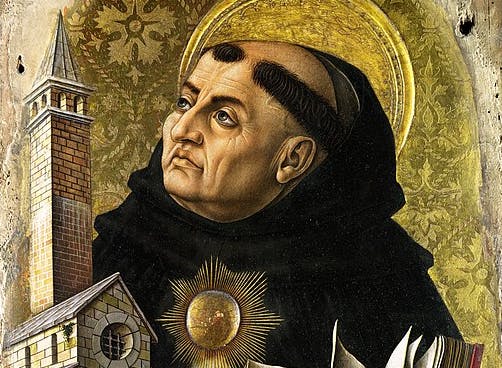
In “The Silence of Thomas Aquinas,” the former Oklahoma poet laureate and author of the recent “The Family Book of Martyrs,” Benjamin Myers (b. 1975), gives us the ghost of a sonnet. Fourteen unrhymed lines, largely in iambic pentameter, imagine a scene in which the Dominican philosopher Thomas Aquinas (1225–1274), nearing death, observes a novice at his formative work of building a stone wall. The iambic meter is regular enough that the reader notices the trochees that begin lines 5 and 13: watching, putting. The first trochee is Thomas’s action. The second is the novice’s, as Thomas remembers it. Between them intervenes the suggestion of a volta, or turn: the old man’s silent prayer as he watches the boy at work, learning to bend himself to the will of God.
In a poem devoted to an active mind’s withdrawal from the world of the living, details of that world stand out sharply to the dying eye. The young man’s tonsure, pink and vulnerable. His hands not yet hardened to work. The novice’s youth and the life before him, to which he is beginning to learn to submit himself, speak to the longer journey for which the old man prepares. A poem timed for the feast day of Saint Thomas Aquinas on January 28.
By A.R. HOFFMAN
|
By ALEX ZDAN
|
By JOSEPH CURL
|
By ALEXANDER LARMAN
|
By GEORGE WILLIS
|
By TOM TEODORCZUK
|
By DEAN KARAYANIS
|
By A.R. HOFFMAN
|In “The Silence of Thomas Aquinas,” the former Oklahoma poet laureate and author of the recent “The Family Book of Martyrs,” Benjamin Myers (b. 1975), gives us the ghost of a sonnet. Fourteen unrhymed lines, largely in iambic pentameter, imagine a scene in which the Dominican philosopher Thomas Aquinas (1225–1274), nearing death, observes a novice at his formative work of building a stone wall. The iambic meter is regular enough that the reader notices the trochees that begin lines 5 and 13: watching, putting. The first trochee is Thomas’s action. The second is the novice’s, as Thomas remembers it. Between them intervenes the suggestion of a volta, or turn: the old man’s silent prayer as he watches the boy at work, learning to bend himself to the will of God.
In a poem devoted to an active mind’s withdrawal from the world of the living, details of that world stand out sharply to the dying eye. The young man’s tonsure, pink and vulnerable. His hands not yet hardened to work. The novice’s youth and the life before him, to which he is beginning to learn to submit himself, speak to the longer journey for which the old man prepares. A poem timed for the feast day of Saint Thomas Aquinas on January 28.
Cancel anytime
By continuing you agree to our Privacy Policy and Terms of Service.