


Strait of Hormuz Tanker Traffic Returns to Normal, Scoring a Quiet Win for Trump’s War Effort
By DEAN KARAYANIS
|Like Gerard Manley Hopkins a generation later, William Wordsworth in this poem recoils from the blight which the Industrial Revolution has imposed on England’s natural beauties.
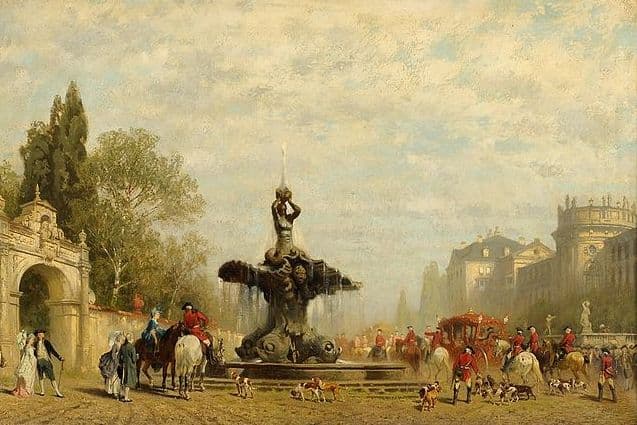
In this holiday week we might well feel, as we read the first line of today’s Petrarchan sonnet by William Wordsworth (1770–1850), that the poet has read our weary minds. Is anybody out there not exhausted? From Thanksgiving to New Year’s, the busyness of the season harries us. It’s winter. People are sick. Bills come due. Even if we haven’t been racing from party to party, welcoming — or steeling ourselves to welcome — various members of our extended families, worrying over gifts and holiday dinner menus, wondering how it is that X number of people can possibly use Y number of towels in Z number of hours . . . let’s just say that at this time of year, for whatever reasons, we can feel, with Wordsworth, that the world is too much with us. In “getting and spending,” we think, we too have laid “waste our powers” and are, “for everything . . . out of tune.”
But our seasonal disconnection from our own inner peace isn’t precisely what Wordsworth is talking about — not precisely. Like Gerard Manley Hopkins a generation later, the patriarch of the English Romantics recoils, in this poem, from the blight which the Industrial Revolution has imposed on England’s natural beauties. Yet where Hopkins, in “God’s Grandeur,” writes that everything about the blighted world “wears man’s smudge and share’s man’s smell,” Wordsworth perceives that blight as an inward condition, a kind of spiritual exile from the ineffaceable intimacy of the created order. The sea may “bare her bosom to the moon,” but the poem’s speaker stands outside that natural relationship. He looks in with yearning on something that still exists, untouched and inviolate.
Where Hopkins’ speaker perceives the natural world as straightforwardly sacramental, “charged with the grandeur of God,” Wordsworth’s can only wish that he believed something that would re-enchant the world. And perhaps, in our paradoxical experience of the season — hastening to get through it, but longing to perceive, and to linger in, whatever is beautiful about it — that’s really what we yearn for. Perhaps, after all, the poet has read our weary minds.
By DEAN KARAYANIS
|
By LUKE FUNK
|
By JENNIFER DOHERTY
|
By MATTHEW RICE
|
By MATTHEW RICE
|
By ALEX ZDAN
|
By BETSY McCAUGHEY
|
By VERONIQUE de RUGY
|In this holiday week we might well feel, as we read the first line of today’s Petrarchan sonnet by William Wordsworth (1770–1850), that the poet has read our weary minds. Is anybody out there not exhausted? From Thanksgiving to New Year’s, the busyness of the season harries us. It’s winter. People are sick. Bills come due. Even if we haven’t been racing from party to party, welcoming — or steeling ourselves to welcome — various members of our extended families, worrying over gifts and holiday dinner menus, wondering how it is that X number of people can possibly use Y number of towels in Z number of hours . . . let’s just say that at this time of year, for whatever reasons, we can feel, with Wordsworth, that the world is too much with us. In “getting and spending,” we think, we too have laid “waste our powers” and are, “for everything . . . out of tune.”
But our seasonal disconnection from our own inner peace isn’t precisely what Wordsworth is talking about — not precisely. Like Gerard Manley Hopkins a generation later, the patriarch of the English Romantics recoils, in this poem, from the blight which the Industrial Revolution has imposed on England’s natural beauties. Yet where Hopkins, in “God’s Grandeur,” writes that everything about the blighted world “wears man’s smudge and share’s man’s smell,” Wordsworth perceives that blight as an inward condition, a kind of spiritual exile from the ineffaceable intimacy of the created order. The sea may “bare her bosom to the moon,” but the poem’s speaker stands outside that natural relationship. He looks in with yearning on something that still exists, untouched and inviolate.
Where Hopkins’ speaker perceives the natural world as straightforwardly sacramental, “charged with the grandeur of God,” Wordsworth’s can only wish that he believed something that would re-enchant the world. And perhaps, in our paradoxical experience of the season — hastening to get through it, but longing to perceive, and to linger in, whatever is beautiful about it — that’s really what we yearn for. Perhaps, after all, the poet has read our weary minds.
Cancel anytime
By continuing you agree to our Privacy Policy and Terms of Service.
Cancel anytime