Mamdani’s Mayoral Bid Fueled by Resentments of Rising Generation of Overeducated, but Unlearned, Socialists
Maybe that Ethnic Studies major was a mistake? This distinctively modern proletariat looks to government to supply status and other comforts to which they feel entitled.
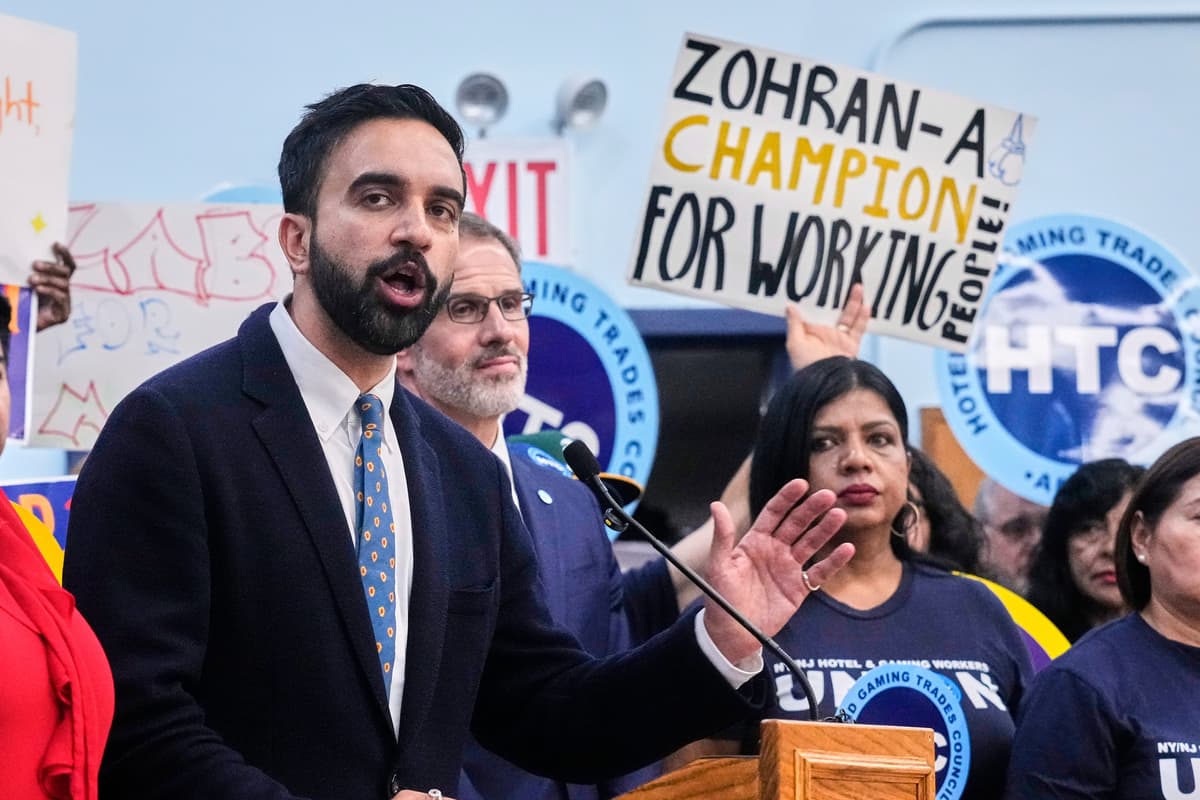

President Trump and Assemblyman Zohran Mamdani are similar symptoms, and similarly reasons for guarded optimism. The president and the self-described “democratic socialist” who is the Democratic nominee to be New York’s next mayor have risen on tides of resentments, and are inadvertent educators.
Mr. Trump is teaching a daily seminar on the Founders’ wisdom, especially the separation of powers, which Congress, by its self-marginalization, has weakened, thereby emancipating presidents from law and other restraints. Mr. Mamdani, if elected, will be similarly instructive regarding elementary economics and the limits of government’s competence.
Governor Tim Walz of Minnesota, selected by Vice President Kamala Harris as a running mate perhaps because he made her seem comparatively substantial, has defined socialism as “neighborliness.” Probably many of Mr. Mamdani’s young supporters have a similarly sentimental understanding of it. Yet always and everywhere, socialism is, first and foremost, about government control of economic life.
Originally, socialism favored government ownership of the means of production, distribution, and exchange. Then it advocated government control of the economy’s “commanding heights.” Nowadays, socialism advances its aims by dominating the formerly “private sector.” Government imposes its preferences, picking winners and losers with regulations, subsidies, import restrictions, and other coercions.
Not since the 1930s New Deal, and perhaps not even then (statism is difficult to quantify), has there been a peacetime American administration as — strictly speaking — socialist as today’s. In June, the Trump administration essentially nationalized United States Steel. MAGA hysteria about “Comrade Mamdani” threatening to permeate everything with government seems synthetic.
More than four decades ago, sociologist Daniel Bell postulated capitalism’s “cultural contradictions”: Capitalism’s success undermines the virtues (thrift, industriousness, deferral of gratification) that are prerequisites for its continuing success. Socialism’s cultural contradiction is that it is parasitic on capitalism, which must produce the wealth that socialism redistributes — until the engine of wealth creation, battered by socialism’s redistributive agenda, sputters.
Mr. Mamdani’s agenda includes “free” (paid for by others) stuff (e.g., transportation and child care), and government bringing its deftness to the running of grocery stores. And even more stringent rent control that will further discourage expanding the inadequate housing supply that is pushing rent higher.
Mr. Mamdani will be powerless, because politics is powerless, to assuage a longing that motivates many of his supporters: a hunger for a radical redistribution of status.
In 1960, in “The Constitution of Liberty,” a canonical volume of modern political theory, Friedrich Hayek wrote: “There are few greater dangers to political stability than the existence of an intellectual proletariat who find no outlet for their learning.” Sixty-five years later, Hayek’s warning needs amending:
The danger is the excessive production of expensively schooled but not remarkably learned persons who are members of a cohort that is of minimal intellectual distinction, and is too large to be elite. They are members of a “reserve army” (Mr. Mamdani might recognize this phrase from Karl Marx’s “Das Kapital”) of persons more or less equally prepared to add not much value to the economy. (Maybe that Ethnic Studies major was a mistake.)
Members of this distinctively modern proletariat, who have chosen to live in one of the nation’s most expensive cities, have resentments not unlike those that motivate angry MAGA partisans: They ache for status and other comforts to which they feel entitled.
Mr. Mamdani as mayor might not be much worse than his principal rivals: Mayor Eric Adams has a mediocre record and an aroma of corruption; the recycled Andrew M. Cuomo resigned under various clouds during his fourth term as governor. As mayor, none of the three would probably be as admired as the current police commissioner, Jessica S. Tisch. None of the three would be apt to challenge the teachers union that controls the nation’s largest public school system, which is producing mostly depressing results.
Besides, if Mr. Mamdani would be marginally worse than those other two products of the city’s political culture, that might be constructive. He might become America’s François Mitterrand.
As France’s president, Mitterrand set back socialism for several generations. He was elected in 1981 promising a “rupture with capitalism” and a “break with the logic of profitability.” He implemented sweeping nationalizations, radically increased welfare benefits, imposed higher taxes on the investing classes, instituted a shorter workweek without reduced compensation, etc.
In 1982, after the franc had been thrice devalued, he pivoted to “socialist rigor,” a.k.a., austerity: “You can’t continue to crush with taxes and fees all those people who create wealth in France.”
Socialism in a circumscribed but conspicuous jurisdiction can occasionally be a valuable reminder of toxic political temptations. Hence Mr. Mamdani’s usefulness.
The Washington Post

