Rob Reiner Leaves Legacy as a Hollywood Liberal Who Cared About Storytelling First

Choose to be an advocate or an entertainer, he said, but ‘you can’t do both.’
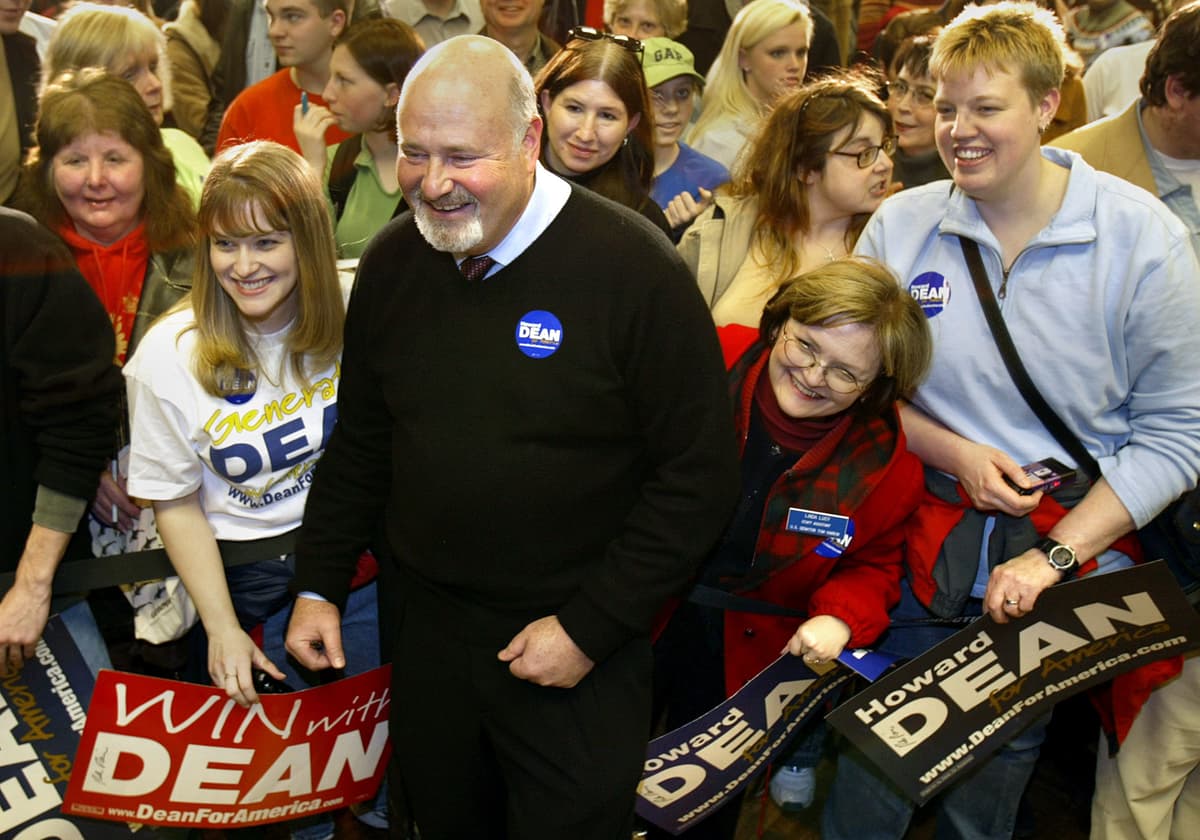
Rick Chase/the Courier via AP
Actor and director Rob Reiner, center, campaigning for Democratic presidential hopeful Howard Dean in 2004 at the University of Northern Iowa at Cedar Falls. Rick Chase/the Courier via AP

A Hollywood scion, Rob Reiner, is dead. Yet 60 years of his work endures as do memories of his passion for left-wing causes. Reiner’s balancing of personal activism and professional storytelling serves as an example for entertainers today, who often face criticism for blurring the line between the two, leaving audiences unfulfilled.

When Reiner was in the director’s chair, he delivered compelling stories free of political harangues. The son of another Hollywood fixture, Carl Reiner, he was stabbed to death at his Brentwood, California, mansion on Sunday along with his wife, Michele.

Reiner leaves behind 1989’s “When Harry Met Sally…” where he and Michele met. Other credits include “The Princess Bride,” “Misery,” “A Few Good Men,” “Albert Brooks: Defending My Life,” and “Stand By Me.” His directorial debut, 1984’s “This Is Spinal Tap,” earned a sequel, “Spinal Tap II: The End Continues,” in September.

“The American President” and “Ghosts of Mississippi” might be said to have a political bent. Yet the former was only an idealized version of a left-wing presidency and the latter a Civil Rights Era tale with a message as universal to the American story as “all men are created equal.”

Even the role that made Reiner a star, Michael Stivic on TV’s “All in the Family,” wasn’t like the two-dimensional liberals familiar in entertainment today. “Meathead” had flaws and questioned the left’s prevailing orthodoxy of the day. He was an idealist but not perfect, an individual just trying to do right.

The conflict at the heart of “All in the Family” was Mike’s relationship with his father-in-law, Carroll O’Connor’s Archie Bunker. “They’re both curmudgeons,” this columnist wrote in January, “stuck in their ways.” The two invited viewers to reflect upon their “stereotypical” avatars and be better people.

Archie accepted that the left might have some points on issues like sex education and gay rights. Mike, though, came to understand Archie’s hard-knocks approach, too. In one episode, the older man shares that, during the Great Depression, he was given a cruel nickname, “Shoe-bootie,” for having to wear mismatched footwear to school.

Later, when Archie drifts off to sleep, Mike kisses him on the head and says, “Goodnight, Shoe-bootie.” In another episode, Archie agrees to let an unmarried couple stay in the house if they sleep “dormitory style.” Mike takes his side, urging his friend to meet the traditionalist halfway and sleep apart from his girlfriend.

Off screen, Reiner was more the liberal firebrand who pulled no punches. Following Mr. Trump’s reelection in November 2024, the director announced his departure from social media and retreated to a “facility for peace and relaxation.” He cited frustration with “MAGA scum” and the need to “heal his pain.”

In October, Reiner warned that America would be a “full-on autocracy” within “a year” under Mr. Trump. But he resisted the temptation to use his work as a political platform. In this, he applied a lesson that the famed writer Rod Serling learned from his screenplay for 1972’s “The Man,” imagining the first Black president.

“That script,” Serling told an author, Mark Olshaker, “taught me never to write about someone who doesn’t go to the bathroom,” meaning has no flaws. Serling resolved to avoid tropes and stereotypes. People in stories had to feel real, not thoroughly good or evil, the better to provoke thought and change attitudes.

In the 1990s, after Reiner suffered a series of flops, he recognized that his focus on politics was to blame. He told the New York Times in 2007 that studios were reluctant to back “The Bucket List,” which turned out to be a hit that year. Following this return to success, he recalled being asked how he balanced work and activism.

Reiner’s response survives as good advice to creators today. Choose to be an advocate or an entertainer, he said, but “you can’t do both” at once, as he’d learned from how it hurt his career. “I can’t split my attention in that way,” he said. “It doesn’t work. I mean, it shows, to be honest with you.”


The New York Sun

© 2025 The New York Sun Company, LLC. All rights reserved.

Use of this site constitutes acceptance of our Terms of Use and Privacy Policy. The material on this site is protected by copyright law and may not be reproduced, distributed, transmitted, cached or otherwise used.

The New York Sun

Sign in or  create a free account

or
By continuing you agree to our Privacy Policy and Terms of Use