Exclusive: ‘Saddened and Angry’ Jack Smith Denounces Trump Without Naming Him as He Emerges From the Shadows With Speech
The erstwhile special counsel gets a standing ovation at George Mason University.
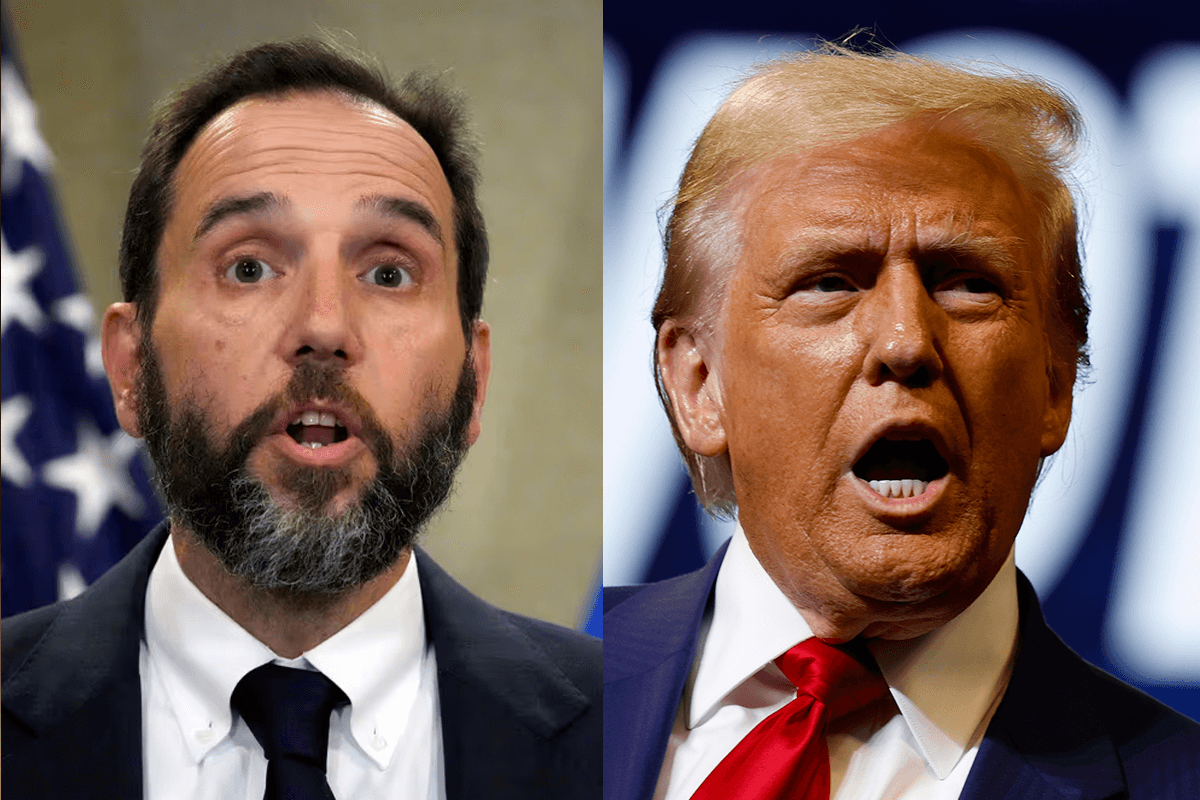
Special Counsel Jack Smith, who had all but vanished since his two cases against President Trump collapsed and his adversary returned to power, has now taken the gloves off in his criticism of the 47th president — even as he declines to mention him by name.
Mr. Smith last week delivered a prestigious endowed lecture at George Mason University that was greeted with a standing ovation. The prosecutor declared that “what I see happening at the Department of Justice today saddens me and angers me … the government, using the vast powers of the criminal justice system to target citizens for exercising their constitutional rights.”
The special counsel, who was appointed by Attorney General Merrick Garland, reflected, “My career has also shown me how fragile” the rule of law can be. “As an international prosecutor, I have seen in other countries the rule of law erode. … One of my concerns is that we have had the rule of law function in this country for so long that many of us have come to take it for granted.”
Security was reportedly tight for the lecture, with police officers out in force to guard Mr. Smith, who oversaw the prosecution of Mr. Trump for both election interference and the storage of classified documents at Mar-a-Lago. Mr. Smith claimed that it is “a bald-face lie that public servants are secretly partisan.” He urged prospective lawyers to “run toward the fire.”
Mr. Smith insisted until the end of his tenure that he could have convicted Mr. Trump “but for” his victory over Vice President Kamala Harris in the 2024 election. Once Mr. Trump won he gained the “categorical immunity” that the Department of Justice has determined is owed to sitting presidents. Mr. Smith at George Mason reflected that “current DOJ policy is to not prosecute a sitting president. My job was not to set policy in the department.”
Mr. Smith has recently come under scrutiny from the Trump administration over accusations that his prosecutions violated the Hatch Act, which prohibits federal employees from undertaking certain political activities. The allegations came from Senator Tom Cotton and are being probed by the Office of Special Counsel, a department unrelated to the post Mr. Smith once held. Under scrutiny is Mr. Smith’s rush — despite his insistence that he is not partisan — to try Mr. Trump before the election.
Mr. Smith’s attorneys call those allegations “imaginary and unfounded” and say that allegations of wrongdoing are “wholly without merit.” The lawyers argue that their client “was fiercely committed to making prosecutorial decisions based solely on the evidence … and he did not let the pending election influence his investigative or prosecutorial decision-making.” Mr. Smith never explicitly mentioned the election in his briefing.
The special counsel, though, was clearly in a rush. He requested expedited consideration from both the United States Court of Appeals for the District of Columbia Circuit and the United States Supreme Court. The trial judge presiding over the January 6 case, Tanya Chutkan, granted his every request with dispatch. The case, though, was upended when the Supreme Court ruled in Trump v. United States that official presidential acts are presumptively immune from prosecution. Mr. Smith’s case never recovered.
Mr. Smith’s other case, for storage of classified documents at Mar-a-Lago, had an even less successful trajectory than the election interference case. Judge Aileen Cannon was skeptical from the outset of Mr. Smith’s contention that Mr. Trump violated the Espionage Act dozens of times. She threw up multiple roadblocks to the case proceedings to trial, and ultimately ruled that Mr. Garland’s appointment of Mr. Smith was unconstitutional. She dismissed the case.
Mr. Garland appointed Mr. Smith, who has never been confirmed by the Senate — he spent years prosecuting war crimes at the Hague, but did not serve as a United States attorney — two days after Mr. Trump announced his intention to retake the White House. Judge Cannon ruled that his appointment was unlawful and all of the charges he brought were ultra vires.
Mr. Trump has made eradicating any vestige of Mr. Smith’s tenure a priority of his efforts to remake the DOJ. Most staffers who worked with Mr. Smith — including support staff like paralegals — have been fired. Mr. Smith’s chief deputy, Jay Bratt, resigned before Mr. Trump took office.
Attorney General Pam Bondi has convened a “Weaponization Working Group” to probe, among other tasks, “Special Counsel Jack Smith and his staff, who spent more than $50 million targeting President Trump.” Democratic senators contend that the firings amount to “a grave injustice that mocks the American ideal of nonpartisan government. Firing these public servants without cause is antidemocratic at best and likely unlawful.”
As Mr. Trump presses publicly for three of his other chief antagonists — Letitia James, James Comey, and Adam Schiff, a prosecutor and two former prosecutors — to be criminally prosecuted, Mr. Smith may have reason to look over his shoulder. A career public servant, he is being represented pro bono by attorneys at Washington, D.C.-based Covington & Burling. Mr. Trump, in one of his first executive orders, sanctioned the firm for providing its services to Mr. Smith, but the firm has not dropped its client.
The annual lecture that Mr. Smith delivered is named after Roger Wilkins, who served as assistant United States attorney under President Johnson and, as a member of the Washington Post’s editorial board, was awarded a Pulitzer Prize for his coverage of the Watergate scandal.
George Mason University, which has prioritized “diversity, equity and inclusion,” is currently a standard bearer in the national pushback by higher education against the Trump administration’s efforts to crack down on antisemitism and racial and gender discrimination on college campuses. While George Mason’s law school — named after Justice Antonin Scalia — is a conservative enclave, Mr. Smith’s lecture was sponsored by the school’s Philosophy, Politics and Economics program.