
Scrutiny Rising Over Council on American-Islamic Relations’ Ties to Terrorism — and Turkey’s Government
Turkish entities with ties to the Erdogan government have increasingly become enablers of CAIR Action’s emerging political influence machine inside the United States.
The Council on American-Islamic Relations is taking a beating this holiday season. Just before Thanksgiving, Texas designated the civil rights organization, known colloquially as “CAIR,” as a foreign terrorist organization. Florida followed suit on December 8.
The day that Governor Ron DeSantis designated CAIR, news broke that the organization’s political advocacy arm, CAIR Action, has been operating in America “without the licenses, registrations, or legal authority required in any of the 22 states where it raises money or conducts political activity.” Nor does CAIR Action possess the documentation required to “legally operate or solicit funds” at Washington, D.C., where it’s incorporated.
CAIR has repeatedly fallen under federal scrutiny for alleged “ties to terrorist organizations, including Hamas and the Muslim Brotherhood.” That its political organ is allegedly and simultaneously operating outside the bounds of American law is startling enough. The issue, however, is more than an administrative one. Turkish entities with ties to the Erdogan government have increasingly become enablers of CAIR Action’s emerging political influence machine inside the United States, and the pattern should alarm American policymakers.
Evidence shows that CAIR Action and senior CAIR leadership maintain close operational ties to Turkish state–linked organizations. Multiple CAIR chapters, say, have received sponsorship from Turkish Airlines, a company roughly half-owned by Ankara’s sovereign wealth fund and widely understood as an instrument of Turkish state influence in foreign jurisdictions — including at New York City, where Mayor Eric Adams was indicted for improperly accepting “free or discounted travel” on the airline. In 2012, Turkish Airlines helped raise $235,000 for CAIR Chicago’s eighth annual banquet, and contributed between $2,500 and $5,000 to CAIR New York’s 25th Anniversary Gala in 2023.
Just as concerning, CAIR and CAIR Action have repeatedly used the Diyanet Center of America — a facility funded, owned, and controlled by Turkey’s Directorate of Religious Affairs — to conduct youth leadership and political-social programming. A recent report argues that “CAIR chapters have repeatedly held youth-leadership and political-social programming” at the Diyanet Center “in 2016, 2019, 2024, and 2025.”
The report adds that in light of the Diyanet Center’s “institutional linkage to the Turkish government and the broader role of the Diyanet in Turkey’s global diaspora influence strategy, this partnership constitutes direct interaction with a foreign-government entity 45 in the context of U.S. domestic political-mobilization.”
Meanwhile, CAIR and CAIR Action officials frequently appear on Turkey’s state-run broadcaster, TRT World, to advance political messaging aligned with Ankara’s foreign-policy priorities — particularly anti-Israel rhetoric and efforts to constrain U.S. security cooperation with Israel. TRT World is part of Turkey’s national broadcasting corporation and is widely considered to be the propaganda arm for the Erdogan regime.
Further technical indicators show CAIR Action’s accounts routing through the Turkey App Store — an unusual footprint for an American political entity that raises funding and influences elections domestically.
Atop all these connections is CAIR Action’s national political operation, which is allegedly evading regulatory compliance in 22 states where it raises money and conducts political activities. When a foreign-aligned network operates outside American election and tax-law oversight, two questions arise: Who is underwriting the political messaging? And to what end? These questions are of higher consequence in Turkey’s case, given Ankara’s historic support for Hamas and the Muslim Brotherhood.
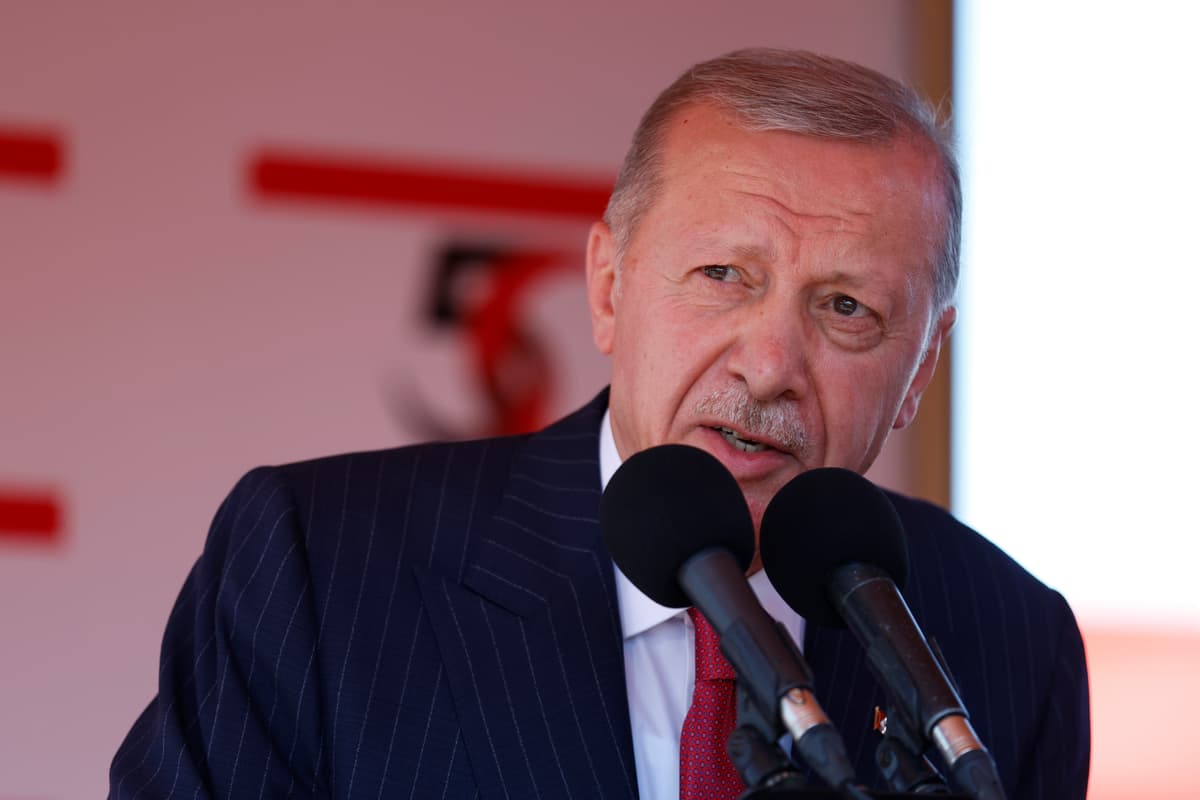
From a national-security perspective, the concern is straightforward: Turkey under President Recep Tayyip Erdoğan
has positioned itself as a geopolitical competitor to American regional priorities, particularly in the Middle East. When state-linked Turkish institutions provide sponsorships, venues, media platforms, and communications infrastructure to an unregistered American political influence operation, Congress cannot assume benign intent.
The issue is not merely whether CAIR Action violates regulatory norms. It is whether a foreign state — one increasingly hostile to the United States’ partners and interests — is using American civil-society channels to shape electoral outcomes, push extremist narratives, and weaken congressional support for key allies. That question alone justifies immediate federal scrutiny.
__________________________________
A senior research analyst at FDD, Natalie Ecanow, contributed to the authorship of this article.