

Secret Recording of Sotomayor in Switzerland Captures Liberal Justice Admitting ‘Mistake’ on Failure To Recuse for Multimillion-Dollar Book Deal

The court’s most senior liberal justice also muses on the prospects of a binding code of ethics and term limits.
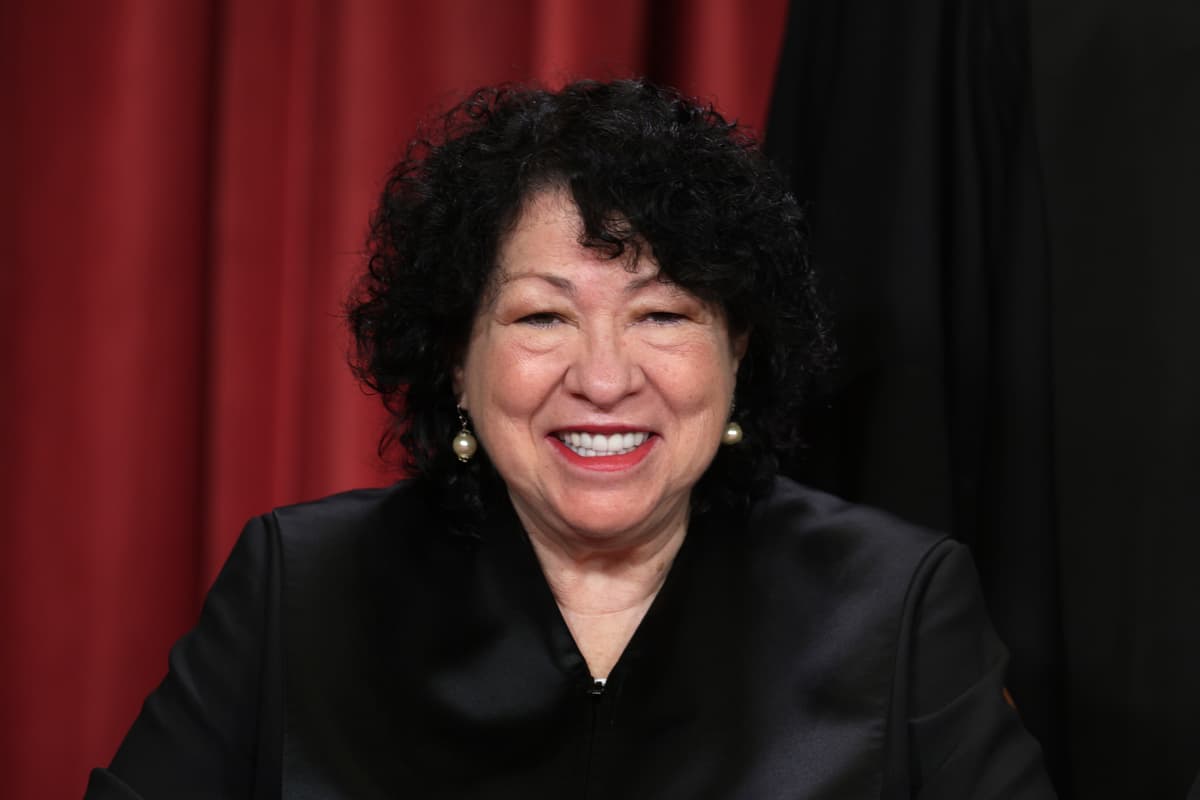
Alex Wong/Getty Images
Justice Sonia Sotomayor on October 7, 2022. Alex Wong/Getty Images

A recording of Justice Sonia Sotomayor at Zurich underscores her openness to a fundamentally altered Supreme Court, one with a binding and enforceable ethics code and term limits for justices. She also admitted to committing a “mistake” connected to her multimillion-dollar book contract.

The high court’s senior liberal justice, who was appointed to the bench by President Obama, made those remarks last summer at the University of Zurich. The audio is being released now by a liberal advocacy group, Fix the Court, that pushes for reform in how the high bench conducts its business. The practices of justices speaking abroad during their summer breaks is a common one.

Justice Sotomayor told the Swiss that “virtually all” of her colleagues are “committed” to the ethics code adopted by the Nine in November 2023, which aimed to “set out succinctly and gather in one place the ethics rules and principles that guide the conduct of the Members of the Court.” The adoption of the code  — the first in the court’s history — came following outrage over gifts accepted by Justices Samuel Alito and Clarence Thomas.

Some on the left, though, chafed that the 14-page code contains no enforcement mechanism and is less draconian than the rules under which lower federal court judges labor. President Biden, in a Washington Post op-ed less than two weeks after Justice Sotomayor made her comments on the Swiss Plateau, castigated that ethics code as “weak and self-enforced.” He reckoned that it is “common sense” that the justices should work under a “binding” code. 

Another subject on which Justice Sotomayor and Mr. Biden appear to be in sync is term limits. The justice told the Swiss that “the rest of the world tends to have functioning courts with term limits” and that such restrictions would “keep the long-term balance” on the Supreme Court because presidents would have less incentive to appoint younger justices to lock in long-term majorities.

Justice Sotomayor ventured that ending lifetime appointments would prevent the court from “becoming skewed for too long, which is a great value.” Mr. Biden, in that piece in the Post, endorsed “a system in which the president would appoint a justice every two years to spend 18 years … on the Supreme Court.” He echoed the justice in declaring that America is “the only major constitutional democracy that gives lifetime seats to its high court.” 

Such a change, though, would appear to require a constitutional amendment. Article III ordains, “The Judges, both of the supreme and inferior Courts, shall hold their Offices during good Behaviour.” That suggests that in the absence of an impeachable offense, judges sit the federal bench for life. The Supreme Court has upheld the semi-retirement status of “senior judges,” though some scholars insist that such a position runs afoul of the Constitution.

Justice Sotomayor in her comments in Switzerland reckoned that “the problem with a term limit is how will they institute it, because I am promised my job for life, and that can’t be taken away constitutionally — I don’t believe even with a constitutional amendment — because you cannot have a retroactive law changing something that you’ve earned.” 

The justice mused that term limits could be decided with a vote “of the legislature … some day,” but left unsaid whether such a vote would be on a statute or a full-fledged constitutional amendment. Only Congress, she ventured, is constitutionally empowered to bind the court, whether in respect of term limits or a code of ethics. 

Justice Sotomayor added that just because the court has voluntarily accepted limits on its behavior — albeit unenforceable ones — “does not mean that mistakes are not made. I’ve made one. I failed to notice that there was a party of my book publisher who was in a case.” The justice did not specify the case. Her publisher, Penguin Random House, appeared on the court’s docket in 2019 and 2021. In both cases the justices denied certiorari.

In May, though, four justices, including Justice Sotomayor, recused themselves from a case in which Random House was a party. They all enjoy book contracts with the publisher, and by stepping back they ensured that the high court failed to muster a quorum. Federal law mandates a judge or justices to recuse from “any proceeding in which his impartiality might reasonably be questioned.”

Supreme Court justices, unlike lower court judges, are bound by what Chief Justice Rehnquist called “the duty to sit,” meaning they are obligated to hear a case unless they are disqualified from doing so. Chief Justice Roberts, in the code of conduct cited by Justice Sotomayor, writes that “lower courts can freely substitute one district or circuit judge for another. The Supreme Court consists of nine Members who sit together. The loss of even one Justice may undermine the ‘fruitful interchange of minds.’” 

Justice Sotomayor has earned some $4 million from the autobiographical “My Beloved World,” which she modeled after Mr. Obama’s “Dreams From My Father.” The book reached the top spot on the New York Times’s bestseller list, with the Gray Lady’s Supreme Court scribe, Adam Liptak, calling the justice “a writer of depth and literary flair, a surprise to readers of her judicial prose,” which is generally workmanlike.

Justice Sotomayor, who is 71 years old and has long lived with diabetes, told the Swiss, “When I no longer feel that I’m making incrementally or writing incrementally better decisions, I will quit.”

________

Correction: Most senior liberal is the status of Justice Sotomayor on the Supreme Court; her seniority was given erroneously in the bulldog edition.


The New York Sun

© 2025 The New York Sun Company, LLC. All rights reserved.

Use of this site constitutes acceptance of our Terms of Use and Privacy Policy. The material on this site is protected by copyright law and may not be reproduced, distributed, transmitted, cached or otherwise used.

The New York Sun

Sign in or  create a free account

or
By continuing you agree to our Privacy Policy and Terms of Use