Seizing an Oil Tanker in the Caribbean Might Be Just the Beginning

Will America act against others that violate sanctions on Russia, Iran, and Venezuela, helping Communist China satiate its thirst for cheap energy?

Via U.S. Attorney General's Office
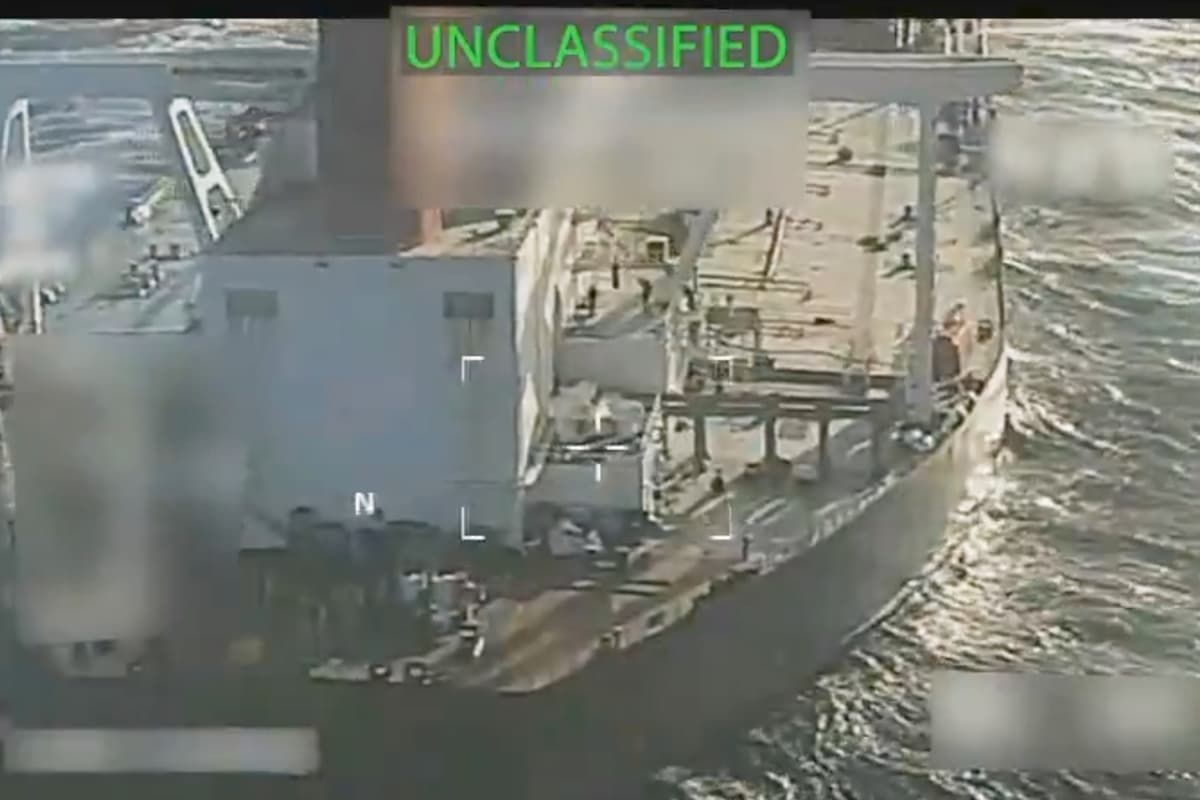
This image from video posted on Attorney General Pam Bondi's X account, and partially redacted by the source, shows an oil tanker being seized by U.S. forces off the coast of Venezuela, December 10, 2025. Via U.S. Attorney General's Office

Will the seizure of a tanker in the Caribbean this week be widened to combat a world-wide armada of ships carrying illicit oil to finance activities that endanger America? 

The seized vessel, now called the Skipper, has in the past been observed off Iranian shores, in the Pacific, and elsewhere, as part of a vast shadow fleet that carries sanctioned Russian, Venezuelan, and Iranian oil to Communist China and elsewhere.

Flying under a Guyana flag, although not registered in Guyana, the Skipper was boarded by a specialized Coast Guard unit on Wednesday morning. Washington had earlier listed the tanker as a carrier of sanctioned Iranian oil, when it sailed under a different name, the Aldisa. When seized on Wednesday, it carried 1.8 barrels of sanctioned Venezuelan heavy oil, which reportedly headed to Cuba. 

President Trump, who said the seized ship was the “largest one ever,” added that “other things are happening.” Taking the Skipper out of commission might have been an attempt to choke a major income source of the Caracas regime. It might also signal a larger attempt at combating America’s top foes that partly fund terrorist and military activities by evading oil sanctions. 

Far from Venezuela, Mr. Trump has reportedly given Ukraine tacit approval to strike Russia’s “shadow fleet” that transports oil in violation of American and European sanctions. In several cases, Washington is providing intelligence to assist Ukraine’s operations. Kyiv  destroyed five Russian tankers recently, the Atlantic reports. 

Countries that are under American oil-export bans are cooperating in an operation of a large fleet of tankers that sail across the globe. In some cases the vessels, like the Skipper, fly false flags. The crews are a ragtag group of non-unionized sailors. In many cases the ship crews disable a mandatory Automatic Identification System. 

These tankers carry “Iranian oil, Russian oil, and Venezuelan oil,” a senior research analyst at United Against Nuclear Iran, Jemima Shelley, tells the Sun. Prior to arriving in Venezuela, she says, the Skipper was spotted in the Persian Gulf, then performed a ship transfer just south of Hong Kong. From there the oil went to China. The tanker then travelled back to the Middle East, and from there to the Caribbean.

UANI has long tracked the shadow fleet that the Islamic Republic and its allies use for smuggling oil out to finance its military and terrorist activities. On Friday UANI published a list of 20 ships that are linked to Iran’s oil trade and are now operating in Caribbean waters. “The presence of these ships in the Caribbean underscores the fluid and interchangeable nature of the dark fleets or Ghost Armadas operated by Iran, Russia, and Venezuela,” UANI writes. 

That “illicit oil network ecosystem,” as Ms. Shelley calls it, benefits yet another major competitor of America. “We have these three primary regimes, the Venezuelan, the Russian, and the Iranian, all selling their oil, and primarily to their number one client, China,” she says. “So China is definitely the driving force behind all of these various illicit trades.”

Communist China purchases 90 percent of Iran’s oil exports, as well as much of the Russian and Venezuelan oil. The need to avoid sanctions forces these regimes to sell at discounted rates, which feeds Beijing’s energy needs in the cheap. The Islamic Republic oil exports finance its attempts at reinstating the nuclear program and its network of terrorist proxies.  

The shadowy nature of the illicit oil trade could explain the ease with which the Coast Guard was able to seize the Skipper. Special Guard units, as well as the Navy Seals, have teams specializing in what the Navy calls vehicle Boarding, Search and Seizure, a former Navy pilot, Ward Carroll, tells the Sun. One VBSS procedure, like in the Wednesday operation, uses helicopters to approach a vessel by surprise. 

“In the late 1990s I was flying overhead in an F-14 to provide cover for the helicopters,” Mr. Carroll says. “They come in at wave top level, and then at the very end, you get up to the deck level, get aboard, and boom. If you’re on the bridge, kind of having coffee, and just looking out the front, you may not know anybody’s even around, until suddenly these guys have guns against your head.”

Until now America mostly shied from such operations, fearing military escalation with foes. The Caribbean operation might signal a decision to deprive these foes of a major funding source.  


The New York Sun

© 2025 The New York Sun Company, LLC. All rights reserved.

Use of this site constitutes acceptance of our Terms of Use and Privacy Policy. The material on this site is protected by copyright law and may not be reproduced, distributed, transmitted, cached or otherwise used.

The New York Sun

Sign in or  create a free account

or
By continuing you agree to our Privacy Policy and Terms of Use