
South Koreans Set To Head to the Polls, With Leftists and Rightists Seemingly Further Apart Than Ever

The election may mark the end of a chapter in an ongoing political crisis that could well get worse, as neither side appears likely to accept the verdict of the voters and respect the policies of the other.
AP/Lee Jin-man, file
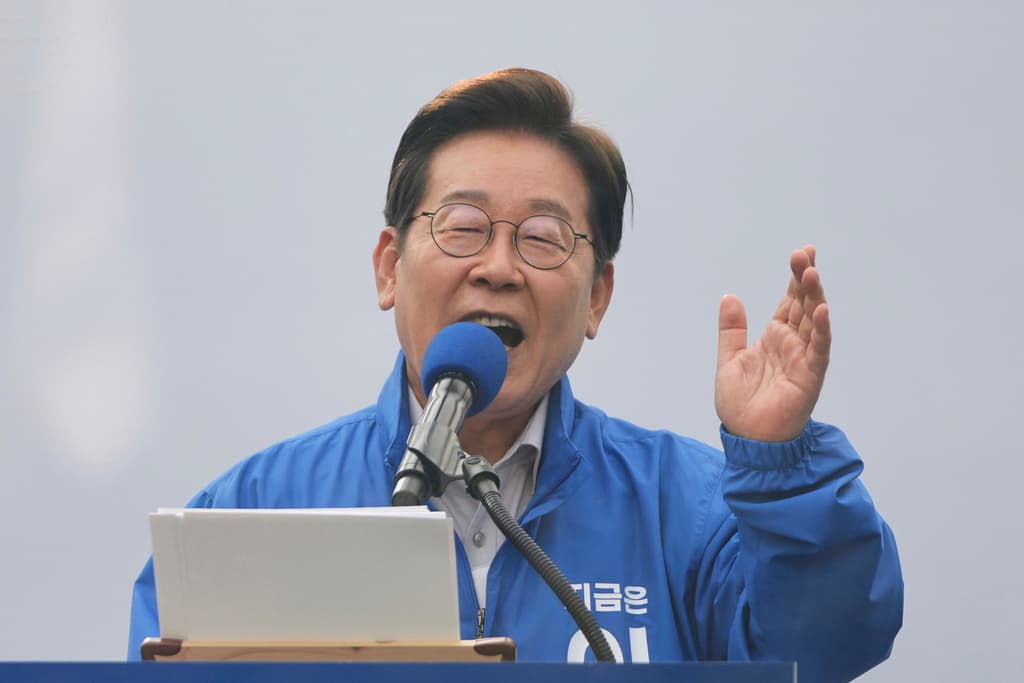
South Korea's new president, Lee Jae-myung, speaks during a campaign event at Seoul, May 28, 2025. AP/Lee Jin-man, file

SEOUL —  Koreans elect a new president Tuesday in a contest that’s sure to deepen divisions after a whirlwind campaign that has accentuated the rift between embittered forces on the right and left.

Polls show nearly half of Korea’s 44 million eligible voters backing the left-leaning leader of the Minju, Lee Jae-myung, who is mired in corruption scandals. The rightist, Kim Moon-soo, a former labor minister, has less than 40 percent support in the polls but is seen as gaining strength in a furious campaign fraught with charges of corruption and Chinese influence. 

The leader of the conservative New Reform Party, Lee Jun-seok, who refused to give up his candidacy in favor of Mr. Kim, could get as much as 10 percent of the vote.

On the last night of the campaign, frenzied advocates on both sides flocked to enormous rallies at which the candidates gave emotional speeches interrupted by chants of their names. The tone of the remarks, by the candidates and their fervent followers, suggested the election would mark the end of a chapter in an ongoing political crisis that could well get worse, as neither side appears likely to accept the verdict of the voters and respect the policies of the other.  

It was those differences that led the previous president, Yoon Seok-yul, to declare martial law on December 3 — only to rescind the decree six hours later after the national assembly led by Mr. Lee, whom Mr. Yoon narrowly defeated in the previous presidential election in 2022, voted it down.

Since then, Mr. Lee has completely turned the tables on Mr. Yoon, first by getting the assembly to impeach him and then by persuading the constitutional court to approve the impeachment decree, ousting Mr. Yoon from office and bringing about a “snap election” for a successor.  Mr. Yoon, his former defense minister, and about 20 others now face charges including insurrection, which carries a sentence of life imprisonment or even the death penalty. Mr. Yoon is now free while on trial, while the others are being held.

Cries of “Lee Jae-myung, Lee Jae-myung” reverberated as Mr. Lee promised to “end the insurrection” and cure economic difficulties that have led to rapid price rises, the closures of many small businesses, and increases in unemployment. He did not refer specifically to the Korean-American alliance, which only in recent weeks he has promised to uphold; his foes accuse him of cozying up to China and North Korea. 

Mr. Lee rose to the leadership of the Minju, or Democratic Party, with the support of a number of assembly members who had defied the central government as young activists.

Similar cheers of “Kim Moon-soo, Kim Moon-soo” greeted Mr. Kim as he warned of the danger of electing a president seen as not only pro-Chinese and pro-North but mired in corruption dating from his years as mayor of Seongnam City.

A constant refrain, in Korean, ran through Mr. Kim’s remarks: “Communism is not paradise.” Referring to his opponent, he stated: “We should not have a leader mired in scandals. If he becomes a leader, he will be a dictator.”

Mr. Kim, on the campaign’s final day, spoke at rallies on the southern island of Jeju, in the major port of Busan, and at the heart of Korean conservatism, Daegu. His campaign gained speed in a university district in Seoul noted for political activism, with support from well known figures who had previously been seen as liberals or even leftists. One of them, Lee Nak-yeon, said to loud cheers: “I never imagined I would be here supporting the conservative party. Do not let the leftists rule like a monster.”

Another commentator who formerly leaned left, Jeon Han-gil, speaking at the Korea Press Foundation, said he had “turned right” after examining the reasons why Mr. Yoon sought to impose martial law. “I asked, ‘Why is this happening?’” he said. “Then I started doing research.”

The differences between the leftists and rightists were also evident in the flags flown at the rallies. The flags of labor unions and leftist groups flew proudly at Mr. Lee’s event, while many American flags were evident at the rally for Mr. Kim, illustrating attendees’ faith that President Trump is the leader most ready to defend them — even though he has talked about withdrawing some of America’s 28,500 troops from the country.


The New York Sun

© 2025 The New York Sun Company, LLC. All rights reserved.

Use of this site constitutes acceptance of our Terms of Use and Privacy Policy. The material on this site is protected by copyright law and may not be reproduced, distributed, transmitted, cached or otherwise used.

The New York Sun

Sign in or  create a free account

or
By continuing you agree to our Privacy Policy and Terms of Use