
Stifling America’s ‘Can-Do’ Spirit Emerges as an Unintended Result of 1960s-Era Liberal Reforms

Philip Howard, in an excerpt from his new book, ‘Saving Can-Do,’ argues that freedom is being forgotten as the culture plummets towards opposing visions of the lowest common denominator.

AP
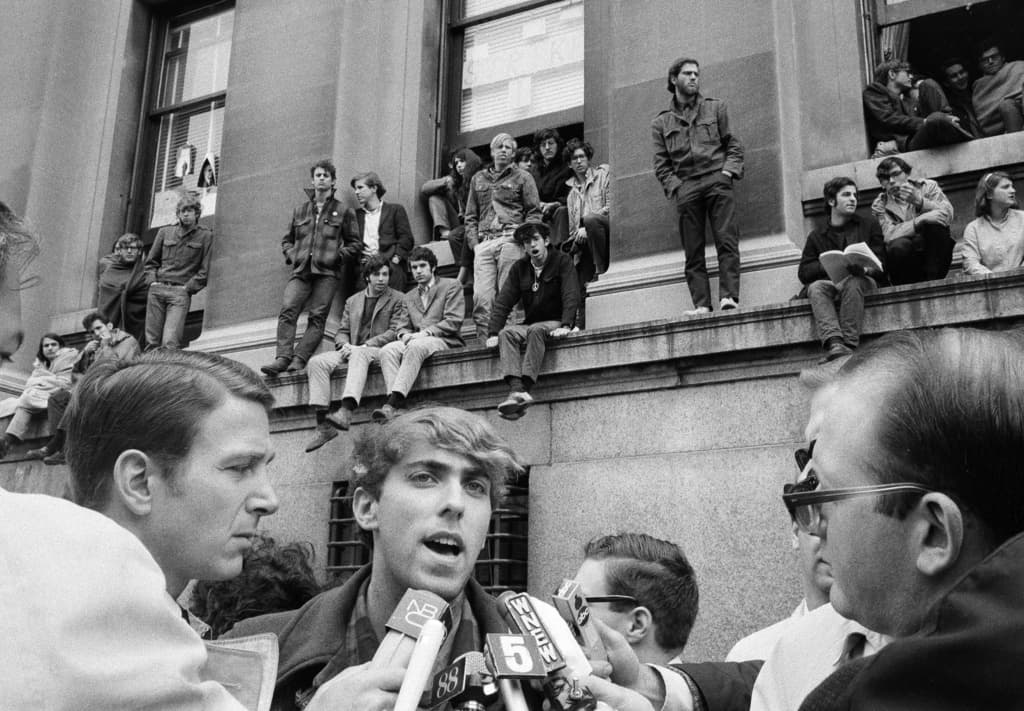
A leader of the student protest at Columbia University, Mark Rudd, outside Low Memorial Library, which had been occupied by students, April 25, 1968. AP

The following is an excerpt from Philip Howard’s ‘Saving Can-Do,’ forthcoming from Rodin Books on September 23, 2025.

The post-1960s complex of rules, processes, and rights has been designed with one overriding operational premise — to preempt human judgment. The defect in human judgment, the theory goes, is that it is tainted with subjectivity. People should not be allowed to assert their beliefs, especially if they affect someone else. Here is the motto for our time: Who am I to judge?

But subjectivity is the main feature of freedom, not a bug that justifies a legal takeover of human judgment. Our subjective beliefs are in large part who we are, as individuals, as participants in an institution, and as a society. Subjectivity is not random but is the

manifestation of the American spirit.

Good judgment is not objective. There’s an irreducible subjective quality to our choices. Our judgment is formed by perceptions, experience, training, values, and biases that cannot be sorted into component parts. Human judgment is fallible, of course, which is why organizations often run important decisions by others. 

Can-Do
The cover of Philip Howard’s book, ‘Saving Can-Do.’ Rodin Books

Avoiding human judgment, on the other hand, is like wearing a blindfold. Life situations are too varied to be prescribed in advance by objective criteria. Because “the world, like a kaleidoscope, never exactly repeats any previous situation,” Michael Polanyi explained, “we can achieve consistency only by identifying manifestly different situations . . . and this requires a series of personal judgments.”

Governing sensibly is impossible if officials can’t use their judgment — regulatory choices almost always involve trade-off judgments that cannot be codified in advance. Do the benefits of a transmission line outweigh the harm of building through a pristine forest? That’s a value judgment, not a decision enhanced by years of legal argument.

Judgments about people require human perception, not just objective and provable criteria. How do you prove that someone doesn’t try hard, or cooperate, or is selfish? How does a school principal prove that a teacher is boring and ineffective? 

Nor can academic and cultural excellence be dissected into objective parts. “Good expert judgment is generally of an intuitive nature,” psychologist Gerd Gigerenzer notes, and cannot be demonstrated by “after-the-fact justifications.” Other than in hard sciences, academics can’t prove by objective evidence what’s good, thoughtful, and well written. 

Nor can they prove that they’re not biased. But lack of objective proof doesn’t make their expert judgments invalid. “What we reject about the words objective and subjective,” Philip Jackson and colleagues observed in their study of teachers, “The Moral Life of Schools,” “is the implication that one refers to something real and the other does not.”

Deciding only by objective criteria generally guarantees unfairness — “exalting what we can know and prove,” philosopher Michael Polanyi observed, “while covering up . . . all that we know and cannot prove.” Like water finding a crack, people quickly learn to frame their self-interest in legalistic terms:

  • Government procurement procedures favor inferior vendors who know how to “game” the so-called objective criteria.
  • Public permitting can be dragged out indefinitely by parties known to have an ulterior motive, for example, to get financial benefits by agreeing to drop their objections. 
  • Due process hearings for teacher termination have little to do with their performance, and become exercises in legal sophistry—in one case, whether the school could prove by objective evidence whether the teacher had been told to grade student work.
  • Broad resentment at DEI programs is not generally based on giving everyone a fair shot, but how DEI worked — compelling a supervisor to prove a negative. How can a supervisor prove that the DEI candidate is not as good as another candidate? 

Instead of a brave new world of pure objectivity, what’s replaced subjectivity are the subjective values of whoever’s not in charge. Who’s to say that a Rembrandt is more compelling than a contemporary painting? Finger-pointing about bad values in prior eras is used to discredit cultural achievements from the same period. 

No pillar of our culture is safe from the assault on subjectivity. Why do Caucasians and Asians score better on standardized tests? Who wrote those tests? Attacking values on the basis that they’re merely values, without any generally accepted values to replace them, is wanton destruction.

A counter-assault on DEI is now pushing institutions towards the opposite values. First we had the DEI Stasi: where my freedom belongs not to me but to the sensitivities of whomever I deal with. Do you feel unsafe? Maybe just scrap “King Lear” and “Huckleberry Finn.” 

Now we’re telling universities what to teach and law firms whom they can represent, and deporting foreign students who demonstrate for the wrong cause. Freedom is forgotten as the culture plummets towards opposing visions of the lowest common denominator.

“Subjectivity,” Pope John Paul II observed, is “a kind of synonym for the irreducible in the human being.” Subjectivity is what freedom is supposed to empower. Society too depends on empowerment of subjective norms that most citizens accept. Without subjectivity, the levers of social order become empty gestures. 

Job evaluations and recommendations say little or nothing. Grade inflation makes grades meaningless. Wisdom of the ages is supplanted by an obligation to endure new art, music, literature, and history on the basis, mainly, that it was made by someone else.

Subjectivity is not license to let the imagination run wild. Facts still matter. Reasonableness is a standard by which people will be held accountable. But human judgment and cultural values are unavoidably subjective. Subjectivity is who we are.


The New York Sun

© 2025 The New York Sun Company, LLC. All rights reserved.

Use of this site constitutes acceptance of our Terms of Use and Privacy Policy. The material on this site is protected by copyright law and may not be reproduced, distributed, transmitted, cached or otherwise used.

The New York Sun

Sign in or  create a free account

or
By continuing you agree to our Privacy Policy and Terms of Use