Success of Trump’s Mideast Peace Deal Turns on the First Step — the Release of the Hostages

The president calls it ‘one of the greatest days ever’ and speaks of the prospect of an era of regional peace.
Win McNamee/Getty Images
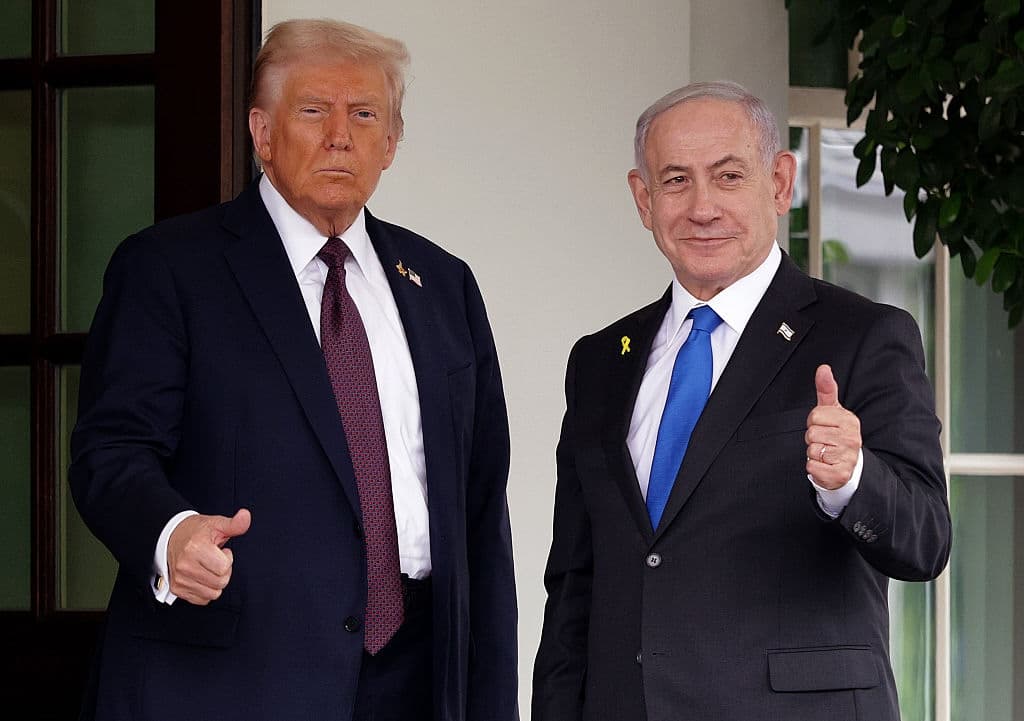
President Trump greets Prime Minister Benjamin Netanyahu as he arrives at the White House on September 29, 2025. Win McNamee/Getty Images

President Trump speaks of “one of the greatest days ever in civilization,” and the end of Mideast wars, but the deal he is proposing could hinge on the first stage — the release by Hamas of Israelis the terror group is holding hostage.

“Within 72 hours of Israel publicly accepting this agreement, all hostages, alive and deceased, will be returned”: That is how the first step is described in a White House release regarding the deal that Mr. Trump has worked out with Arab and Muslim leaders and to which Prime Minister Benjamin Netayahu agreed.

What, then, happens if Hamas — which said over the weekend that it lost touch with two hostages due to the Israel Defense Forces’s operation at Gaza City — makes only a partial release or none at all? For now, details of a 20-point deal to end the Gaza war are unclear on such questions. 

“Many questions are yet to be answered, and are worded opaquely,” the head of the Jerusalem Institute for Strategy and Security, Yossi Kuperwasser, tells the Sun. “What is clear is that if all the hostages are not returned, there won’t be an end to war.”

Addressing reporters at the White House, Mr. Netanyahu was cautious, but made clear that much depended on Hamas. “If Hamas rejects your plan, Mr. President, or if they supposedly accept it and then basically do everything to counter it, then Israel will finish the job by itself.” 

Following the Monday announcements at the White House, officials of Hamas are telling Qatar-owned Al Jazeera that the terror organization is yet to receive the deal’s details. A 20-point plan issued by the White House does not specify what happens if Hamas delays an answer or refuses to accept the deal.  

Mr. Trump first detailed the new deal to Arab and Muslim leaders last week at the United Nations. Heads of state from Qatar, Egypt, Jordan, Turkey, Indonesia, and others expressed satisfaction. Yet, afterward some of them complained that under Israeli pressure, some points were tweaked to satisfy Mr. Netanyahu’s political needs. 

Nevertheless, Washington is hoping that pan-Arab pressure, combined with further Israeli military threat, would force Hamas to agree to implement the deal. Qatar, a Hamas patron, is emerging as a key player in that effort.   

During a meeting at the White House, Mr. Trump handed the phone to Mr. Netanyahu, who proceeded to apologize to the Qatari prime minister for the recent Israeli strike at Doha. The orchestrated apology, complete with a White House release detailing it, was widely seen as a step toward pressure that Doha would exert on its Hamas client.   

Beyond the goal of an immediate end to the Gaza war, Mr. Trump made clear his hope that the new deal that he and Mr. Netanyahu signed would open the doors to a peaceful Mideast. “I’m not just talking about Gaza. Gaza is one thing, but we’re talking about much beyond Gaza, the whole deal, everything getting solved,” he said. “It’s called peace in the Middle East.”

The deal was worked by top aides to Mr. Trump, including special envoy Steven Witkoff and the president’s son in law, Jared Kushner, as well as a former British prime minister, Tony Blair, who will be part of a team that would oversee Gaza after the IDF starts withdrawing. On the Israeli side, a group headed by Mr. Netanyahu’s top aide, Ron Dermer, negotiated with the White House and traveled to Doha for meetings with Hamas’s Qatari patrons. 

Following Hamas’s release of the Israeli hostages, the deal says that Israel would let go of 250 terrorists who were sentenced to life in prison for their roles in murdering Israelis, as well as 1,700 Gazans who were arrested after the October 7, 2023, massacres. 

Such a release depends on approval of Mr. Netanyahu’s cabinet, where objections are expected. Some of Mr. Netanyahu’s partners also oppose other parts of the deal, including references to a future Palestinian state. 

The 20-part deal, as detailed by the White House, envisions an immediate end to the war, and a phased IDF withdrawal to a narrow security belt on the Gaza-Israel border. It entails the  establishment of a body composed of Palestinian “technocrats,” forces from Arab countries, and international “experts,” including Mr. Blair, “until such time as the Palestinian Authority has completed its reform program.”

The vague reference to the Palestinian Authority’s future role is designed to pull in such players as Saudi Arabia, in order to widen the peace circle in the region. “The Abraham Accords, they were amazing,” Mr. Trump said. “Jared, you did that along with your group of geniuses. And nobody thought that could be done.”

If the Gaza war ends at or near the second October 7 anniversary, Mr. Trump sees a bright, peaceful future for the region. It could usher an “eternal peace in the Middle East, more than anyone ever expected,” he said, adding, “who knows, maybe even Iran can get in there.”


The New York Sun

© 2025 The New York Sun Company, LLC. All rights reserved.

Use of this site constitutes acceptance of our Terms of Use and Privacy Policy. The material on this site is protected by copyright law and may not be reproduced, distributed, transmitted, cached or otherwise used.

The New York Sun

Sign in or  create a free account

or
By continuing you agree to our Privacy Policy and Terms of Use