Supreme Court Allows New 2026 Texas Congressional Maps, Giving New Life to GOP Redistricting Effort

With the Texas map upheld, the gerrymandering war may end up in a stalemate before the 2026 elections.

Susan Walsh/AP
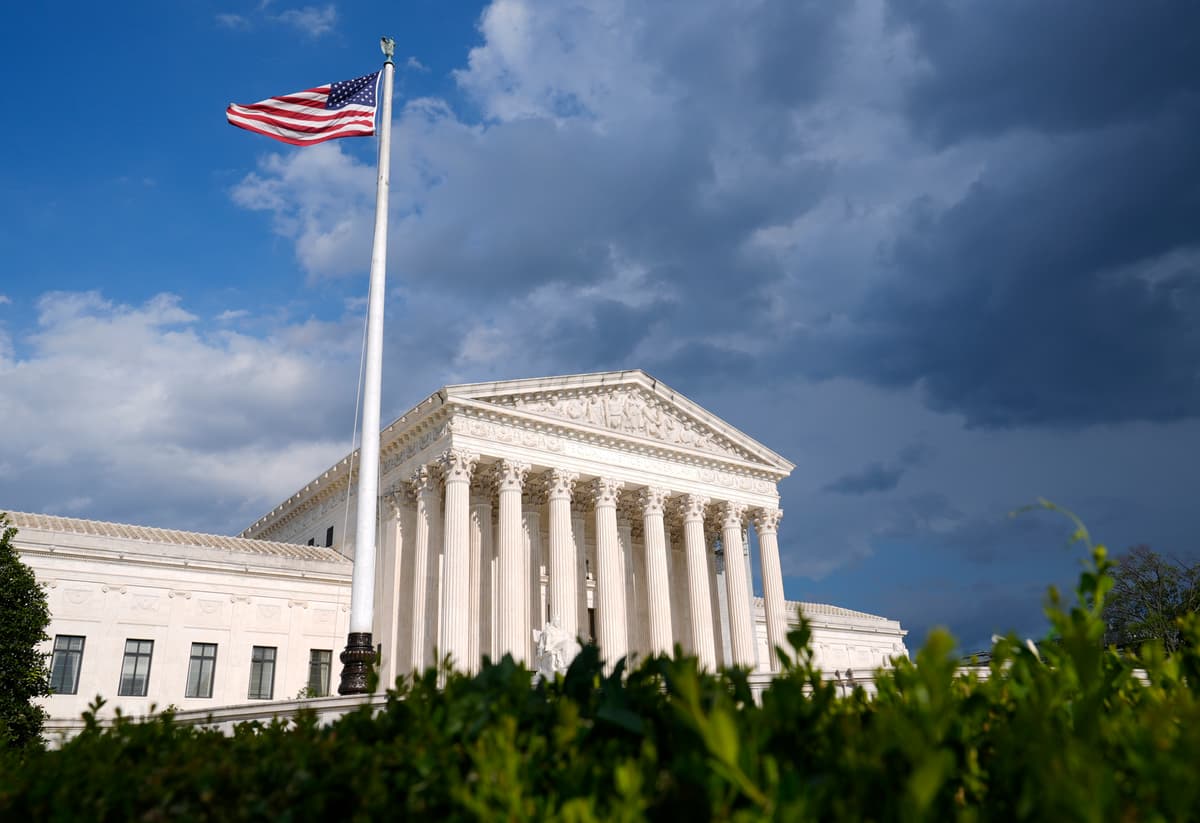
The Supreme Court at Washington, D.C., on June 30, 2024. Susan Walsh/AP

The Supreme Court will allow Texas to use its newly drawn congressional maps for the 2026 elections, the justices said in an order on Thursday night. The map was drawn over the summer in an attempt to pad the GOP House majority as all signs point to a Democratic edge in the coming midterms. 

The decision was 6–3, with all conservative justices voting to let the maps take effect. The maps were originally struck down by a panel of three judges in Texas. The judge who authored the opinion striking down the map was nominated to his judicial post by President Trump. 

“In the face of Democrats’ attempt to abuse the judicial system to steal the U.S. House, I have defended Texas’s fundamental right to draw a map that ensures we are represented by Republicans,” Texas attorney general Ken Paxton wrote on X after the justices issued their order. 

Texas Republicans’ hopes for flipping five congressional districts into their column next year relies heavily on one group — Hispanic voters. If that bloc stands by Republicans by the margin they did in 2024, then the GOP is heavily favored to win five new seats. If Hispanics shift substantially back toward Democrats — as they did in Virginia and New Jersey this year — then Republicans may only pick up three seats in the Lone Star State. 

In its order, the court’s majority writes that the district court erred in invalidating the new maps just weeks away from the state’s congressional filing deadline, which is Monday.

“The District Court improperly inserted itself into an active primary campaign, causing much confusion and upsetting the delicate federal-state balance in elections,” the Supreme Court majority said. 

Justice Samuel Alito — joined by Justices Clarence Thomas and Neil Gorsuch — wrote in a concurrence that “the impetus for the adoption” of Texas’s new maps “was partisan advantage pure and simple.” Justice Alito writes that the same is true of California, where Democrats redrew their maps to eliminate five Republican seats in order to counteract Texas’s move. 

Justice Elena Kagan wrote the dissenting opinion, in which she was joined by Justices Sonia Sotomayor and Ketanji Brown Jackson. Justice Kagan argues that the new Texas map is a clear violation of the Fourteenth and Fifteenth Amendments of the Constitution. 

“Without so much as a word about that standard, this Court today announces that Texas may run next year’s elections with a map the District Court found to have violated all our oft-repeated strictures about the use of race in districting,” Justice Kagan writes. “Today’s order disrespects the work of a District Court that did everything one could ask to carry out its charge — that put aside every consideration except getting the issue before it right.”

With the Texas map now officially in effect, Republicans are keeping their heads above water in the redistricting fight. Democrats, however, are doing everything they can to fight back against the state’s new gerrymander. 

The California map effectively negates what Texas has done in this case. With that being the case, Mr. Trump and his allies have looked elsewhere to pick up additional seats. Republicans in Ohio, North Carolina, and Missouri have all redrawn their congressional lines in order to pick up one GOP seat in each state. 

Indiana Republicans are considering a new map to eliminate two Democratic seats, though it is unclear if the mid-decade redistricting effort has the requisite support to pass the state senate. Even if the Indiana GOP does redraw the state’s maps, Illinois Governor JB Pritzker says he may eliminate one or two of the Republican districts in his own state. 

Maryland Democrats, too, are pushing for a redistricting bill which would eliminate the state’s lone GOP district. 

Virginia Democrats kicked off the process of joining the gerrymandering fight early next year. The speaker of the house of delegates, Don Scott, and the president pro tempore of the state senate, Louise Lucas, have both said that eliminating four of their state’s five Republican seats is on the table. 

The biggest question marks now are how Florida Republicans redraw their maps and what the Supreme Court does with respect to the Voting Rights Act — the gutting of which could net Republicans around half-a-dozen seats in the deep south, though legal observers do not expect the justices to rule on that matter in time for the 2026 elections.


The New York Sun

© 2025 The New York Sun Company, LLC. All rights reserved.

Use of this site constitutes acceptance of our Terms of Use and Privacy Policy. The material on this site is protected by copyright law and may not be reproduced, distributed, transmitted, cached or otherwise used.

The New York Sun

Sign in or  create a free account

or
By continuing you agree to our Privacy Policy and Terms of Use