Supreme Court Seems Poised To Rein in Race-Based Voting Maps That Heavily Favor Democrats
Justices hear arguments over a Louisiana case involving a sprawling, gerrymandered district drawn to give black voters a majority.
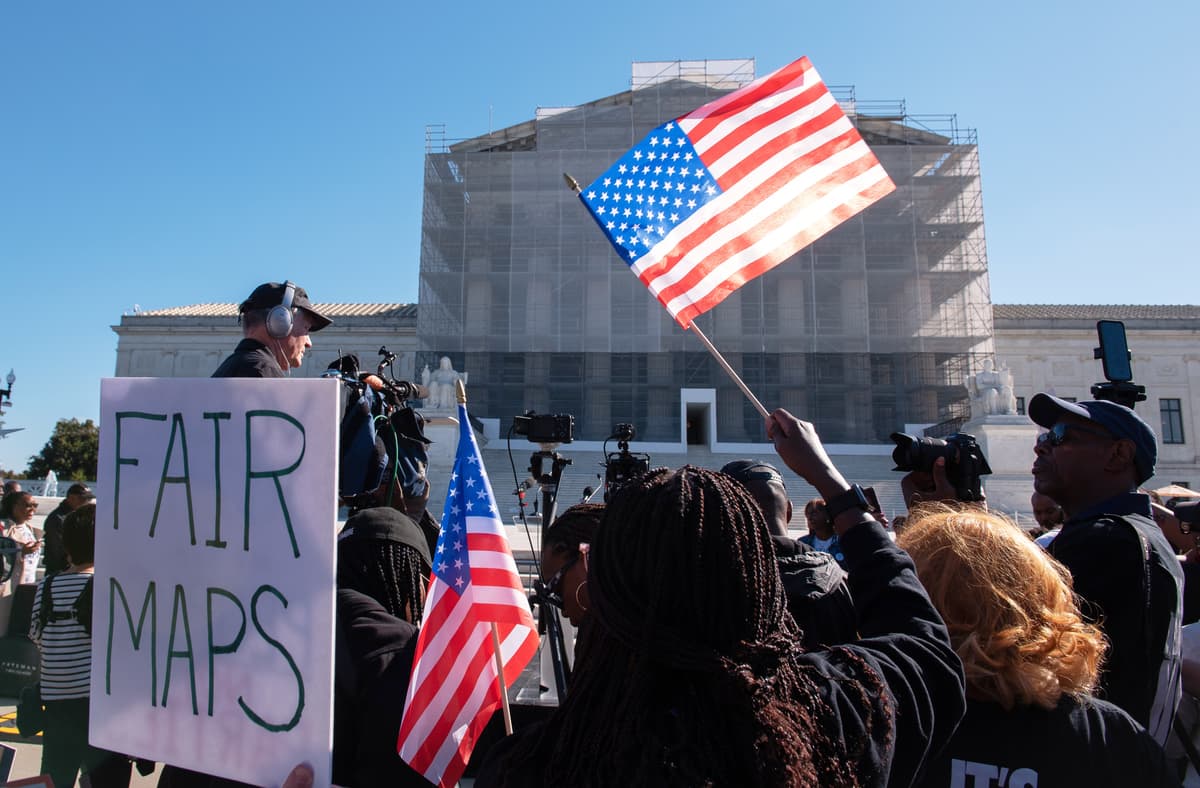

A majority of the Supreme Court appears skeptical of the use of the Voting Rights Act to force states to create majority-black voting districts â a decision that could put several Democratic-leaning districts in southern states in danger.
Justices heard arguments Wednesday in Louisiana v. Callais in a case to decide whether a second majority-black congressional district that stretches 250 miles across Louisiana was wrongfully racially gerrymandered. Conservative justices seemed to lean toward making it harder to force the creation of such districts using race-based challenges to congressional maps, a practice that has been common since the passage of the Voting Rights Act of 1965.
If the conservatives prevail, it would be a win for Louisiana and the Trump administration, who say majority-minority voting districts violate the 14th Amendmentâs Equal Protection Clause and the 15th Amendment. They are seeking to end the use of race as a basis for redrawing voting districts, an outcome that could allow the redrawing of an estimated 12 other majority-black districts, primarily in the South, according to the New York Times.
The district at issue in Callais was drawn up to comply with Section 2 of the Voting Rights Act, the primary way potentially discriminatory voting measures can be challenged. The court upheld Section 2 in a 2023 case that required Alabama to draw an additional congressional district with a majority of black voters, but the justices are now revisiting the issue.
âThere has never been a black person in Louisiana elected statewide is additional indicia that race is playing an outsized role in the electoral process in Louisiana,â a lawyer with the NAACP, Janai Nelson, who argued in favor of keeping the district intact, said.
Ms. Nelson claimed that weakening or throwing out Section 2 would be âcatastrophicâ for racial diversity among elected officials. âWe only have the diversity that we see across the South, for example, because of litigation that forced the creation of opportunity districts under the Voting Rights Act,â Ms. Nelson told the court.
But Justice Brett Kavanaugh and Chief Justice Roberts â who sided with the liberal justices in a 5-4 decision in the 2023 case â sounded more inclined to allow a different interpretation during Wednesdayâs questioning.
Racial gerrymanders were conceived as a temporary fix to protect the voting rights of blacks, but they have become entrenched across the decades. Justice Kavanaugh asked whether the time has come to end the creation of race-based districts.
Louisianaâs solicitor general, Benjamin Aguiñaga, argued for the elimination of that criteria. âThe Constitution does not tolerate this system of government-mandated racial balancing,â Mr. Aguiñaga said.
Congressman Troy Carter, one of Louisianaâs two black members of Congress, said that the Supreme Court could topple the Voting Rights Act if it rules in favor of the state.
âAt question is whether one-third of our stateâs population â Black Louisianians â will continue to have an opportunity to elect representatives of their choice, or if decades of hard-won progress will disappear under the guise of âcolorblindâ politics,â Mr. Carter wrote on X.
But legal reporter Chris Geidner wrote in an X post that his initial take after the more than two hours of questioning was that while the justices appeared ready to make it more difficult for Voting Rights Act vote-dilution challenges, they also seemed unlikely to call all ârace-based redistrictingâ unconstitutional.
The case comes as states are redrawing lines in order to cement the power of the dominant political party in the state. Texas recently redrew its congressional maps to favor Republicans, and California is in the process of a redistricting attempt to favor Democrats.
The justices will now decide if the case should go back to a lower court with instructions to draw a new map or rule against Section 2 of the Voting Rights Act entirely. A decision could come as late as June, when the current term is scheduled to end.