Texas Law Opens Door for Students To Be Punished for Wearing Hats, ‘Chatting With Friends’ After Dark
‘The First Amendment doesn’t set when the sun goes down,’ an attorney for a student group says.
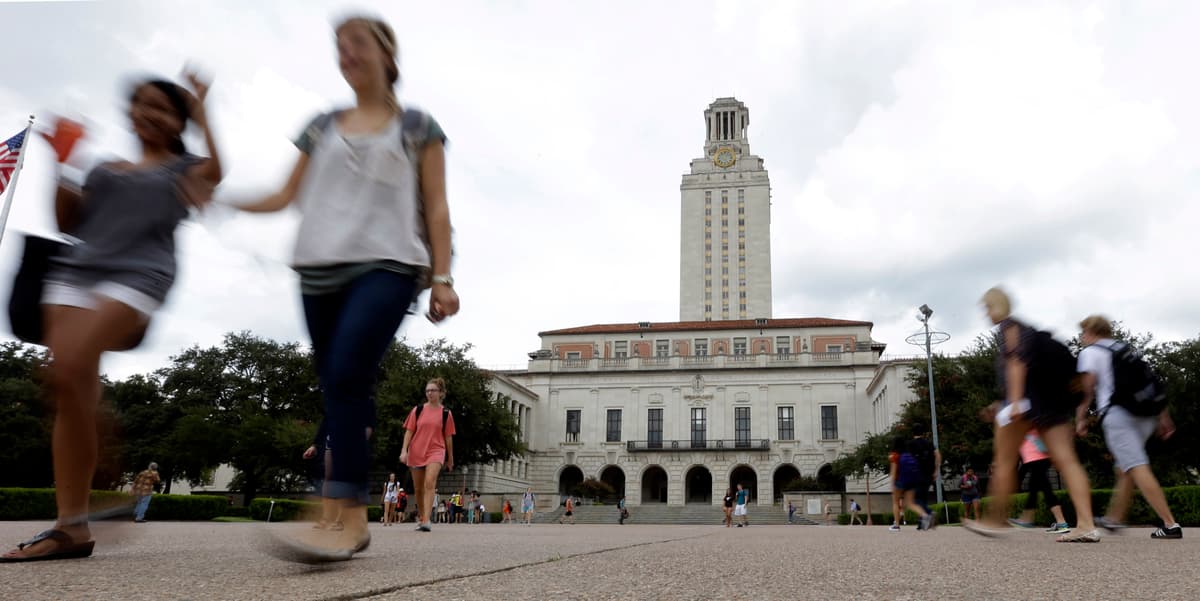
A new law in Texas could lead to students being disciplined simply for wearing hats or shirts promoting free speech after dark, critics say.
The law, Senate Bill 2972, which went into effect on September 1, prohibits “any speech or expressive conduct protected by the First Amendment to the United States Constitution,” which includes “assemblies, protests, speeches, the distribution of written material, the carrying of signs, and the circulation of petitions” at public universities between 10 p.m. and 8 a.m. It also prohibits “expressive activities” during the last two weeks of a semester.
The Foundation for Individual Rights and Expression filed a federal lawsuit against the University of Texas System to block the new law. In the lawsuit, FIRE takes issue with the broad language of S.B. 2972 that restricts when expressive activities can take place, suggesting that under the law, “Universities now have the power to discipline students at nighttime for wearing a hat with a political message, playing music, writing an op-ed, attending candlelight vigils — even just chatting with friends.”
The organization also notes that the law has exemptions for its prohibition for “commercial speech,” which it says means that students “are free to advertise t-shirts featuring the First Amendment after hours … but could face discipline for wearing them.”
A supervising attorney at FIRE, J.T. Morris, says, “The First Amendment doesn’t set when the sun goes down. University students have expressive freedom whether it’s midnight or midday, and Texas can’t just legislate those constitutional protections out of existence.”
The Fellowship of Christian University Students at UT Dallas, which is one of the organizations represented by FIRE, said the law’s prohibition on expressive activities during the last two weeks of the semester would prevent the organization from hosting guest speakers and ministers for prayer during finals.
The committee chairman of the fellowship, Juke Matthews, said in a statement, “Our organization gives students on campus a place to worship with one another and hear from Christian leaders. For many of them, this is their church away from home. This law would yank away part of their support system right at the most stressful time of the term.”
State Republicans passed the law earlier this year in response to anti-Israel protests. It limits protections offered by a law passed in 2019 that required that outdoor spaces on public universities be considered open forums for free speech.
Other measures of S.B. 2972 include a prohibition on students building encampments on campus or taking down the American flag and replacing it with another nation’s, actions that anti-Israel protesters on college campuses have frequently taken since Hamas’s October 7 attack.
A state senator who sponsored the bill said when it was introduced in April that it actually strengthens the 2019 law by reaffirming “the expressive rights of students and employees in Texas public institutions of higher education while also setting boundaries intended to prevent unnecessary disruption and to ensure campus safety.”
The University of Texas System did not respond to the Sun’s request for comment by the time of publication.