

Texas’ Redistricting Plan Is Back in Play After Supreme Court Justice Suspends a Lower Court Ruling

The full court will now consider whether to allow the new, Republican-favoring map to be used in the 2026 midterm elections.
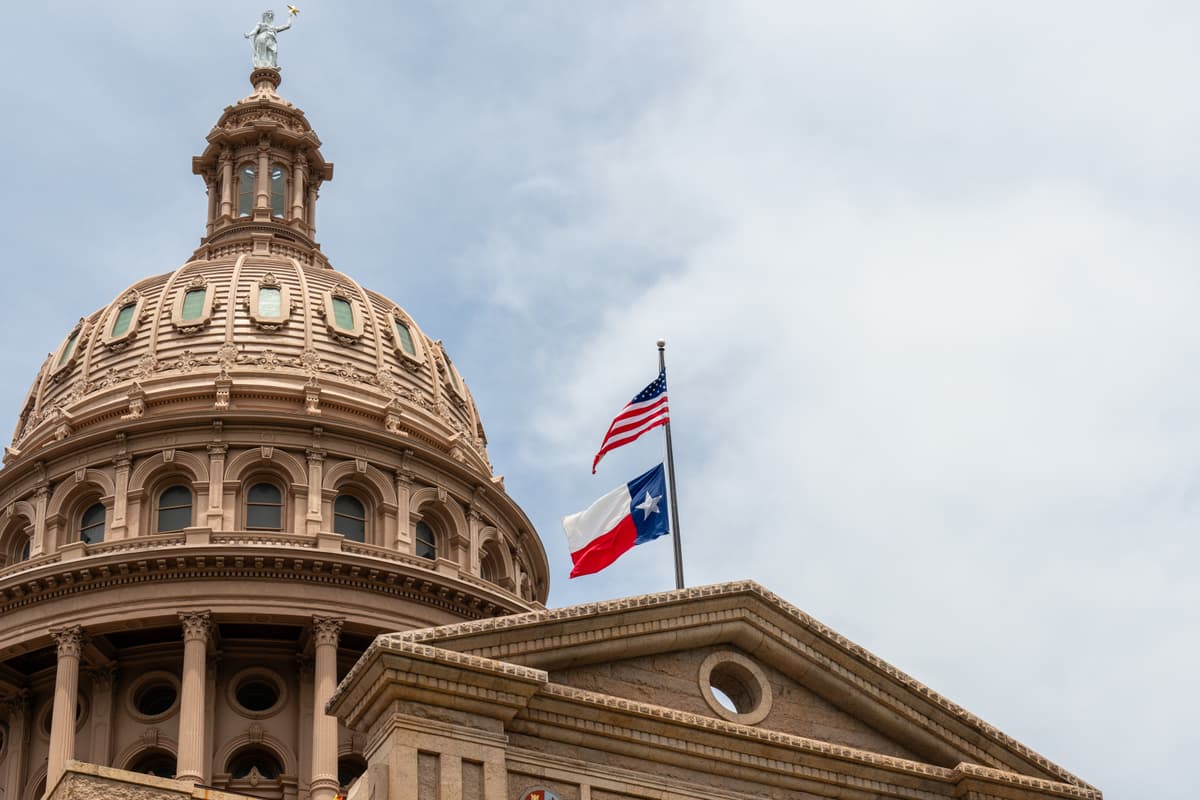
Brandon Bell/Getty Images
The Texas state Capitol is seen as lawmakers gather for a special session at Austin on July 21, 2025. Brandon Bell/Getty Images

The Texas governor’s aggressive redistricting plan is back in play after the Supreme Court temporarily blocked a lower court ruling that found the plan was likely an unconstitutional racial gerrymander.

The order, signed by Justice Samuel Alito on Friday, puts a hold on the lower court’s decision while the full court considers whether to allow the new, Republican-favoring map to be used in the 2026 midterm elections.

The state of Texas had urged the Supreme Court to intervene, arguing the lower court’s ruling had caused “chaos” as the March primary elections approach. Candidates have until December 8 to file for the election, and Texas officials noted that early voting was only 91 days away.

“Campaigning had already begun, candidates had already gathered signatures and filed applications to appear on the ballot under the 2025 map,” Texas officials said in their appeal.

Justice Alito, who handles emergency appeals from the region, has asked challengers of the map to respond by Monday. The temporary stay will remain in effect until the full Supreme Court reviews the case. The court’s conservative majority has blocked similar lower court rulings that came close to an election, a principle Texas heavily emphasized in its appeal.

The redistricting scheme is part of a broader “arms race” between red and blue states to redraw congressional lines to maximize partisan advantages ahead of the midterm elections, which will determine control of the U.S. House.

The legal battle began after the GOP-controlled Texas legislature, at the behest of  President Trump, redrew the state’s congressional map in a rare mid-decade redistricting effort. The new map was engineered to give Republicans five additional House seats, increasing their hold from 25 to 30 of the state’s 38 districts.

However, a three-judge federal panel ruled 2-1 on Tuesday that the map was likely discriminatory and blocked its use. The panel ordered that the 2026 election “shall proceed under the map that the Texas Legislature enacted in 2021.”

In the majority opinion, U.S. Judge Jeffrey Brown, a Trump appointee, wrote that the case was about more than just politics. “Substantial evidence shows that Texas racially gerrymandered the 2025 Map,” he said.

The new Supreme Court ruling was celebrated by Democrats and civil rights groups that had challenged the map on behalf of black and Hispanic voters.

“A federal court just stopped one of the most brazen attempts to steal our democracy that Texas has ever seen,” said the states’s House minority leader, Gene Wu of Houston. Governor Greg Abbott “and his Republican cronies tried to silence Texans’ voices to placate Donald Trump, but now have delivered him absolutely nothing.”

The state’s legal argument centered on a letter from the U.S. Department of Justice that directed Texas to redraw its maps over concerns about four majority non-white districts. Judge Brown noted that Mr. Abbott “explicitly directed the Legislature to redistrict based on race” to address the DOJ’s concerns.

Mr. Abbott called the court’s reasoning “absurd.”

“The legislature redrew our congressional maps to better reflect Texans’ conservative voting preferences – and for no other reason,” Mr. Abbott said. “This ruling is clearly erroneous and undermines the authority the U.S. Constitution assigns to the Texas Legislature.”

Texas’ attorney general, Ken Paxton, argued that the state engaged in permissible partisan redistricting. “For years, Democrats have aggressively gerrymandered their states and only cry foul and hurl baseless ‘racism’ accusations because they are losing,” Mr. Paxton said.

The lone dissenter on the three-judge panel, U.S. Circuit Judge Jerry Smith, issued a fiery opinion, calling the majority’s ruling a “prime candidate” for the “Nobel Prize for Fiction.”

“In 37 years as a federal judge, I’ve served on hundreds of three-judge panels,” Mr. Smith wrote. “This is the most blatant exercise of judicial activism that I have ever witnessed.”


The New York Sun

© 2025 The New York Sun Company, LLC. All rights reserved.

Use of this site constitutes acceptance of our Terms of Use and Privacy Policy. The material on this site is protected by copyright law and may not be reproduced, distributed, transmitted, cached or otherwise used.

The New York Sun

Sign in or  create a free account

or
By continuing you agree to our Privacy Policy and Terms of Use