The Antifa Crime Family?

Denials of the extent and scale of Antifa could echo the doubts over the scope of La Cosa Nostra prior to evidence emerging in the 1950s.

Stephanie Keith/Getty Images
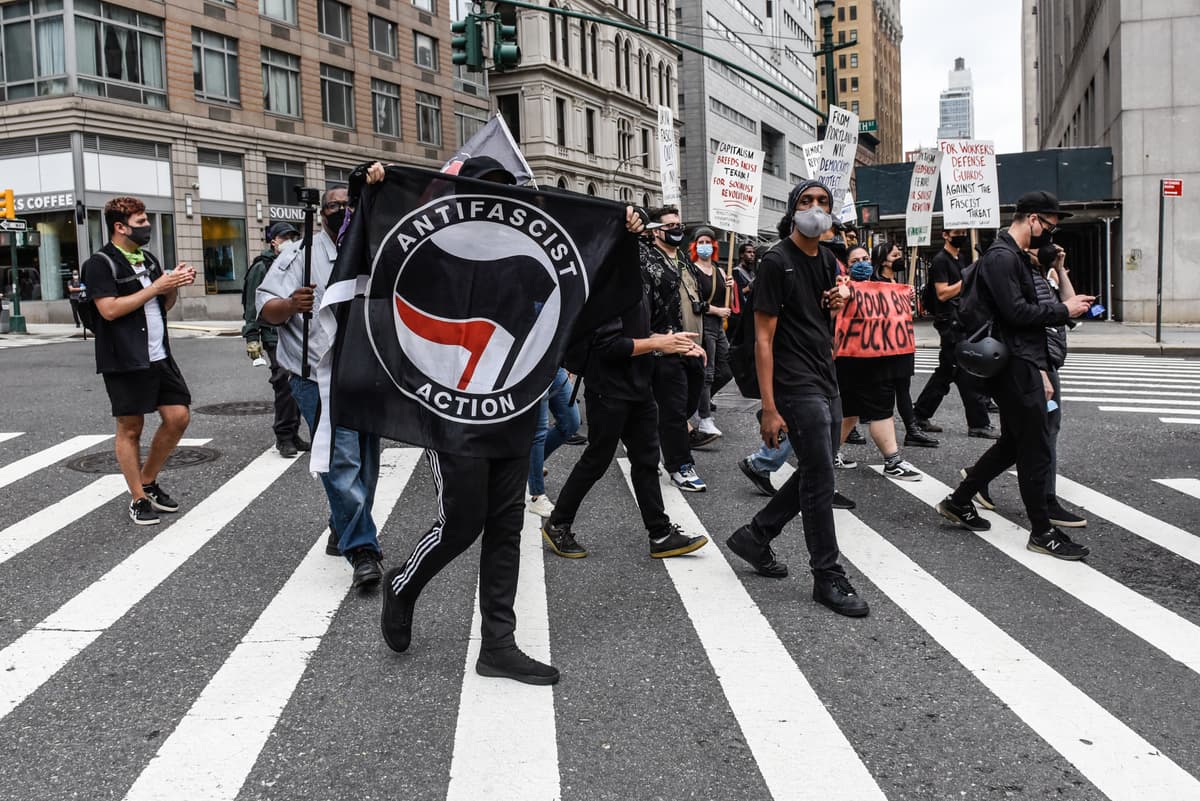
Left wing protesters, some affiliated with Antifa, hold a protest at New York City on July 25, 2021. Stephanie Keith/Getty Images

Digging secrets out of the criminal underworld is hard and exacting work. It has to be that way in the American system. Antifa, the left-wing group, is a perfect example.  

The controversy is simple: Antifa and many on the left say there is no such thing. Antifa doesn’t exist because it isn’t an organization, merely a widespread group of cells and individuals who act independently to do battle with “fascists.”  

A Rutgers historian and activist, Mark Bray, wrote the best-known description of the phenomenon in a 2017 interview. He said “it’s not a specific group, it’s a mode of politics.” In Mr. Bray’s view “there is no central command, although some countries have networks.” Antifa, in his telling, is “a way of doing politics.  It’s also an interpretation of strategy in response to fascism.”

Mr. Bray, incidentally, has found himself in the middle of the question in recent days. He says he is leaving America out of fear for himself and his family.

WASHINGTON, DC - OCTOBER 08: U.S. President Donald Trump (C) delivers remarks alongside U.S. Attorney General Pam Bondi (L) and U.S. Secretary of Homeland Security Kristi Noem during a roundtable discussion in the State Dining Room of the White House on October 08, 2025 in Washington, DC. Trump’s administration held the roundtable to discuss the anti-fascist Antifa movement after signing an executive order designating it as a “domestic terrorist organization”. (Photo by
President Trump, center, at a roundtable discussion about Antifa alongside Attorney General Pam Bondi, left, and Secretary of Homeland Security Kristi Noem at the White House on October 8, 2025. Anna Moneymaker/Getty Images

A more nuanced view of “antifa,” as opposed to Capital-A “Antifa,” comes from the Center for Strategic and International Studies. In 2021, a CSIS analyst, Seth Jones, said Antifa “poses a relatively small threat to the United States” compared to right-wing violence.

Yet, Mr. Jones said, recent data do indicate an “increase in violent activity by Antifa extremists, anarchists and related far-left extremists.”

America’s right is adopting a far stronger view, as evidenced this week by a White House roundtable of independent journalists and advocacy groups. The participants included President Trump, three cabinet officials, and the director of the FBI. They and an assortment of independent reporters and advocates mooted the idea that Antifa is a deeply-rooted “organization.” 

The message from the conclave was that Antifa is well-funded, coherently if loosely organized, secretive and capable of spreading chaos to discredit American government and society.  

Homeland Security Secretary Kristi Noem said that the feds have arrested “dozens of members” of the Rose City (Portland) Antifa “and their affiliates” this summer.  Rose City Antifa was organized in 2007 and has staged violent and fiery demonstrations since then.  

The arrests and the roundtable make clear there is a concerted government effort to discredit Antifa by opening up its organization and finances. That is a good idea, but it has to be done with a firm commitment to truth. The administration needs to make that commitment because history has shown us truth is the only way to confront secret and subversive political or criminal organizations.

Hoover
The director of the FBI, J. Edgar Hoover, in 1961. Library of Congress via Wikimedia Commons

The man who created and directed the FBI for 37 years, J. Edgar Hoover, learned that lesson the hard way.  

For decades, Hoover denied the existence of a secret “organization,” La Cosa Nostra, sometimes known as the Italian-American Mafia.

After Prohibition, the outlaw underworld of at least 25 American cities was dominated by local Cosa Nostra cells. 

The cells, or crime families, in 1930 at Cleveland created a National Commission to sort out jurisdictional boundaries. The commission met secretly for years.

During that time, Hoover stoutly denied that there was any collaboration between crime families. He said their activities didn’t cross state lines, making them merely a local problem.

Al Pacino as Michael Corleone in the film 'The Godfather: Part II', 1974.
Al Pacino as Michael Corleone in the film ‘The Godfather: Part II’, 1974. Paramount/Getty Images

So, until 1957, local officials had to cope with organized criminal gangs by themselves. That didn’t work. Local crime families corrupted police departments, courts, and politicians to an extent that seems impossible today.

Then, in 1957, a New York state trooper named Ed Creswell and some local officers busted a meeting of the National Commission in the little upstate community of Apalachin. About 100 well-dressed men arrived by car at a New York mafioso’s country retreat. They intended to redraw some boundary lines between families.

By checking out-of-state license plates, Creswell identified dozens of the men as local crime lords. The cops blockaded a road leading to the meeting and half the mobsters fled into the surrounding woods. Prominent Cosa Nostra figures ruined their alpaca overcoats and silk suits before being arrested.  

Word of the meeting spread to the New York press, which had a field day. The sudden awareness of the national meeting forced Hoover to change his mind.  He set up organized-crime squads in a number of cities and began to accumulate intelligence on La Cosa Nostra.

Valachi
A member of the Mafia, Joseph Valachi, testifying at a Senate committee hearing in 1963. U.S. News and World Report via Wikimedia Commons

Yet the country’s leaders needed to put a face on the Mafia. That took five years. In 1963, the first Mafia turncoat, Joseph Valachi, entertained the nation on television with remarkable tales about how the nationally organized gang worked.  

The organization required initiates to kill as proof of their loyalty. â€œStreet taxes” were imposed on common crooks called “associates.” Valachi described an entire hidden structure of “dons, consiglieri, capos and soldatos.” Mario Puzo popularized it in his novel “The Godfather,” but Valachi had created the model.  

The turncoat said La Cosa Nostra regarded itself as the “second government,” second only to Washington. His matter-of-fact testimony set the stage for a 30-year FBI effort to dismantle the Mob.

The White House roundtable discussion began from the assertion that Antifa exists, albeit in a loosely organized way. The panelists made allusion to its use of funds from government and nongovernmental sources.  

Proof of those assertions is coming, they said. We all should hope that it is. The current chaos and forceful resistance is destroying order. We need solid proof.

Nothing less than solid, verifiable, authentic evidence will suffice.  

To convince the doubters, the new FBI will have to find and showcase sharp investigators like Creswell and authentic turncoats like Valachi. We need them to put faces on the Antifa organizers, if they do in fact exist. 


The New York Sun

Š 2025 The New York Sun Company, LLC. All rights reserved.

Use of this site constitutes acceptance of our Terms of Use and Privacy Policy. The material on this site is protected by copyright law and may not be reproduced, distributed, transmitted, cached or otherwise used.

The New York Sun

Sign in or  create a free account

or
By continuing you agree to our Privacy Policy and Terms of Use